

Big bad, p.1
Big Bad, page 1


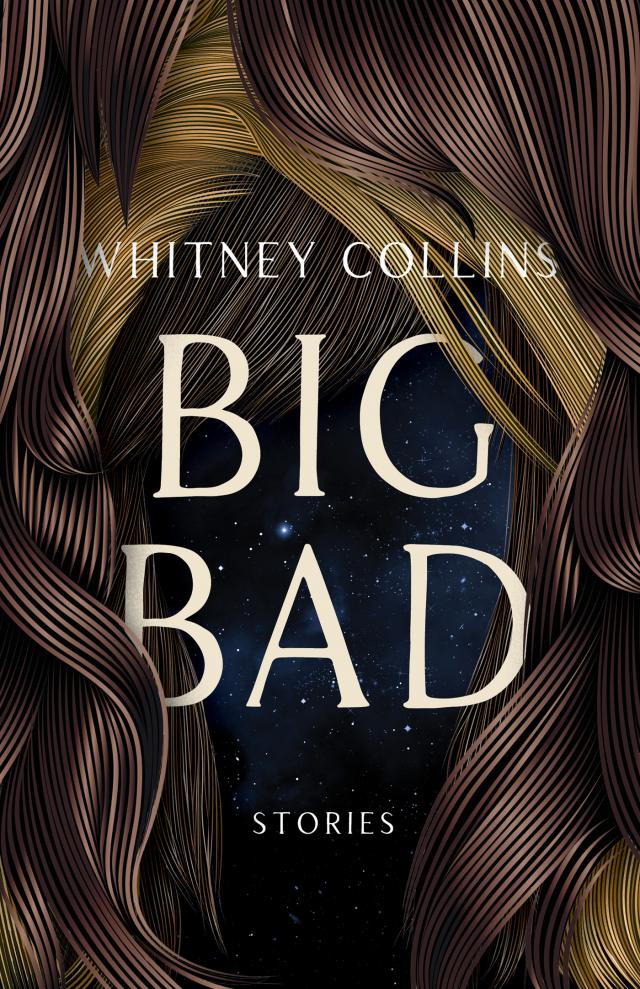
BIG BAD
WHITNEY COLLINS
SARABANDE BOOKS
Louisville, KY
Copyright © 2021 by Whitney Collins
All rights reserved.
No part of this book may be reproduced without written permission of the publisher.
Library of Congress Cataloging-in-Publication Data
Names: Collins, Whitney, MFA, author.
Title: Big bad : stories / by Whitney Collins.
Description: First edition. | Louisville, KY : Sarabande Books, 2021
Identifiers: LCCN 2020016783 (print) | LCCN 2020016784 (e-book) ISBN 9781946448729 (paperback) | ISBN 9781946448736 (e-book)
Subjects: LCGFT: Short stories.
Classification: LCC PS3603.O45633 B55 2021 (print) LCC PS3603.O45633 (e-book) | DDC 813/.6—dc23
LC record available at https://lccn.loc.gov/2020016783
LC ebook record available at https://lccn.loc.gov/2020016784
Cover and interior design by Alban Fischer.
Printed in Canada.
This book is printed on acid-free paper.
Sarabande Books is a nonprofit literary organization.
This project is supported in part by an award from the National Endowment for the Arts. The Kentucky Arts Council, the state arts agency, supports Sarabande Books with state tax dollars and federal funding from the National Endowment for the Arts.
for my sons, my suns
CONTENTS
THE NEST
SUNDAY
BIG BAD
DRAWERS
THE ENTERTAINER
DADDY-O
THE PUPIL
STONE FRUIT
THREE COUCHES
LONELYHEARTS
GOOD GUYS
THE HORSE LAMP
BJORN
Acknowledgments
You save yourself or you remain unsaved.
—ALICE SEBOLD
THE NEST
ON TUESDAY, FRANKIE’S father took her two places against his better judgment. The first was to see her premature brothers at the Our Lady of Peace NICU. Three days prior, and sixty days too early, James and Jasper had slipped out of Frankie’s mother like a pair of feeble insects that doctors promptly secured under glass for observation both scientific and sacred. In the ensuing emergency, Frankie’s father, unable to locate a sitter, deposited his six-year-old daughter on the foot of his blind mother’s nursing home bed with a naked baby doll and a box of Sun-Maid raisins.
For two days, Frankie watched The Young and the Restless and Who Wants to Be a Millionaire? from a vinyl recliner, eating saltines and applesauce and drinking Boost, while her grandmother’s friends leaned on walkers in the doorway, admiring her like a misplaced peacock. “She’s a prodigy,” the grandmother claimed. “She’s in first grade and can balance a checkbook. She knows all the Canadian provinces.”
Every so often, the grandmother would run her fingers over Frankie’s soft face, as if her eyebrows were made of Braille, and tell her the baby brothers would probably die. “They’re like worms on a summer sidewalk, child. They don’t stand a chance in the heat of this world.” To Frankie, this honesty felt so much like affection, she sometimes asked her grandmother to repeat herself, which the grandmother did with gusto, adding details about Frankie’s father and her Uncle Eric. How they weren’t born early, but they’d been stuck together at the hip and the doctors had to slice the grandmother open to remove them. “I was the one who almost died,” she said. “Those boys were laying inside me, side by side, like a butterfly. Your father. He got the hip. Eric, he never was right.” At this, the grandmother patted Frankie’s face and body with her hands. “Looks like you’ll make it,” she said. “You’re one of the lucky ones.” Then Frankie, full of herself, excused herself to faux tap-dance in the hallway for nickels, making four dollars in one commercial break—enough to buy just one brother something in the hospital gift shop.
Back in the recliner, Frankie covered herself with an afghan that smelled of menthol. She saw that her grandmother was on the verge of sleep, so she asked, “Did it hurt when they pulled the babies out of you?”
Her grandmother jolted, frowned, then nodded. “It was hell,” she quietly moaned. “Oh, child. Let me tell you: I know hell.”
Frankie thought about this in the dark, while the mute television featured a man selling electric grills that nothing stuck to, not even cheese. Frankie knew a little about hell. About how, in October, she’d turn seven. How then she’d be considered responsible for everything she did and everything she thought. How the week before Halloween, Father Greg would be waiting for her and her classmates in the church booth to tell him everything they had ever done wrong.
Frankie had already started the list in her mind. She had stolen a pack of Juicy Fruit from the drugstore when she was four. She had dropped one of her mother’s diamond earrings down the drain (on accident) and never told (on purpose) when she was five. And once, just a month ago, when her mother was too pregnant to get off the park bench, Frankie had come across a boy inside the playground tunnel beating a rock against a limp chipmunk. When he offered her a turn, she said okay, but made the mistake of wrapping her hand completely around the rock so that when she hit the chipmunk, her knuckles could feel its bones break, could feel how it was still warm. Frankie had decided to only mention the gum to Father Greg, which would be another sin. The more Frankie thought about it, the more she couldn’t see a way to keep herself out of hell. But she fell asleep regardless.
On Tuesday, the nursing home manager came to the grandmother’s room. He stood in the doorway and explained that Frankie, by law, had to leave. Frankie gathered up her things, but not before noticing that the toes of the man’s shoes were wrapped in black tape to hold the soles on. In his office, he called her father and said, “Either you or the police can come pick her up.”
*
Last November, to everyone’s surprise, Uncle Eric called to invite Frankie and her parents to Thanksgiving dinner at his house.
“He says your mother will be there with her nurse,” Frankie’s mother said to Frankie’s father. “Maybe he’s finally trying.”
“Right,” her father said. “Don’t hold your breath.”
On the day of the party, Frankie’s mother dressed Frankie in her brown, sashed dress and her gray wool coat with the brass buttons. Frankie had only met her uncle once before, at her grandfather’s funeral. She remembered he’d stood under a pine tree away from the crowd, holding an umbrella even though it wasn’t raining.
“Will any kids be there?” Frankie asked.
“No,” her mother said. “Just you.”
When they arrived at his house, Frankie could barely contain herself. The bungalow was painted bright purple with an orange front door, and on the roof, attached to the chimney with duct tape, was a faded plastic Santa Claus.
“Jesus,” her father sighed.
“David,” her mother said.
For dinner, instead of turkey and stuffing and a normal-sized pumpkin pie that fed eight people, Eric served each guest a tiny roasted quail, and minuscule mounds of sweet potatoes scooped with a melon baller, and dwarfed apple tarts the size of poker chips. In her whole young life, Frankie had never been so delighted. There were ropes of blue tinsel over every doorway and glitter sprinkled on the tablecloth and six strangers at the meal who were of no relation to Frankie or her parents or her blind grandmother, but who loved on Frankie more than she’d ever been loved on before—strangers who looked like women but talked like men and smoked cigarettes as long as chopsticks and cried every time a song came on the radio.
“The dishes,” Eric announced at dinner, pinching up a teacup for everyone to see, “are antique doll’s china from Russia.”
Frankie inspected her plate with awe. The dinner guests, the ones who weren’t family, gasped.
“They belonged to Anna Rasputin,” Uncle Eric said. “Anna Goddamn Rasputin. That’s how much I love you all.”
Frankie ate four apple tarts and eleven scoops of sweet potatoes. Her quail was so precious she wrapped it in her napkin then excused herself to the bathroom. She found her winter coat in the hallway and placed the bird in its inner silk pocket.
Frankie noticed her father did not eat. Frankie noticed her grandmother’s nurse excused the grandmother from the dining table and fed her from a paper plate in the living room. Frankie noticed her mother spent the whole meal watching Frankie’s father in the same way she watched Frankie when she ran a fever. Frankie noticed Uncle Eric noticed none of this.
After dinner, Uncle Eric took Frankie upstairs to his bedroom where he showed her a red toddler-sized piano. “We must bring this downstairs,” he said, flushed and wide-eyed. “We’ve got to keep the teeny-tiny theme going.” Frankie nodded in agreement. “What do you play, Frankie? Für Elise? Please tell me you play Für Elise.”
Frankie was worried; she only knew “The Mayflower Song.” “I only know ‘The Mayflower Song,’” she said.
“That’s perfect!” Uncle Eric said, placing the piano on the shoulder opposite his cane. “Because guess who invented Thanksgiving, Sugar? The motherfucking Pilgrims, that’s who.”
On their way downstairs with the piano, Frankie and Uncle Eric met Frankie’s father on his way upstairs. “It’s time to go, Frankie. Your mother is waiting on the porch.”
Uncle Eric stomped a foot. “You’re leaving?” he huffed. “But Frankie was just going to play us a song.”
Frankie’s father shook his head. “Frankie will not be participating in your ci rcus, Eric.”
“Circus?” Uncle Eric exclaimed. “That’s what you call this?” Uncle Eric waved his cane in all directions. “I spent six days getting this ready. Do you know how hard it was to find twelve quail that would fit on that china? I took one of Anna Rasputin’s doll plates around to four butchers and then a farm. Four butchers and a farm, David.”
Frankie stood and watched. Uncle Eric’s blue eyelids looked heavy. Her father had his feet on two different steps as if he might pounce. “Why can’t you just do things the regular way?” her father said. “Why couldn’t there have been a normal turkey? And why all these people, Eric? Answer me that.” Uncle Eric patted his pockets with the crook of his cane. Frankie knew he was looking for a cigarette. “I’ll tell you why,” her father continued. “It’s because it’s never about anybody but you. It’s about what you want. It’s about drawing attention to yourself. It’s not about Thanksgiving or family. It’s about Eric. The Eric Show.”
Frankie looked at her uncle. She wondered what he might say. How he might make her father feel terrible for what he’d just done. But Uncle Eric said nothing. He simply lifted the toy piano off his shoulder and into the air with one hand and then threw the piano down the stairs, over Frankie’s father’s head and onto the first-floor landing, where it jangled and splintered in a way that almost made Frankie laugh. It was exciting to see her father scared, even for a flash. Frankie’s father reached up and yanked her down by her dress sash to the step his back foot was on. Uncle Eric pulled out a pack of Viceroys and pointed at his brother. “Get the fuck out,” he said. “And Frankie? I love you.”
On the ride home, Frankie’s mother and father were silent. Neither of them moved, not one millimeter. It was as if the car drove itself. In the backseat, Frankie sat, replaying the piano scene. Up it went, her father cringed, down it came, exploding in a plinking pile. Frankie smiled wide in the dark in her brass-buttoned coat. She placed her hand over the lump that was the hidden quail.
*
When Frankie’s mother saw her in the doorway of her hospital room, she succumbed to a spasm of sobs that Frankie at first mistook for uncontrollable laughter and that her father, quite clearly, had grown accustomed to. Maybe even tired of.
“Frankie is here, Catherine,” her father said, as if reintroducing them at a dinner party. “She’s come to see her brothers.”
Frankie’s mother convulsed in the wheelchair on the way to the NICU. “They’re …,” she struggled, “so tiny, Frankie. Say a prayer,” she choked. “Oh, God. Say your prayers.”
Frankie was revulsed by her mother’s brokenness, by her desperate pleas for the pointless type of prayers that had no beginning or end. She touched her mother’s hair absentmindedly to pretend she was not appalled, but her curiosity over James and Jasper outweighed her compassion, and she tried to make up for this by showing her mother the fringe of her socks. Frankie did not like fringed socks, but her grandmother had insisted she dress as if for a recital. On Monday, her grandmother had sent an orderly out to buy a pair of patent leather shoes and dress socks on her lunch break, and Frankie had been instructed to go to the grandmother’s jewelry box and give the orderly a gold watch for her efforts.
“See my socks?” Frankie said, smiling, looking past her mother’s contorted face. “See my shoes?” Where were these brothers? was what Frankie really wondered. How terrifying would they be?
To Frankie’s delight, they were horrendous. Beetles under bell jars. Featherless starlings fallen from a nest. Their skin red and shiny, their matchstick arms like roasted chicken wings stretched out to reveal pitiful armpits, their closed eyes bulbous and alien. Nurses turned them this way and that way with latex gloves, adjusting the tape and tubes and gaping diapers, but nothing made them look better or better off. When Frankie watched them, she imagined all the times she had twisted a coin in a candy machine only to forget to cup her hands under the silver spout. She remembered all the times a gumball had escaped her, rolling under the desk at a car wash or on the tarry carpet of an old restaurant. All the times she had been forced to beg for a second quarter. And now, see? Her mother would have to ask for two. Frankie watched her brothers breathe, their tiny ribcages pumping to the beat of a frantic song. Scary, scary, scary. Very, very, very. Frankie could tell one of them was worse off than the other—Jasper it seemed from the sign on his little greenhouse. Frankie decided to root for him. Go, Jasper, she thought. Beat James. She knew this was terrible and she bent down to check that the lace of her socks was still folded neatly.
“I know it’s hard to believe,” her father said unconvincingly. “But one day your brothers will grow up to be big and strong. Bigger and stronger than you.”
Frankie was done looking at them. She tapped her new shoes against the tile floor of the hospital hallway to show her parents she was the same as she had always been. “Can I go to the gift shop?” Frankie asked. “I have four dollars.”
Her father nodded, and after they wheeled Frankie’s mother back to her room, downstairs, in the hospital store, Frankie bought a tiny blue T-shirt that said Early Bird.
“Who’s that for?” her father asked.
Frankie put it on her naked doll as they walked to the car in the heavy August heat. Go, Jasper, she thought. Beat James. “It’s for my baby,” she said.
*
The second place Frankie’s father took her that day against his will was to his brother’s, back to the Thanksgiving neighborhood where rainbow windsocks blew horizontal from porches.
“If I had my way …,” her father began, as he searched for a parking spot.
“You’d rather take me to the zoo,” Frankie finished for him. “Why don’t you go back to the hospital?” She changed the subject. “Before something bad happens.”
Frankie’s father slouched at the wheel, and she felt a small surge of victory in her stomach. “You can just drop me off,” she said. “I know which house is his.”
But her father parked and walked her up the stairs to the purple bungalow where Uncle Eric met them on the porch. He wore a silk bathrobe and a pair of red velvet slippers. He held an unlit cigarette and a new, jaunty magician’s cane in one hand and placed his other hand on top of Frankie’s head. “We’re going to have a big time,” he said. “You and me, Sugar. A grand old time.”
Frankie left the men on the porch and went inside to snoop. She overheard her father say, low and tense, “Don’t pull any of your shit.”
In Uncle Eric’s living room, Frankie watched a working stoplight in the corner cycle through its red-yellow-green. In his downstairs bathroom, she saw that the toilet water was blue. She flushed it once to see if it was blue again and it was and she was thrilled. In the kitchen, in the refrigerator, Frankie found a pink cake with one slice missing. “Happy Tuesday—itch,” Frankie said aloud, with her hands on her hips.
“I ate the W,” Uncle Eric confessed from the doorway. “And it was delicious.”
Frankie turned. She suddenly felt shy but refused to show it. “My brothers will probably die,” she said. “They’re like two worms in the sun.”
Uncle Eric snorted, shocked. “Gurrrrrl,” he purred, fumbling through the pocket of his robe. “Go on, now. Tell us how you really feel.” He produced a lighter and lit his cigarette and looked hard into Frankie’s eyes when he exhaled.
“It’s true,” she said. “I’ve seen them. They’re probably dead right now.”
Uncle Eric shook his head admiringly. “I doubt that, Hon. What with modern medicine and all. But still.” He shuffled to the refrigerator with his cane and brought out the cake, from which he cut a slice. He served it to Frankie on a paper towel at the chrome table. “I bet they looked bad off.” He sat down across from Frankie with an amber ashtray and a coffee mug shaped like a woman’s breast. “Didn’t anybody tell you the story of your dad’s and my birth? Everybody thought we wouldn’t make it. And now, see? Look.” Uncle Eric tilted his head back like a supermodel and puckered his lips. He rapped his cane on the floor three times. “They were right about one of us.” At this, Eric laughed long and hard, and Frankie could tell he expected her to do the same. Eric pointed to her cake and then at her. “Oh, I’m just playing, Doll.” He crushed out his cigarette and winked. “Now, you eat that, and then I want to show you something.”






