

Sam j lundwall science.., p.1
Sam J. Lundwall - Science Fiction, page 1
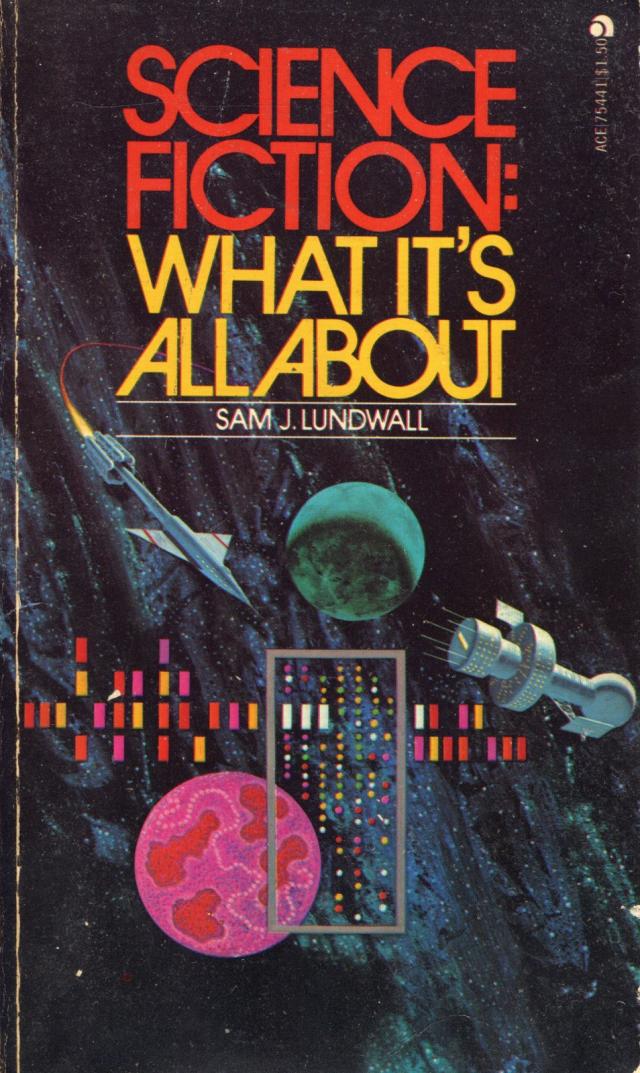


SCIENCE FICTION:
SAM J.LUNDWALL '
WHAT IT'S AL/BOUT
SCIENCE FICTION: Three definitions:
"Science fiction is a branch of fantasy identifiable by the fact that it eases the 'willing suspension of disbelief on the part of its readers by utilizing an atmosphere of scientific credibility for its imaginative speculations in physical science, space, time, social science and philosophy."
— Sam Moskowitz
"Science fiction is what you find on the shelves in the library marked science fiction."
— George Hay
"Science fiction doesn't exist."
— Brian W. Aldiss
SCIENCE FICTION: WHAT IS IT ALL ABOUT
Illustration for From theEarth fo the Moon by Jules Verne.
WHAT IT'S ALL ABOUT
Sam J. Lundwall
¿1
ace books
A Division of Charier Communications Inc.
1120 Avenue of the Americas New York, N.Y. 10036
SCIENCE FICTION: WHAT IT'S ALL ABOUT
Copyright ©, 1971, by Sam J. Lundwall
This is a revised, enlarged, and specially translated edition of a work first published in Sweden under the title: Science Fiction—Fran begynnelsen till vara dagar, and which is copyright ©, 1969, by Sam J. Lundwall, for Sveriges Radios forlag. Translated by the author.
An Ace Book. All Rights Reserved.
Cover art by Dean Ellis. For INGRID
Author's acknowledgments: For invaluable help and suggestions given to me during the work on this revised edition I am grateful to Alvar Appeltofft, Kenneth Bulmer, E. J. Carnell, Alan Dodd, Philip J. Harbottle, George Hay, Archie Mercer and L. Sjdanov. And, of course, to Donald A. Wollheim, who encouraged me to undertake the job of translating and revising the book.
- S.J.L.
Printed in U.S.A.
CONTENTS
INTRODUCTION by Donald A. Wollheim 7
1. THE FANTASTIC NOVEL 13
2. THE PREHISTORY 26
3. UTOPIA 41
4. THE AIR-CONDITIONED NIGHTMARE 58
5. THE MAGIC UNREALITY 74
6. OUT IN THE UNKNOWN 116
7. WOMEN, ROBOTS AND OTHER PECULIARITIES 143
8. THE MASS-CULTURE STRIKES 180
9. THE MAGAZINES 199
10. FIAWOL! 216
11. THE FUTURE 228
NOTES 242
BIBLIOGRAPHY 245
INDEX 247
INTRODUCTION
by Donald A. Wollheim
We science fiction readers whose native language happens to be English—that is to say we American, we Canadian, we British, and we Australian science fiction readers—tend to a curious sort of provincialism in our thinking regarding the boundaries of science fiction. We tend to think that all that is worth reading and all that is worth notice is naturally written in English. In our conventions and our awards and our discussions we slip into the habit of referring to our favorites as the world's best this and the world's best that. The annual American science fiction convention calls itself the World Science Fiction Convention, though every now and then it deigns to allow itself to meet overseas, but always with a strong cord attached so that it will return the next year to its "natural" heliocentric American habitat.
Of course we recognize with some moderate historical condescension that once there was a famous founding father named Jules Verne and that he was French. And we pay tribute to the fact that in the oldest issues of American science fiction magazines series appeared that had been translated from the German. Somehow, we also assume that abroad, in non-English speaking lands, there probably may be some local writers and even local magazines turning out stories and novels in the native tongues, but obviously going unnoticed and scarce worth translating.
To one sensitive enough to think about it and to
realize how provincial such a viewpoint surely must be, it comes therefore as something of a bewildering discovery upon going abroad to Western Europe or to Japan to find that these prejudices have real basis. Scan the published science fiction in Germany, or Holland, or Italy, Spain, Japan, France, Sweden, Denmark and —lo!—you will find that from eighty to ninety percent of it is indeed from English originals! Translations galore into every language, but always of the same American and British masters we honor in their original editions.
We come back to wondering how this came to be so. We come back perhaps also not a little pleased that this is so. What a pat to the ego to discover that "our" science fiction does indeed dominate the Western world and that the Hugos given as "World's Best" by some predominantly American readerhood may be quite justified in that designation.
(It goes without saying that all this does not apply to that mysterious world of literature masked by the unreadable Cyrillics of the Russians. There we hear rumors of a vast literature of science fiction having little in common with our own—of writers whose fame extends behind that side of the Iron Curtain but not on our side and where our Big Name writers are scarcely known over in that unexplored hemisphere.)
Surely, in the days of Hugo Gernsback's first magazines there were European writers of equal caliber with our own. Somehow, though, in the intervening decades, there has been a lapse. Somewhere the potential of European imaginative fantasy has been shunted aside.
What then is the true perspective of science fiction in literature? What is science fiction that it so seizes the minds of youth? What is science fiction today and what was it in the past? What does it mean to literature and society? In short—science fiction: what is it all about?
I myself tried to answer this in a book entitled The Universe Makers: Science Fiction Today published by
Harper & Row this year (1971). My views therein represent more the philosophical overview of the answers.
Perhaps a further enlightening perspective on this problem is to be found, not from someone at the center of this American-British dominated literature such as myself, but from a qualified observer on the perimeter —someone to whom English is a foreign language to be learned and mastered by hard study in order better to appreciate the ideas contained therein; ideas which may not be present in such quantity in the literature of a language limited by a much smaller audience. Such an observer has the advantage of both appreciating the virtues that exist and noting the oversights. He can see more closely the values of non-English-language writings, both past and present, and compare them with the giants we acclaim today. He can evaluate the impact of our writers in translation and he can point out the demerits of our perhaps overinflated self-importance in this field.
Such an observer is the author of this book, Sam J. Lundwall, a native of Sweden, student of science fiction and so sufficiently skilled in English as to have been able to translate this work itself into the English you see before you.
Sam J. Lundwall, still below thirty in age, started off, as most s-f writers do, as an active reader, as an active fan, and rapidly rose to the top of the small but very intensely competitive Swedish s-f fan world. Publisher of one of those fan magazines that briefly dominate those microcosms. Science Fiction Nytt, a journal of news and reviews, he became a leading authority on the subject of science fiction. Evidence of his status was confirmed bv his first professional publication, a comprehensive Bibliography of Science Fiction and Fantasy in the Swedish language, published in 1964, and soon to reappear in a third and further enlarged edition. Reading English fluently, he became as versed in the writings of the United States and England as any of our native collectors and fans, and being talented, began to assert himself in the cultural sphere of his own country.
In the past several years, Lundwall has been connected with the government-operated Radio Sweden, and has written and produced television shows, directed plays, held down disc-jockey tasks in pop music, and has himself composed and sung folk music. He is widely known in his native land for his work in that field and has appeared on popular recordings in both 45 and long-playing records—and is soon to appear on casettes. Most recently, Lundwall has become the editor of a new line of paperback science fiction for the Stockholm publishers, Askild & Karnekull, primarily translations but also to include original novels.
I first met Sain Lundwall when Radio Sweden sent him to England with a camera crew to interview science fiction personalities and to do a coverage of the annual British Science Fiction Convention, held that year at Oxford. I had the pleasure of working with him on that project and was myself interviewed, and I am told subsequently—ahem—starred in one such showing over the Swedish television network.
In any case, this apparently started the directors of Radio Sweden to thinking about science fiction and what it all meant and they commissioned Sam J. Lundwall to write a book about it. That book, whose title was Science Fiction-, frdn begynnehen till vara dagar, was published in 1969 and was an immediate success. We understand that it went into two or three printings —which is phenomenally good for Sweden. Essentially that book is the same as the one you have in your hand now.
It has been translated into English by its author, at my request, and in so doing Lundwall has slightly enlarged it, revised certain sections to be of greater interest to an English-reading audience, corrected some minor items, added others, and generally improved the work. Most of the original illustrations are included with this new translation and a few extra ones added.
Although I think I know a lot about science, fiction, I found it fascin ating. Lundwall gives a depth to the field we do not find among other writers on the subject. He presents both a history of science fiction, a study of its roots and backgrounds, and a commentary. He covers it in all its aspects: books, magazines, comics, fans and fandom, juvenilia, series characters, and literary giants. He does this with accuracy and yet with wit. He does not stint in his admiration nor withhold his scorn when such attitudes seem to be called for. He can be bluntly harsh or admiringly applauding.
No one will agree with everything he says ... I certainly do not . . . but reading him is educational, stimulating, and exciting. He brings to science fiction the perspective we dearly need—someone on the European perimeter, able to praise where praise is deserved, and able to prick overblown balloons when they need such deflation.
I commend this book to everyone who reads science fiction or who wants to know more about it. Sam J. Lundwall is eminently capable of telling the world what it's all about.
— DONALD A. WOLLHEIM
1. THE FANTASTIC NOVEL
There is a very short story, attributed to Fredric Brown, which better than any explanation gives an insight into the world of thought that is the substance of science fiction. It is exemplarily short, three sentences, and goes, approximately, as follows:
After the last atomic .war, Earth was dead; nothing grew, nothing lived. The last man sat alone in a room. There was a knock on the door . . .
I do not say that this is the archetype of all science fiction, or even that it is typical of the genre as such; but I can safely assert that if anything can be said to constitute the heart of the field, call it Sense-of-Wonder or whatever you wish, it must be found somewhere in those three sentences. For those readers who prefer more emphasis on the specula-rive scientific element in their science fiction, there is another and more venerable example, from Bishop John Wil-kins' novel A Discourse Concerning a New World and Another Planet (1638):
Yet I do seriously, and upon good Grounds, affirm it possible to make a Flying Chariot, in which a man may sit, and give such a motion unto it, as shall convey him through the Air. And this perhaps might be made large enough to carry divers Men at the same time, together with Food for their Viaticum, and Commodities for Traffique.
So that nonwithstanding all these seeming impossibilities, 'tis likely enough, that there may be means invented of Journeying to the Moone. And how happy shall they be that are first successful in this attemptl
It might be thought that this is all pretty obvious and old hat, but how obvious it might seem this day, it was certainly not obvious in the year 1638. The first moon landing did not take place until July 20, 1969, which was somewhat later than the good Bishop had expected, but obviously there was both foresight and (some might say) some accuracy in the story. Personally, I do not think that John Wilkins did prophesy anything, least of all Apollo XI, but in 1638, this was Sense-of-Wonder in capital letters.
This might be called the We-told-you-so-didn't-we science fiction. The third example is of a somewhat later date, and if the earlier samples did not evoke the specific feeling of Sense-of-Wonder, perhaps this one will:
The Gibbelins eat, as is well known, nothing less good than man. Their evil tower is joined to Terra Cognita, to the lands we know, by a bridge. Their hoard is beyond reason; avarice has no use for it; they have a separate cellar for emeralds and a separate cellar for sapphires; they have filled a hole with gold and dig it up when they need it. And the only use that is known for their ridiculous wealth is to attract to their larder a continual supply of food. In times of famine they have even been known to scatter rubies abroad, a little trail of them to some city of Man, and sure enough their larders would soon be full again.
Their tower stands on the other side of that river known to Homer—ho rhoos Okeanoio, as he called it—which surrounds the world. And where the river is narrow and fordable the tower was built by the Gibbelins' gluttonous sires, for they like to see burglars rowing easily to their steps. Some nourishment that common soil has not the huge trees drained there with their colossal roots from both banks of the river.
There the Gibbelins lived and discreditably fed. (1)
The principal characters of this story are by science fiction aficionados fondly referred to as BEM's, or Bug-Eyed Monsters; hostilely inclined creatures of some disagreeable land, often green and decidedly slimy. The BEM's belong to the sf arsenal in the same degree as the old faithful ray guns and the space ships, and even though they nowadays only seldom twine their tentacles around the beautiful (and seminude) heroine's attractive figure, as the noble space-hero raises his trusty atomic blaster somewhere in the background, they still prosper in blissful abandon in the branch of sf that is known as Fantasy and Sword & Sorcery. It is the old fairy tale all over again, complete with the dragon and the milksop princess and the magic sword and the bags of tax-free gold. The above example is from Lord Dun-sany's short story The Hoard of the Gibbelins (1912), which is a moral story with an unusually credible ending; the monsters devour the hero. The most well-known representative for this branch of science fiction is otherwise. J. R. R. Tolkien's mighty trilogy The Fellowship of the Ring, which contains all the time-honored ingredients, including BEM's, called Ores. They are small, malignant and guaranteed atrocious.
Now the friend of order and discipline might ask how a literary genre with the pretentious name of science fiction can contain such disparate elements as space-flight and fire-breathing dragons. Where is the logic? And, above all, the definition of the genre?
The melancholy fact is that there does not exist any unitary definitions of the genre. Or rather, there exists about as many perfectly valid definitions as there are readers of what I here for simplicity's sake call science fiction. (For myself, I would prefer the term Speculative Fiction as being more descriptive.) The sf buffs present in this connection certain resemblances to a select club where the venerable old men in the reading room have sat and slept in their moldering easy-chairs since the early twenties, with Amazing Stories and Astounding SF over their white heads; this is the Old Guard, which reads their science fiction with the emphasis on science, expecting nothing in the way of purely literary merits and, consequently, getting nothing of that land. Every deviation from the rule of scientific accuracy is a scathing sin against all decency.
The lovers of Space Opera are huddled behind enormous piles of Startling Stories, Captain Future Magazine, Thrilling Wonder Stories and the collected works of E. E. Smith, and follow with glowing eyes the latest super-scientific adventures of the glorious Space Patrol in the Crab Nebula, where green BEM's of the most atrocious sort are plotting vile schemes against Humanity. Atomic blasters blast, heroines cry, and the space ships leap in and out of hyperspace like frightened hens.
Right by, one can discern the Horror-lovers with their blood-curdling Weird Tales and H. P. Lovecraft. European members of this group might be more fond of E. T. A. Hoffmann. They are a small and persecuted minority, far from loved by the Amazing readers.
The Fantasy and Sword & Sorcery" groups are crowded together in a small room behind the reading room, from which they look rancorously out toward the sleeping gentlemen, thoughtfully fingering at their gleaming broadswords. They are also a minority, but literarily acceptable since the recent upswinging interest in adult fantasy, and in strong need of lebensraum.
The group of social reformers sit by the bar, where they exchange views on the future overpopulation, the food crisis, environment pollution, the goal of Humanity etc., anxiously watched by the H. G. Wells phalanx which stands somewhere between the reading room and the bar and doesn't know exactly where they belong.






