

Rustic vendetta, p.1
Rustic Vendetta, page 1


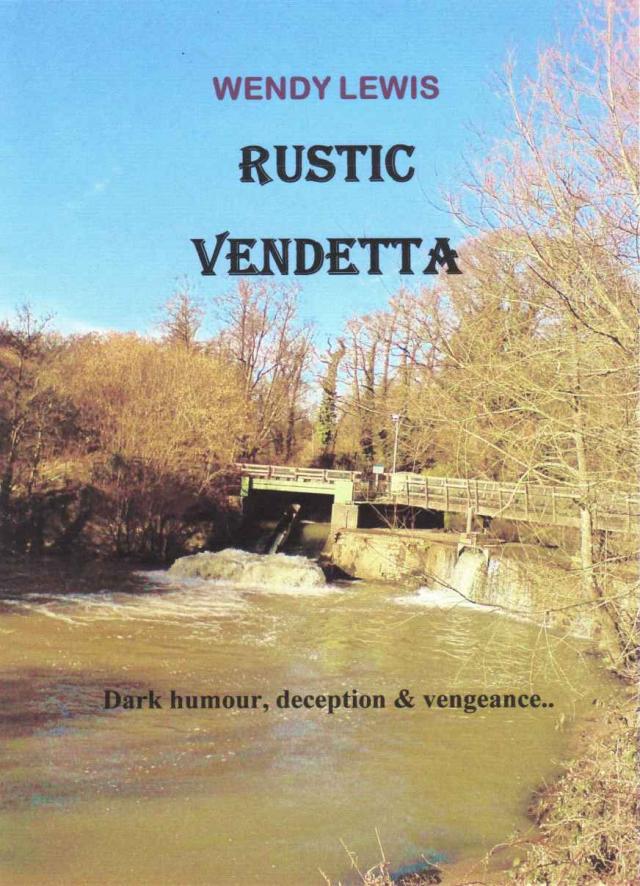
RUSTIC VENDETTA
Wendy Lewis
© Copyright 2003
WENDY LEWIS
The right of Wendy Lewis to be identified as author of this work has been asserted by her in accordance with Copyright, Designs and Patents Act 1988.
All rights reserved. No reproduction, copy or transmission of this publication may be made without written permission.
No paragraph of this publication may be reproduced, copied or transmitted save with the written permission or in accordance with the provisions of the Copyright Act 1956 (as amended).
Any person who does any unauthorised act in relation to this publication may be liable to criminal prosecution and civil claims for damage.
All characters in this publication are fictitious and any resemblance to real persons, living, or dead, is purely coincidental.
Original Paperback ISBN 0-954502213
Published by Mazard
5 Heathfield Gardens
MIDHURST
Sussex
GU29 9HG
ABOUT THE AUTHOR
Wendy Lewis was born in West Sussex, England, and grew up to enjoy the freedom of the countryside and the neighbouring farm. Educated at Chichester High School for girls, she went on to a varied career as Post Office Clerk, Pub Landlady, Dog Breeder, Farmer and Freelance Journalist. She has had many magazine articles published and five short stories read on local radio. She has eight books currently available in e-books on Amazon Kindle, four published by Endeavour Press:- TOWN & COUNTRY. STARTING OVER. THE GETAWAY and VETTING THEM. Then VILLAGE OF DOGS. The sequel, NEW DOGS IN THE VILLAGE and DON’T PANIC, a non-fiction book about dog breeding, published by Mazard.
Praise for Wendy Lewis’s novel TOWN & COUNTRY:- ‘…has you smiling by page two and laughing out loud by page six…Milland Valley News.
As a failed dairy farmer myself, I found it too easy to identify with Wendy Lewis’s main characters. Several times she made me laugh (and wince) aloud. John Humphrys. Presenter Radio 4. The Today Programme.
Wendy Lewis tells her tale of the down-shifter’s dream, the agony and ecstasy of rural re-location, with charm and wit. Hugh Fearnley-Whittingstall.
Contents
CHAPTER ONE
CHAPTER TWO
CHAPTER THREE
CHAPTER FOUR
CHAPTER FIVE
CHAPTER SIX
CHAPTER SEVEN
CHAPTER EIGHT
CHAPTER NINE
CHAPTER TEN
CHAPTER ELEVEN
CHAPTER TWELVE
CHAPTER THIRTEEN
CHAPTER FOURTEEN
CHAPTER FIFTEEN
CHAPTER SIXTEEN
CHAPTER SEVENTEEN
CHAPTER EIGHTEEN
CHAPTER NINETEEN
CHAPTER TWENTY
CHAPTER TWENTY ONE
CHAPTER TWENTY TWO
CHAPTER TWENTY THREE
CHAPTER TWENTY FOUR
CHAPTER TWENTY FIVE
CHAPTER TWENTY SIX
CHAPTER TWENTY SEVEN
CHAPTER TWENTY EIGHT
CHAPTER TWENTY NINE
CHAPTER THIRTY
CHAPTER THIRTY ONE
CHAPTER THIRTY TWO
CHAPTER THIRTY THREE
CHAPTER THIRTY FOUR
CHAPTER THIRTY FIVE
CHAPTER THIRTY SIX
CHAPTER THIRTY SEVEN
CHAPTER THIRTY EIGHT
CHAPTER THIRTY NINE
CHAPTER FORTY
CHAPTER FORTY ONE
CHAPTER FORTY TWO
CHAPTER FORTY THREE
CHAPTER FORTY FOUR
CHAPTER FORTY FIVE
CHAPTER ONE
Heather watched the shadows slowly change their form, as the late afternoon sun glowed on the stone cottages surrounding the drowsing village square. Nothing else moved except the square’s only other occupant, a grey cat lying bonelessly on the garden wall of the cottage beside the pub. Even then the movement was minimal - just an ear twitched as it picked up the thin screams of the swifts wheeling and diving on the midges dancing above the thatched roofs. The clock on the square church tower chimed the four tones of the quarter, rousing a muted ‘chack’ from a jackdaw preening itself on the castellated wall above the clock.
From the bench outside the pub Heather could feel herself relaxing into the same state as the cat. A sudden eddy of air wafted the drifting scent of drying hay around her, mixing it with the delicate perfume of roses from the garden behind the cat.
It was for this that she and Alan had deserted the clamour of the city and bought the Shepherd and Dog pub, whose sun-warmed wall now supported her back. She was still finding it odd not being able to hear the sound of traffic. She strained her ears for a moment; then just faintly in the distance managed to pick up the noise of a tractor. The buzz didn’t seem to be coming closer but was continuous, and she remembered passing a field where they were hay-making the day before.
A movement from across the square, on the road leading into the village, caught her eye. She idly watched a woman trudging up the hill towards her, her body bent forward at a sharp angle against the weight of the man in the wheelchair she was pushing. Heather was wondering whether to rouse herself and offer to help the woman up the steepest part of the hill, when raised voices from the couple reached her. They appeared to be having a row. They would have known that she had heard them and might have been embarrassed.
She would soon learn that embarrassment was not an emotion on which the residents of North Tegridge wasted much time. Vindictive violence was more their line.
The man sitting in the wheelchair shouted again. Although they were too far away for her to make out what he was saying, he sounded angry. Life was so different out here in the country that, in the two days she and Alan had been in the village since taking over the pub, she had decided that it might take a little while for them to be accepted. Best not to interfere.
She leaned back against the wall again and lowered her eyes to her hands - rather than be seen to be watching the small drama across the square - then froze. Her hands were covered in blood, as was the knife she was holding. She blinked furiously, heart racing, and glanced up at the approaching pair to see if they’d noticed. She seemed to be gripped in a cloud of black despair. Looking down again she saw that they were…just her hands…no knife…no blood…nothing unusual. The dark, claustrophobic feeling, vanished as swiftly as it had come.
‘What the hell was that?’ she said quietly.
The woman steered the chair onto the pavement and stopped beside the spiked iron railings surrounding the churchyard. She straightened up, struggling for breath. Her passenger must have weighed at least fifteen stone.
‘Come on,’ he complained.
‘Just a minute…while I do catch…me breath.’ She brushed straggling wisps of greying dark hair off her forehead.
‘You can do that at ‘ome. I want me tea.’
Heather decided that if Alan ever spoke to her like that she would give his wheelchair a push and send him back down the hill on his own, but of course Alan didn’t have, or need, a wheelchair. ‘But you wouldn’t stab him,’ her mind said. She looked back at her hands, which were shaking slightly.
The man glanced up at the church clock.
‘I’m going to miss me programme, get a move on, woman.’
‘Just a minute,’ the woman repeated.
‘I’ll give you just a minute,’ he shouted, his voice echoing round the empty square. The jackdaw took off, sweeping across the treetops down to the bottom of the valley. The cat opened one yellow eye.
Heather was horrified to see the man turn awkwardly in the chair and give the woman a resounding, back-handed crack across her shoulders with a heavy walking stick. She made no sound; just tightened her grip on the chair, lowered her head and began to push again. As they drew level with her Heather couldn’t stop herself from asking the woman, quietly, if she was all right. She stared at Heather for a second with impenetrable black eyes before lowering her head and mumbling something in which Heather caught the words ‘dance’ and ‘grave’, and continued with her burden towards the housing estate on the outskirts of the village.
‘You mind your own business,’ the man shouted at Heather, peering round the woman and waving his stick.
The latch rattled and the pub door creaked as Alan came out.
‘Oh, there you are. I thought you were upstairs doing some more unpacking. I fancied a cup of tea. Isn’t it quiet out here.’
‘There’s too much happening for my liking,’ she said.
Alan stared round the empty square.
‘Where exactly?’
Heather pointed to the couple in the distance.
‘He just hit her…with a bloody great stick.’ She shuddered and wished she hadn’t said ‘bloody’. She clenched her dry, empty hands.
‘He what!’
‘He hit her, as if she was a donkey or something. If she had been a donkey the RSPCA would have had something to say about it.’
‘Why?’
‘Why what?’ said Heather
‘Why did he hit her.’
‘She wasn’t moving fast enough for him. I’m not sure I’m going to like it here.’
‘There’s probably more to it than we know about,’ said Alan, trying to sound comforting but not succeeding. ‘I’ll go and put the kettle on.’
‘That poor woman didn’t even complain,’ said Heather staring after the couple who were just turning the corner onto the estate. ‘We seem to have stepped back into an earlier, more brutal age.’
‘I thought that was what you liked about North Tegridge. Not the brutal bit, but the slower pace of life, the lack of traffic, the fact that we don’t have to lock our cars. Come on. We’ll be open soon; our first night as publicans.’
‘I think I had a sort of premonition,’ said Heather, still sitting, and gazing unseeingly across the square. ‘It was a bit creepy.’
‘Oh…er…what d’you mean exactly?’ Alan had always been very dismissive at any hint of there being a supernatural, but he could see something had disturbed her.
‘I don’t really know…there was a knife, and blood on my hands,’ she said, glancing down at them again.
‘Well I wouldn’t brood on it. Just be careful when you’re cutting stuff in the kitchen,’ said Alan, making light of it to try and lift her out of her sombre mood.
Half an hour later Heather walked across the polished wooden floor of the bar, and pulled back the old iron bolts on the heavy oak door which opened onto the village square. She swung the door back and faced their first customer, a puzzled looking ewe with her black tongue lolling out, panting heavily from some recent exertion. As Heather backed away out of range of the ewe’s smelly breath, she realised the square was full of sheep which were being efficiently penned against the front of the pub by a pair of lean, filthy collies. A man in his late fifties rose from the bench against the wall and pushed his way in past the ewe. He walked over to the bar where Alan stood, hand suspended over the beer pumps, transfixed by the scene framed in the doorway.
Heather regained her composure first. She grinned at Alan.
‘Well, you can’t say the pub isn’t well named.’
‘Pint of bitter,’ said the man, finding no need to explain the presence of his flock.
Alan, though, couldn’t ignore them.
‘Nice looking sheep,’ he said, trying not to sound like a ‘townie’ and managing to do just that as he passed the man his pint.
The man gave him a funny look.
‘Just moving ‘em,’ he said, lowering the level in his glass considerably with one swallow. ‘Warm,’ he explained, seeing Heather’s glance at his glass. He wiped the back of his hand across his mouth. Heather winced as the greying stubble on his chin rasped against the flesh.
A woman came into the bar, the sun behind her picking out red tones in her long black hair. She could have been attractive but the effect was spoiled by the fact that she obviously didn’t care about her appearance. The hair could have done with a wash, and her grubby crimplene trousers and shapeless jumper were covered in hay seeds. On her feet she wore men’s boots which clattered on the bar floor.
‘Your bloody sheep are crappin’ all over the square, Dave. People ‘ave to walk through there. You wants to ‘ave more consideration.’
‘That’s rich looking at where you come from, muckiest bloody farm in Devon.’
Alan’s eyes locked with Heather’s, their glances a mixture of suppressed hysterical laughter and panic. Heather quickly stepped behind the bar.
‘What can I get you? Please… both of you have your drinks on the house. You are our first customers.’
‘Oh, right,’ the woman looked thoughtful. ‘I’ll ‘ave a Dubonnet and lemonade.’
‘Dubonnet and lemonade!’ scoffed Dave. ‘She usually drinks pints like the rest of us.’
‘Shut up, you rude old bugger.’ The woman held out a large square hand and Heather went to put the glass in it before she realised the woman wanted to shake hands. The hand which gripped hers was unsettling in it’s ugliness. It was coarse and clumsy, with short thick fingers and square nails. It reminded her of a photograph she had once seen, in a book on palmistry, of the hand of a violent murderer.
‘Peggy,’ the woman introduced herself. ‘Peggy Ashley. I used to do the cleanin’ ‘ere. I come round this evenin’ to see if you would want to keep me on. I do a good job an’ I knows where everythin’ is.’ She raked her fingers through the mass of black hair, dislodging more of the countryside onto the bar floor as she studied Alan with eyes as dark as those of the woman Heather had seen earlier.
‘Good lookin’ bloke, your ‘usband,’ she said to Heather, her eyes following Alan as he lifted the bar flap and walked across the room to the window.
‘Er, yes.’ Heather watched him too, as he pushed up the heavy sash window, caught the pungent smell of hot sheep, and closed it again.
‘Well?’ Peggy was leaning across the bar, looking questioningly at her.
‘What do you think, Alan?’ Heather asked.
‘Think?’ He re-joined her behind the bar.
‘Peggy used to be the pub cleaner. She would like to work for us.’
‘Yes, fine, if that suits you, darling.’
‘Good,’ said Peggy, leaving no room for manoeuvre. ‘I’ll come tomorrow mornin’ at eight o’clock. I’ll ‘ave a pint now… thirsty day… been ‘aymakin’.’
‘Where’s Luke then?’ asked Dave.
‘Mendin’ the baler. Keeps tanglin’ up the twine. ‘E’s good and mad. Thought I’d get out the way for a bit before ‘e decides it’s my fault.’
‘When you two going to get married then?’
‘None o’ your business. Anyway, when they can’t find no body you ‘ave to wait seven years before they can assume she’s dead.’
There was a commotion outside in the square, and two sheep banged against the door as they dived into the bar. Over their heads Heather could see the cause of the problem was a little red dachshund, who thought he had caught his supper and was gamely hanging onto the leg of a struggling sheep, while his elderly owner tried to drag him off.
Peggy and Dave caught the two ewes and pushed them out of the bar, Dave shouting at the woman that he would be round later to shoot her dog. A swift kick from Dave loosened the dachshund’s hold. The farmer whistled to his dogs and began to move the sheep down the road out of the village.
Peggy came back into the bar and finished Dave’s pint for him. ‘’E won’t be back now. ‘E’s takin’ them down Small Profits.’
‘Small Profits?’ said Alan.
‘’Is farm.’
‘Will he really shoot her dog?’ asked Heather, who quite liked dachshunds.
‘Won’t be the first,’ said Peggy.
The dachshund’s owner came into the bar.
‘You don’t mind dogs, do you?’ she asked, taking the answer for granted as she tied his lead to the leg of a chair. He lay down and proceeded to try to dislodge a piece of wool which had stuck between his teeth, by clawing at it with a front paw. His mistress didn’t seem unduly perturbed by the encounter.
‘Gin and tonic please; may as well make it a large one… Anne,’ she introduced herself and held out a hand.
‘Heather and Alan,’ said Heather, shaking the hand as Alan poured the drink.
‘Silly old fool should know better than to leave his sheep unattended in the square like that. Dreadful temptation to any dog. Can’t blame Rudi for succumbing.’ Rudi looked up at his name, then went back to picking his teeth.
‘How’s your father, Peggy?’ asked Anne.
‘’Bout the same. Miserable old bugger. ‘E makes out ‘e’s worse than ‘e is you know. I don’t know why mum puts up with it. ‘E can walk better than ‘e lets on, but ‘e still makes ‘er push him about.’
Heather made the link with the dark eyes. It was Peggy’s mother who had taken the beating that afternoon. She rather wished they hadn’t been so quick to employ Peggy. It would be very hard to be civil to her father if she ever had to meet him.
As it happened she was spared this problem when Peggy turned up the following morning, and announced that she couldn’t start work that day as she had to take her mother to the undertakers in town.
‘Dad’s dead,’ she said, with no emotion. ‘We’ve got to sort out the funeral.’
‘I’m so sorry. I didn’t realise he was that ill,’ Heather said.
‘’E wasn’t. Silly old bugger tripped over his walkin’ stick and fell down the stairs. ‘It ‘is ‘ead a couple of times on the bannisters on the way down, and that was that. Blood all over the new stair carpet. Didn’t show too much on the bannisters ‘cause they’m red anyway.’
‘How’s your mother,’ Heather asked, with genuine sympathy, tinged with horror at Peggy’s callous attitude to the death of her father.






