

Hat girl, p.1
Hat Girl, page 1


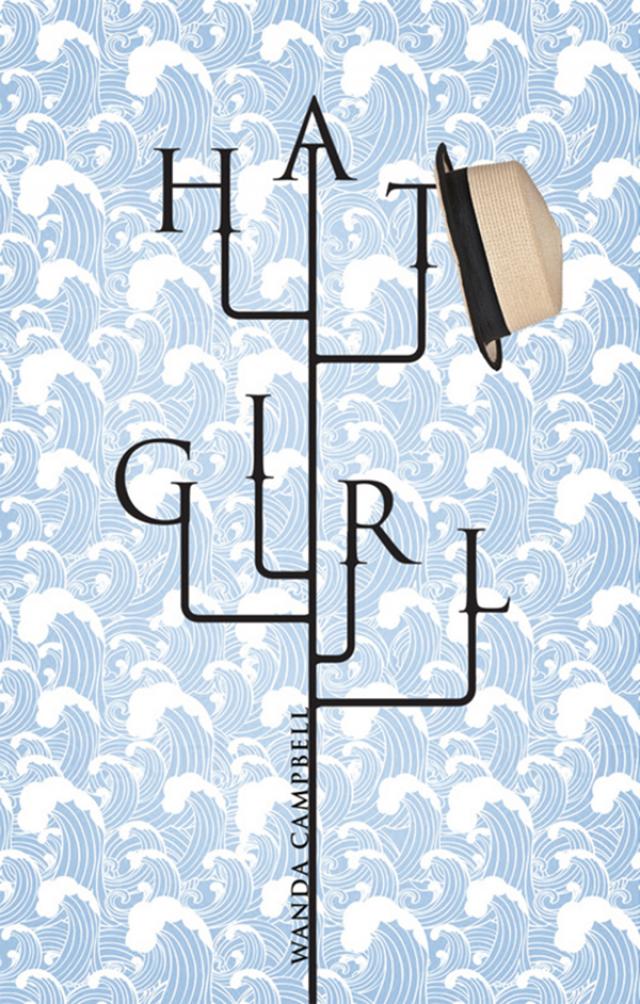
HAT GIRL
WANDA CAMPBELL
© 2013, Wanda Campbell
All rights reserved. No part of this book may be reproduced, for any reason, by any means, without the permission of the publisher.
Cover design by Doowah Design.
Photo of Wanda Campbell by Dune Campbell.
Acknowledgements
Ernest Hemingway’s definitions of bullfighting terms are from the Explanatory Glossary of Death in the Afternoon (1932). The character of Will Murdoch is based on the life of British-born, New Brunswick artist Robert Percival. Though Percival did paint crucifixions including Tormented Torsos (1968) and Crucifixion Collage (1969), those described in the novel are fictional. Percival’s descriptions of his medical condition are excerpted from an article by Douglas Hughes that appeared in the New Brunswick Reader, November 19, 1994. I am deeply grateful to my husband, without whom this book would not have been written, to my wonderful editor, to the Islanders who welcomed me, and to my friends who have kept the faith.
We acknowledge the support of the Canada Council for the Arts and the Manitoba Arts Council for our publishing program.
Library and Archives Canada Cataloguing in Publication
Campbell, Wanda, 1963-, author
Hat girl / Wanda Campbell.
Issued in print and electronic formats.
ISBN 978-1-927426-20-3 (pbk.). — ISBN 978-1-927426-21-0 (epub)
I. Title.
PS8555.A5439H38 2013 C813’.54 C2013-905422-7 C2013-905423-5
Signature Editions
P.O. Box 206, RPO Corydon, Winnipeg, Manitoba, R3M 3S7
www.signature-editions.com
In memory of Robert Murdoch Percival
1924-1995
For Dune
Contents
Prelude: Death in the Afternoon
1. Boater
2. Merry Widow
3. Deerstalker
4. Bergère
5. Pillbox
6. Sou’wester
7. Endurable
8. Cloche
9. Bowler
Postlude: Life in the Afternoon
About the Author
Prelude: Death in the Afternoon
The great thing is to last and get your work done and see and hear and learn and understand; and write when there is something that you know; and not before; and not too damned much after.
~Ernest Hemingway, Death in the Afternoon
I am no stranger to death. After all, I am a Hemingway aficionado. I have taken courses on books he wrote, wars he fought, languages he spoke, art he admired, and I chose to be a journalist like he was. In the old days, you could get a job at the Toronto Star by sitting on a rusty radiator and telling exaggerated war stories in which you were the hero until someone took notice. It didn’t hurt either if the head of the Canadian chain of Woolworth’s department stores, who spent lots of money on newspaper advertising and whose crippled son you had been hired to turn into a man, put in a good word for you. At least that’s how Hemingway did it. Then he proceeded to write articles about ether, war, canoeing, and how the pollution in Toronto was bad enough to kill trees. That was 1923.
Nowadays, of course, to be a journalist it helps to have education and experience, so I completed my degree in journalism from Ryerson while keeping body and soul together working as a cook at a restaurant called Carnivores that specializes in steaks, burgers, and wings. Experience is harder to come by. I did cover a Brownie Fly-Up for the Ingersoll Times one summer. “Get lots of pictures,” the editor told me, repeating the golden rule of small-town reporting. “People like to see themselves.” The Brownie leader said, “This is the last Fly-Up we’ll have. Now it’s not considered fair that the girls who earned badges get to fly up while the others have to walk up. Now everybody goes up to Guides together.” I arranged the Brownies for a group photo, asking them to flap their arms as if they were flying. The picture appeared in the Saturday paper under the headline “Winging into History.”
I can also say that, technically, I have written for the Globe and Mail. One of my salad dressing recipes appeared under “Creature Comforts” and I wrote a piece in defence of Hemingway that appeared in the “Facts and Arguments” section. In it I quoted Hemingway’s bit about what newspapermen keep in their pockets. A cub reporter’s pockets, he wrote, contain letters from his best girl, a street directory, stamps, receipts, a cigarette case he thought was silver, and, of course, clippings of articles he himself has written. When the police find a dead body with a pocket full of clippings, they know it is either a cub reporter or an actor. As reporters never die, it is always an actor.
I chose to study in Toronto in the first place because it was the only Canadian city where Hemingway spent any time. Throughout my four years at Ryerson, I took comfort in visiting the places Hemingway had lived. There was the Connable mansion at 153 Lyndhurst that had been at the northern edge of the city in 1920, but was now in the heart of it. It is still a graceful structure with its balconies, and arched windows and dormers, though it has been turned into upscale condominiums. I suspect the music room, the wine cellar, the skating rink, and the stables have all disappeared. Gone the glory. And then there were the far less glamorous lodgings on Shelburne and Bathurst Streets where Hemingway lived with his first wife Hadley. The Bathurst Street apartment was so tiny it didn’t hold much more than a Murphy bed, but had a view that redeemed it for Hemingway. Beyond the ravine you can see the open country. Now there is no open country left in Toronto, as far as I can tell.
At some point the city started to worry me. I felt like I was inside a human body, the kind you see in old biology textbooks or encyclopaedias with the clear overlays showing the various systems moving over and under one another. The vascular system is transportation carrying a flow of life, a surging plasma of subways below and traffic above, red tramcars hurtling along like platelets. The nervous system is all the voices and digital information zipping through wires and cables and the air itself. Everywhere this intense buzz of process and mitosis. The CN Tower is like a giant needle penetrating the skin of the city and injecting it full of adrenaline, or some drug that speeds everything up, making the heart of the city beat faster and harder, fierce fluids rushing at a fever pace.
I had to walk through the U of T campus to get to Ryerson and had discovered a few quiet places like the campus chapels, or the cloisters at University College where the monastic stone arches echo with quiet, a soothing balm against the singe and hum of the traffic. But even there, more often than not, someone would be in the quadrangle doing performance art or tai chi or just talking. I also liked to wander in the Allan Gardens, especially through the old style conservatories where great green fronds press against a glass ceiling that keeps them from the sky. Everywhere in Toronto the green is contained. Even the trees in Queen’s Park wear asphalt leg irons. There is a man in a kilt who plays the bagpipes in the park sometimes in the evening, but the plaintive sound of the pipes cannot compete with the roar of the city. When I walked there, I noticed how the pigeons defecate on the bronze shoulders of famous men, and found myself looking carefully at the bushes, as if one of them might be burning.
Hoping for guidance, I kept Hemingway’s book on bullfighting, Death in the Afternoon, on my bedside table like a bible. I wrote down his descriptions of various bullfighting manoeuvres from the glossary on recipe cards and posted them around my apartment for inspiration. By the door: Ver llegar: to watch them come; the ability to watch the bull come as he charges, with no thought except to calmly see what he is doing and make the moves necessary to the manoeuvre you have in mind. To calmly watch the bull come is the most necessary and primarily difficult thing in bullfighting. Next to the bathroom mirror: Natural: pass made with the muleta held low in the left hand, the man citing the bull from in front… It is the fundamental pass of bullfighting, the simplest, capable of greatest purity of line and the most dangerous to make.
Ernest Hemingway is like Elvis Presley. Even people who have never owned a single album of his can sing a bar or two, have some notion of his life and how it ended. The same with Hemingway. People who have never read one of his books know about his safaris, his suicide, his old man and the sea. They have probably seen that famous Karsh photo. They are full of questions. And I respond, “Yes, he really did survive innumerable woundings, five wars, four marriages, three safaris, two plane crashes, and one revolution.” No wonder Hemingway talked a lot about death. Death in the morning. Death in the afternoon. How “amazing” it was that the human body does not explode along anatomical lines, or how the unburied dead change from white to yellow, to yellow-green, to black growing slowly larger like a balloon, and how a man’s head could be broken like a flower pot. Hemingway claimed there were very few people who could look at death without blinking.
All through high school I saved up to head off to Europe to see the places Hemingway loved: Paris and Madrid, Pamplona and Milan. I didn’t stick around for prom or graduation, heading off the moment I was done exams. I actually made it as far as Pearson Airport. I had gone through security and was ready to walk down one of those passageways that reach out from the terminal toward the waiting plane like octopus tentacles when I heard my name on the intercom. I set down my backpack with the maple leaf sewn on it, and took the phone they handed to me at the boarding gate. It was my mother, June, calling from Ingersoll to say that my father had died suddenly.
At my father’s funeral, I overheard people saying how natural he looked because they had fixed his glasses and placed them over his closed eyes. But to me he looked as grey as the ashes he would become. I had seen him looking this grey only once before. In an attempt at father-daughter bonding the previous summer we’d rented a canoe, which Hemingway called that frail, tippy, treacherous and altogether delightful craft. There is only one photograph of me on that trip, taken by my mother before we paddled away from shore. It is out of focus and from the back. I am stretching, arms held up like the Y of a slingshot, red curls falling down the back of my green shirt.
The first day of paddling went well and we slept soundly in our tent with the rush of water all around, but then my father got sick, as he often did when he was away from work. There was no need to panic really. This was southern Ontario. A long walk in any direction would lead to a road, and we weren’t far from where my mother planned to pick us up. It was up to me to navigate the final head pond, while my father half-lay, half-sat in the bottom of the canoe, too sick to paddle. I wasn’t used to being in the stern and it was hard keeping the canoe straight by myself. Deadheads from old log booms lurked treacherously just under the surface. The wind pushed at us like a bully. I did something I had not done since I was small. I prayed. I prayed the wind would go away and paddled like hell.
And the wind did go away. It died, suddenly and completely, whitecaps dropping out of sight like stones. The water became still enough to show the trees their own reflections. As I dragged the canoe ashore, the keel scraping the stones, I told my father what had happened. “The wind usually dies down this time of evening,” he said. He was probably right, but it made me angry all the same. He had a way of blowing out your candles before you had a chance to make a wish. Looking down at his grey face against the white silk lining the casket, I realized I had never forgiven him for that moment. And when you don’t forgive one moment, you don’t forgive those that follow.
That morning on my way to work, I grabbed my mail to read on the subway like I always do, and merged into the flow of people rushing along the sidewalk, some armed with coffee cups and cell phones, others with briefcases and assorted bags and packages. Halfway between my apartment building and the subway station, an empty plastic bag suddenly billowed upward from the sidewalk on a gust of wind. When I looked up to follow its progress, I saw a man fall out of a fourth-storey window. One moment he was seated on the ledge of the window facing inward. The next he was tipping backwards like a scuba diver off the side of a boat. Even before I could cry out or move toward him, he stopped falling. He never reached the sidewalk because the flat overhang above the front door of the building intercepted his fall. I could see the back of his head where it had struck the metal edge of the overhang, and before I would have thought possible, blood was dripping down on the sidewalk, probably making no sound at all, but in my mind, exploding. A child stooped down and stuck his fingers in the blood before his horrified mother could yank him away.
I wondered for a moment if the man had been pushed, if a crime had been committed and I had been a witness. But there appeared to have been a deliberate motion on the part of the man, a clear willingness to descend. It had been there in the thrust and heave of his shoulders. I looked and then I looked away. I once saw a photograph from LIFE magazine of a woman who had leapt to her death from the Empire State Building. The photographer had caught her cradled by the crumpled steel of the car she had landed on, looking serene, even beautiful, in her white gloves and dark lipstick. Only her nylons were torn. But this was different, because of the blood and the impossible angle of his head and the way I had seen it begin four storeys up. Soon there would be sirens and people would rush to the scene, though it would be too late. The police would arrive, and possibly reporters. But there was nothing I could do. Like everyone else in the city, I had other places to be, and so I moved away from the spot I had been standing when the bag billowed up and the man tumbled down.
I thought that perhaps I would read something about it in the paper the next day, but no words would be spoken about the spilling of a stranger’s blood onto the ordinary sidewalk of an ordinary day. I had answered “yes” to the questions on the “Is Journalism for You?” website. (Do you regularly read at least one newspaper or consult an online equivalent? Do you regularly watch or listen to television or radio newscasts? Is it important to you to keep up with current events?) I knew newspapers don’t generally cover suicides. If you kill someone else, that’s news. If you kill yourself, that’s your business, unless, of course, you were famous to begin with, like Hemingway.
Usually on the subway, I read my mail, but that day I just sat there wondering about the man who had chosen to fall. I was beginning to think I am not one of those few people who can look at death without blinking. I watched the other passengers who never look up, faces buried in hefty novels, or in the cleft between the ample breasts of the Toronto Sun’s “Sunshine Girl,” or in official-looking folders filled with numbers and graphs. Some people were sleeping sitting up, swaying slightly with their hands clasped in their laps, their eyes closed, or hidden behind sunglasses. Only a man with a ponytail and a woman with lots of silver rings on her gesturing hands were looking at each other and talking. “How does the camera obscura work?” she asked. “How does a darkened room with a tiny opening to the outside world manage to bring in an image of that world and project it upside down on the wall?”
“I don’t know,” he said.
“What do you mean, you don’t know? What kind of physics is that?”
“It took me years to be able to say, ‘I don’t know.’ These are three valuable words.”
I searched the maps above the flickering subway windows, as if there might somehow be a new destination marked at the end of the line, a new dot I could reach by refusing to get off at the last station. But I got off as usual at the station closest to Carnivores and climbed back up to the surface. When I first moved to Toronto from Ingersoll and started using the subway, I found it disorienting, coming up from underground and being expected to know which way was which. Actually being on the subway is easy; it was the getting on and off that seemed complex in the beginning. In time, though, it became second nature. I could stand with the rest of them, hardly swaying with the lurch, hardly noticing anyone or anything at all.
I walked the remaining blocks to Carnivores with my head down. The restaurant features the front end of a Hummer sticking out over the door as if someone had driven it through the wall. This is not an ideal place for someone who loves to cook because it is part of a chain that promises predictability. There is a book, pages laminated against spatter and spill, with complete step-by-step instructions and photographs, which tells you how to prepare and present each item on the menu. The goal is to make each Death by Chocolate dessert or each platter of Suicide Wings look and taste the same as the last one and the one to come.
The only opportunity for creativity I found was in the salad department. There were, of course, specific guidelines about what you put in the Garden Salad, two wedges of tomato, one slice of cucumber, and one carrot curl, but the customer could choose the dressing. One of the choices was House Dressing and, miraculously, it wasn’t written down anywhere what that dressing should be. So I made my own, smuggling in ingredients and mixing them up, when no one was looking, in a special jar I kept for this purpose: Sesame Scallion, Citrus Ginger, Buttermilk and Cucumber, even one called Green Goddess made with avocados. You could be fired for this kind of thing — taking initiative — supplying your own unique and unapproved ingredients. But I did it anyway.






