Now then v1 0 john bru.., p.1
Now Then (v1.0) - John Brunner, page 1


21-07-0223
JOHN BRUNNER’S WORLD
Is charged with unlimited possibility, infinite horizons and the ultimate in excitement In NOW THEN! he has explored the permutations of parable and prophecy with astonishing depth and insight
Some Lapse of Time in a London hospital brings the promise of a radioactive future to the one man most receptive to its message—a doctor whose emotional instability creates an ironic challenge to the communication of insight he alone possesses.
“Men said that in Ryovora of all cities people had their heads screwed on right” But The Imprint of Chaos is fully realized on the day Bernard Brown innocently walks into a sorcerer’s trap and is hailed as God by that last outpost of mythical sanity.
Born in outerspace and inspired by FRANKENSTEIN, Thou Good and Faithful brings a group of space pioneers into forcible contact with a planet of robots and two possibilities offered to them in a world they are about to make.
NOW
THEN
JOHN
BRUNNER
AN AVON BOOK
This Avon edition is the first
American publication of Now Then!.
AVON BOOKS
A division of
The Hearst Corporation
959 Eighth Avenue
New York, New York 10019
Copyright © 1965 by John Brunner.
Published by arrangement with the author.
some lapse of time first appeared in Science Fantasy,
© 1963 by Nova Publications Ltd.
imprint of chaos first appeared in Science Fantasy,
© 1960 by Nova Publications Ltd.
thou good and faithful first appeared (as by “John Loxmith”)
in a somewhat different form in Astounding Science Fiction,
© 1953 by Street & Smith Publications Inc.
All rights reserved, which includes the right
to reproduce this book or portions thereof in
any form whatsoever. For information, address
Scott Meredith Literacy Agency, Inc., 580 Fifth
Avenue, New York, New York 10036.
First Avon Printing, June, 1968
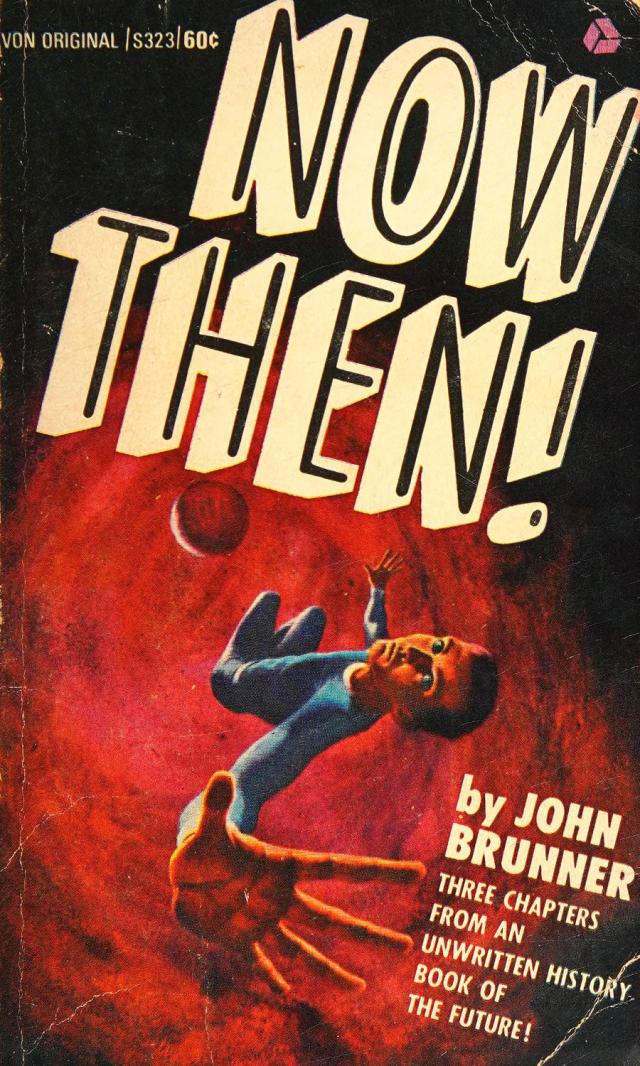
Cover illustration by Hector Garrido
avon trademark reg. u.s. pat. off. and
foreign countries, registered trademark -
marca registrada, hecho en chicago u.s.a.
Printed in the U.S.A.
CONTENTS
NOW
THEN
PREFACE
On one of the (regrettably rare) occasions when Arthur C. Clarke managed to tear himself away from the sunshine and sea of Ceylon and dropped in at the pub where the London Circle of science fiction writers and readers holds its informal meetings, we got around to the question of predictions in science fiction. After a lot of discussion we arrived at the conclusion that, were someone to make a serious attempt at forecasting the events of the year 2000—political, social, technological—he would have to spend at least two years simply gathering facts before putting a word on paper; then during the six months the book would take to write, things would happen to invalidate his careful prophecies.
In other words, a science fiction writer works with a typewriter, not a crystal ball.
This is one reason why I, like many other SF writers, feel that the middle lengths have been the best for much of my work—in the form of a novelette, or short novel, or what is sometimes conveniently referred to by the originally German term “novella.”
Were one to attempt the depth of characterization and emotional analysis which one expects in a contemporary novel, one would rapidly run up against the problem that by definition one is dealing with people who are not contemporary, whose background, attitudes and automatic assumptions are different from ours. (It’s done, of course, and rather more often than might be expected—but it’s always a tour de force.)
On the other hand, there are plenty of promising science fiction ideas which defy condensation within the limits of the short story. Between the two forms: the novella, which is almost a thing of the past in most other fields of fiction. (In SF we inherited it from the old pulp 9 magazines, whose editors were not above labeling a long short story as “a complete book-length novel” … but that’s another story, as you might say.)
I can’t think of any other field of fiction in which it’s customary for a new writer to work his way up the entire spectrum of story lengths, as a matter of fact. Commonly, there is a first novel, and that’s where it begins.
To publish a first novel in the SF field without having written several successful short stories and novelettes is a very rare occurrence. One begins with lengths of- three, four, ten thousand words, and the full-size novel waits, perhaps for years.
Consequently many SF writers reach the middle lengths at a time when they retain their individual freshness of approach but have already mastered the peculiar writing techniques which good SF demands. That’s another reason why so much science fiction of memorable quality is in novella form.
Having said that, I promptly have to torpedo my own thesis by explaining that Thou Good and Faithful, which is included in this collection, was my first-ever sale to a science fiction magazine—and the leading market in the entire field, at that I wrote the short stories preceding it, certainly. It was just that nobody was willing to buy them.
It’s one of the few stories whose genesis I recall with absolute clarity. It stemmed from a passing remark in a novel of Clifford Simak’s—a retired robot had run off to homestead a planet. And the rest followed in smooth succession.
Some Lapse of Time had a far more complicated beginning. I was thinking about extra-temporal perception; usually it’s taken for granted that the purpose one would put such a talent to would be that of foreseeing the future, but I started to wonder about investigation of the past. And blended that with things said during a conversation with Professor Linus Pauling, when we were talking about phenylketonuria and the effects of radiation on the human embryo. And blended that with items in the daily papers about new weapons tests and then with an adaptation done by a friend of mine of the Scholfield Report in which he showed that a nuclear attack on Britain would at once kill four-fifths of the population.
And there it was.
As to Imprint of Chaos: anyone who has read and enjoyed the novels of James Branch Cabell will recognize this as a piece of conscious pastiche. I had a hell of a lot of fun writing it. Some people say they had fun reading it. You too, I hope.
JKHB
SOME LAPSE OF TIME
I
It had to be a dream. Had to! Max Harrow moaned feebly to himself, saying it over and over again, knowing that to recognize he was dreaming had always in the past released him, permitted him to wake up.
But from this he could not break free. It was as though two realities were tearing at him from opposite directions, making him think of frenzied horses. With half his consciousness he remembered clearly going to bed, falling asleep; with the other and now stronger half, he was aware only of things remote from the familiar world.
This place … There were people here, a score of them perhaps, sensed rather than seen in murky gloom. There was a feeling of dank coldness mingled with a smell of stale sweat and a reek of smoke. There was a fire burning, and no chimney carried the smoke away. There were flickering lamps that cast a dim yellow light. The people were clothed in tattered furs, dirty, hungry and in despair. They were in a building patched together from a ruin; logs with the bark still on them had been laid across the stumps of broken brick walls, and the lamps occasionally showed how the smoke had blackened the white cut ends of the timber. Beyond, outside, one pictured snow and frost, and wind with an edge like a razor.
Of all the huddled people, there was one who knelt at the center, bright-eyed, skeletally thin, in clothing that seemed glazed with dirt. A child elsewhere in the place wailed with hunger, and then was too weak to go on crying. The kneeling man noticed nothing. His hands were cupped before him, and a little thing rested in his palms. Max Harrow could see it clearly, and his trained knowledge told him what it was: a bone from a human finger.
Abruptly, it was as though the kneeling man were staring straight into his face—glowering down on him from a few feets’ distance—and ordering: feel our pain, suffer as we are suffering. …
The hungry baby screamed again, and the scream blended into a shrilling noise, and someone seemed to be shaking Max Harrow and speaking angrily to him. He tried to cower away into unconsciousness, and came awake, sweat-damp, trembling.
“Maxi Max, wake up!”
Oh, God. A real voice belonging to the real world. The relief was terrifying. He threw his arms around the warm comfort of the body leaning over him, and murmured his wife’s name.
“Diana, I’ve had another nightmare—oh, I’m so glad you woke me!”
But she repulsed his attempt to draw her down to him. She pushed at him insistently.
“Max, there’s somebody at the door!”
“What?” Foolish, disoriented, he let his arms fall back beside his head on the pillow and opened his eyes and his mind to the world about him. The bedside light was on, shedding a peach-colored glow through its shade, and rain was drumming with wintry fingers on the outside of the house. The shrilling sound came again and continued longer than before, and he understood it to be the bell of the front door.
So that accounted for the way the child’s cry had changed, and maybe the fact that Diana was trying to wake him explained his sense of being ordered to do something, and the noise of rain and wind conveyed the impression he had had of hostile winter. These things he told himself, verbalizing them carefully.
But they didn’t explain the horrifying immediacy of the dream, or its aura of actuality.
“Max!” Diana’s face was drawn with tiredness under her tangled brown hair, and dark rings underlined her large brown eyes. He thought suddenly of the reasons for her look of weariness and anxiety, and pulled himself together. He got out of bed, fumbling with his toes for his slippers.
“Who the hell can it be, anyway?” he said, blinking in an attempt to focus the room. “What’s the time?”
“Half past one.”
‘The hell with them.” He stood up and shrugged his dressing-gown around him, and went shivering down the stairs.
At first he could hardly see beyond the frame of the door; it was very dark out there, and the rain came streaming off the trees. Then the shape against the background came clearer, and he recognized a policeman in a cape glistening with wet.
“Sorry to disturb you, sir,” he said in a bluff voice. “You’re a doctor, though, aren’t you?”
Max cursed under his breath. Not being in general practice he had no sign outside the house from which the constable could have learned his profession. He said shortly, “Yes. Why?”
“I heard a disturbance a few minutes ago and came in to see what it was. I found a man collapsed alongside your car.”
Of course. The car. There was a doctor sticker on the window which saved him parking problems near the hospital. Max sighed.
“A tramp, by the look of him,” the constable went on. “I think he’s seriously ill.”
A tramp … Max grunted and stood back from the door. “Let me get a coat and some proper shoes,” he said. “We’ll get him inside and call an ambulance.”
“Thank you, sir. But he’s only collapsed—I don’t think he’s injured. I can probably carry him indoors by myself if you’ll let me. If you can just call the ambulance, that’ll be enough.”
“Oh-” Max hesitated. Then he wiped his face. “If you’re sure you can manage …”
“Certainly, thank you, sir. He’s not much more than skin and bone.”
“All right.”
The constable turned away towards the car-port alongside the house, and Max went back into the hallway and picked up the phone. He dialed 999 and waited for the answer; when it came, he asked for an ambulance for his address.
He was just putting the phone down again when Diana came to the head of the stairs, dressing-gown clutched around her with one hand, to lean on the banister and call down anxiously.
“What is it, Max?”
“Policeman.” He pushed back his hair from his eyes. “A tramp collapsed in the car-port. You go back to bed, honey. I’ve rung for an ambulance—we’re just going to bring him inside till it gets here.”
She fastened the dressing-gown and began to come down the stairs. “It’s no good my staying in bed,” she said resignedly. “I’d just lie and worry about you. Max, isn’t there something that can be done about these dreams of yours?”
“I’ll—find out. I will.” He spoke the facile words with his mouth gone dry.
“Please, Max. Please really do it, not just talk about it.” She was at the foot of the stairs now, picking up an old coat of Max’s which he had left hanging over the banister, and moving to spread it on a couch in the lounge.
“This’ll do to put the tramp on,” she added as she pulled it straight.
“Here he is, sir.”
The policeman’s voice made Max swing around. He was in the doorway with the tramp over his shoulders in a fireman’s lift.
“Bring him in here, officer,” Max said. “I rang for the ambulance.” He stood aside from the door of the lounge.
As soon as the tramp had been laid down on the couch, Max made a quick examination. The constable had said the man was mostly skin and bone; it was no exaggeration. Seldom had Max seen anyone in such appalling physical condition. The tramp’s legs and arms were pipestem-thin and his hands were blue with cold. That was hardly surprising; he proved to be clad in nothing but the ancient and dirty raincoat and the cracked rubber boots which were his visible garments.
Odd. Max had always imagined tramps as wearing layer on layer of clothing, afraid to throw away any item before it reduced to shreds. He frowned.
While Diana sat dully in a chair across the room, and the constable hovered near the couch, he checked his first findings again. There was something else peculiar about the man besides his skimpy clothing.
“What’s wrong with him, sir?” the constable asked at length. “Starvation, is it?”
“I’m not sure yet.” Max palpated the bloated pumpkin of the tramp’s belly with careful fingers, then pushed back his lips, noting the poor condition of his teeth. Against the gums and in the gaps where teeth were missing there were scraps of food, some apparently fresh, but mostly decaying. His breath stank. His skin was slightly jaundiced, it seemed—though he was so dirty it was hard to tell what his natural color ought to be. His cheeks and jaw were covered with a stubbly beard; his hair was long and greasy, and patches of his scalp were bald.
Max drew a deep breath. With shaking hands, because million-to-one chances didn’t often enter his life, he thumbed back the tramp’s eyelids and stared at the motionless whites beneath. They were tinged with an unpleasant pus-green.
Under his breath he said, “But it can’t be …”
“What can’t be?” Diana asked dispiritedly. Max caught himself. It would be far better not to mention that the man was suffering from this of all conceivable diseases.
“Uh—nothing, honey. It looks like a rather rare complaint, that’s all. But I can’t be certain yet.”
There was the noise of a vehicle drawing up outside. Diana got to her feet.
“That’ll be the ambulance. I’ll let the men in.”
Max’s next surprise of the night was a more pleasant one; when the men came through the door with their stretcher, he recognized them as being from his own hospital. They exchanged wry greetings with him as they made to pick up the tramp.
Coming to a decision, Max turned to his writing-bureau.
“Who’s on duty tonight, Jones?” he asked the nearer of the new arrivals.
“Dr. Faulkner, sir,” the man answered over his shoulder.
Excellent. Max uncapped a pen and took a sheet of his personal notepaper. He wrote:
Dear Gordon—You’ll probably think I’m obsessed by what happened to Jimmy, but it looks to me very much as though this tramp who’s been sprung on me in the middle of the night is a case of the same thing. Look at the whites of his eyes, for instance. But if it’s true, it’s incredible! I’d have said an adult case of heterochylia was out of the question, yet this man must be in his thirties or forties—
Behind him he heard Jones say, “What’s that he’s got in his hand?”
“I don’t know,” his companion answered. “But he’s clinging like death to it—ah, there we are.”
Max glanced around. The ambulanceman, having pried the tramp’s fingers open, was triumphantly displaying what he had found. Max’s heart sank, and the world swam dizzily about him.
The object was unmistakable. It was a human finger-bone.
II
For the rest of the night Max had no sleep at all. Partly he was kept awake by fear of returning to the nightmare world he had visited earlier—and not then only, but several times in the past few weeks.
Since, in fact, what had happened to Jimmy.