Goliath, p.33
Goliath, page 33


When it got like this, he stopped being a person. Linc had seen it, gone through it, enough times to know that this was just how it went. Wanting things, wanting to deserve them, thinking and feeling in two different directions, all of that evaporated when it got like this and everything became inevitable. Every community disintegrated eventually. Every place was broken and whatever wasn’t lost forever in the breaking crawled out through the fault lines. He stopped being a person and became, instead, an instrument. A symbol. A shell to put things into or maybe a glove for someone else’s hand.
That’s what he told himself up on that hill with the light of the fire warming his face. It wasn’t him. It was fate or prophecy or whatever else it’s called when you remember that losing what you love is part of the game too. That’s what Linc told himself as he’d gone through that barn earlier and ripped open the floor heaters and set some of them on the hay for feeding the horses and set others up against the wood, exposed wiring dug into the frames, and it’s what he told himself when the first columns of smoke swam through the stalls.
It’s supposed to go like this.
That was the deal at the reporter’s place. That was the deal with Bugs. That was the deal with this too.
And whatever was gonna come after, whatever thing he was gonna do next, after he’d erased this place they’d built from the earth, that was part of the deal too.
It was supposed to go like this.
Linc wanted to tell the horses they were screaming at the wrong person.
A few blocks down from Saint Michael Church, where the cherry blossoms had begun to bloom and the last mounds of snow peed clear into the gutters and the wind’s crispness was blunted with the promise of summer, residents had turned the street into a makeshift memorial. On the spot where Bugs had lain, people had planted a pyramid of stuffed animals: silver sharks, striped tigers whose white underbellies had not yet been pimpled with bloodpennies from radiation, cards pinned in the crook of an elephant’s tusk, roses sprouting from every crevice in the small mountain. Blue and yellow ribbons whipped in the breeze. Orange traffic cones set off the memorial, and posted to a telephone pole was a sign that said “SLOW DOWN” in block letters. Radiation tag ran like tattoos on the concrete: R.I.P. BUGS; Angels Never Die; Stay Golden; Black Lives Matter, all in neon calligraphy. Someone had strapped teddy bears to another telephone pole, but with plastic hand-ties so that it looked like some of them were being cuffed.
Linc doubled back and stood before Saint Michael Church, stood there so long he had watched the shadows turn with the sun. He remembered the soot-sheathed, bloodstained hammer in his hand and marched forward. The windows were already gone, but if he could take the walls from the inside, maybe he could bring the whole thing down. He hoped those white boys who’d called the cops on him and Bugs would walk by. He hoped a whole gang of them would walk by. He hoped every white person who had descended from the Colony would walk by. They wouldn’t make it to the memorial.
Purpose drove him up the steps, and he hefted his hammer, prepared to swing at the nearest bench, when he noticed a familiar lump toward the front of the sanctuary. A hammer lay propped up against a pew by the altar. When Linc drew closer, he saw Bishop, utterly still, then, after a moment, turn and notice Linc. Even his wrinkles had wrinkles. The left corner of his mouth hung awkwardly.
And suddenly, everything hurt. He almost dropped his hammer, almost buried his soot-covered face into the dirty rug that ran from door to altar. But the hammer was driftwood for him to cling to. Still, everything hurt so much. Like he had just come up for air, not realizing he’d been in the process of drowning. And he tried to take a step forward, toward Bishop, but couldn’t.
The old man saw him and stared for a long time at his face covered in soot before struggling to his feet and limping heavily to him. The scuff and thump of a stiff leg sweeping and a stiff foot hitting wood was the only sound inside the church. It was the only sound in Linc’s ears. And Linc thought of what was gonna come after and he even thought he could hear Bishop tell him to take Sydney with him, because he knew that there was something between the two of them, and they would need each other. Linc thought he could hear Bishop say all that, even though Bishop hadn’t opened his mouth. He thought he could hear himself telling Bishop that she couldn’t make whatever journey was ahead of them, that she was burnt. Coughing blood into his hair, him pretending not to notice.
But Bishop got to Linc and just put his arms around Linc’s, and to be touched by another human being like this, to be held with tenderness and love and care and fierceness, it made Linc drop his hammer and lean too heavily on the other man so that Bishop had to slowly lower them both to the ground.
“I miss my mom,” was all Linc could bring himself to say.
“I miss my mom” was the last sentence Bishop would ever hear.
The mulberry tree was still there. And the forest growth framed the man’s tiny estate the same way it did when Timeica and Sydney first came down this stretch of highway and saw him. The man with the jug of lemonade under the mulberry tree. The highway, the greenery that flanked it, the erupted pavement where broken maglev lines poked through, all of it looked just like when she’d last seen it a lifetime ago, so maybe it was routine that had her taking the pistol out of the glove box, turning it over in her hand, then putting it on the empty, ratty passenger’s seat.
The man saw her coming, saw her tug her jacket tighter over her shoulders, saw the look on her face, and knew not to ask after her “lil’ friend.” Still, he got to his feet and gestured to the seat on the other side of his table.
“You said,” Timeica managed. “You said if I came back in the springtime and helped you with the burning, I could get a discount. On the blueberries.” She didn’t know how else to ask for what she wanted. But, after a beat of peering into her eyes, the man loosened and said, “Follow me,” and took the jug and his plastic cup indoors with him.
The humidity was below fifty percent, and there was barely any wind, which, the man said, was what today needed to be for them to do it all right. Also, it was late enough in the day that all the morning dew was gone. So the acres were bone-dry. There were suits and thick gloves waiting for them in a shed attached as an extension to the man’s house, along with masks. The man put a cowboy hat on his head for reasons Timeica couldn’t begin to guess at. She pulled a bandanna off the wall and used it to pull her hair back. Then they both put on masks.
The blueberry farmer strapped a five-gallon water sack onto Timeica’s back, then did his own. Armed with drip-torches, they worked in tandem, the farmer lighting the straw that winter had pressed into the ground and Timeica doing her best to then follow his lead and shepherd the flames inward a little over twenty feet to create a charred strip of circle around the fields. It took several hours for them to create the firebreak. Smoke rose from the rich, thick black duff layer of decomposed leaves and other organic matter once the straw was gone. Stone poked through, steaming as well. Soon, the smoke was high enough to dim the sun, so that the angry red of the sky was a little bit less mean.
When the farmer said, “All right,” they were both standing near the center of the circle. “I’ma set this for a more powerful burn.” He lifted his drip-torch. “I’ma light this area here, and soon as the flame gets high enough, we’re gonna make a break for that firebreak there, all right? It’ll keep the burn controlled. Keep the rest of this place from burning down. Get this place ready for some blueberries.” He was grinning. “Now, wait till I say ‘go’ before you start running, okay?”
She nodded. But something in her face musta told the farmer she was nervous, because he took her arm and gently pulled her close and brought his face near to hers.
“You’re gonna be all right,” he told her.
She believed him.
“Go.”
ACKNOWLEDGMENTS
Ultimately, whether or not a writer has been successful in achieving their aims is quite literally in the hands of the reader. Where I’ve come short, I have tried to, in the words of Elizabeth Bear, “fail brilliantly.” But I owe much of what may be judged the book’s successes to my editor, Ruoxi Chen, who has remained superhumanly clear-eyed through each of this book’s many incarnations. Additionally, this was the book that helped seal the bond, personal as well as professional, between me and my agent, Noah Ballard, whom I must also thank. It would take more than four hundred pages to properly express my gratitude to them both.
My thanks, as well, to Jamie Stafford-Hill, who designed the cover that, the moment I first saw it, struck me so powerfully with its rightness. The production staff at Tordotcom Publishing are tireless and heroic, as are the copyeditors who deftly navigated every brambled path and thorn’d trail I threw before them.
Though the events of the book are undated, they directly reference our present and recent past. In that respect, I drew heavily for the prison section in “Winter” from Heather Ann Thompson’s Blood in the Water: The Attica Prison Uprising of 1971 and Its Legacy as well as the Attica Central School District’s detailed online account of the uprising at the archived Attica Correctional Facility website. Dr. Thompson’s book pointed me in the direction of numerous other primary and secondary sources about the event. “The Attica Liberation Faction Manifesto of Demands” is available in Vol. 53, Issue 2 of Race & Class, published September 2011, and a portion of Bishop’s speech during the uprising is adapted from the recorded words of one Elliott James “L. D.” Barkley, a prisoner twenty-one years of age at the time of the uprising who was killed during the prison’s retaking. My first contact with the Attica uprising came during a screening in a law school clinic of a portion of a film depicting the uprising’s aftermath. Meeting Dr. Thompson at a book event three or so years later and hearing her describe the uprising as a civil rights moment seared that episode of American history into both my mind and my heart.
Also inspiring the monologue in “Winter” was The Guardian’s Cancer Town series of reported articles on environmental pollution in Reserve, Louisiana.
Tori Marlan’s January 1999 Chicago Reader piece titled “Brickyard Blues” provided the initial seeds for the short story that eventually grew to become this novel, and perceptive readers might be able to trace the genealogy of a few of the characters in Goliath to the Chicago residents about whom Marlan wrote so compassionately. To my knowledge, brick stacking has not been one of New Haven’s major industries, but much of the relationship between manual labor and race and class, the depiction of which resonated so loudly with me in that feature, seems, to me at least, to transcend geographic and temporal borders.
Virginia Eubanks and her work has informed much of how I’ve tried to imagine the digitization and mechanization of oppression in this story set mere decades from now. I cannot recommend highly enough her book, Automating Inequality: How High-Tech Tools Profile, Police, and Punish the Poor.
The Church of the Nativity described in the scene at the Assawoman Bay refugee camp is modeled in part on the Church of the Nativity in Bethlehem in the West Bank. Parts of the Assawoman Bay refugee camp bear intentional resemblance to the Aida refugee camp, also in Bethlehem. Both are places within which I was fortunate to have stood in person.
For a greater general understanding of urban planning, I consulted, among others, figures with diametrically opposed visions of cities, their function, and their futures. Robert Moses, as chronicled in Robert Caro’s The Power Broker, quite literally shaped New York City to fit his whims, treating neighborhoods and the urban projects that would destroy them less as something meant to serve the city’s residents and more as a sandbox for monuments to his supposed greatness. On the other end of the spectrum stands Jane Jacobs, urbanist and critical thinker behind The Death and Life of Great American Cities and whose smaller works, collected in Vital Little Plans, did more than anything else to reshape how I think about the metropole and all the different ways a city can be occupied. The work of Ruth Wilson Gilmore also pushed me to better see the ways in which environmental racism and the racialized carceral complex in the United States are braided together and how justice movements in both arenas are and should be intertwined. For a deeper awareness of the history of housing segregation in the United States, I would be remiss not to recommend Richard Rothstein’s The Color of Law: A Forgotten History of How Our Government Segregated America. I owe much of my education in housing insecurity, its myriad causes, and legion consequences to Matthew Desmond’s Evicted: Poverty and Profit in the American City.
The two lines of song Michael and Linc speak to each other in “Summer” come from the ScHoolboy Q song featuring A$AP Rocky, “Hands on the Wheel,” a song I fully expect to last through any impending climate-induced apocalypse.
My sincerest thanks to Jeannie Chan, Leigh Bardugo, and V. E. Schwab. Knowing you sustains me.
A hundred other thinkers and storytellers—among them, Arundhati Roy, Malcolm Lowry, Leslie Jamison, Jesmyn Ward, Mohsin Hamid, Roberto Bolaño, and Gene Wolfe—influenced the crafting of this book, and to them, I am indebted. As well as to you, Zack Fox.
ALSO BY TOCHI ONYEBUCHI
Beasts Made of Night
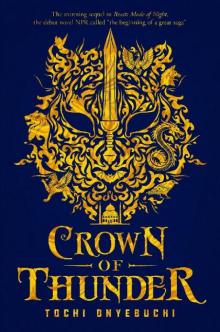
Crown of Thunder
War Girls
Rebel Sisters
Riot Baby
(S)kinfolk: Chimamanda Ngozi
Adichie’s AMERICANAH (nonfiction)
ABOUT THE AUTHOR
TOCHI ONYEBUCHI is the author of the young adult novel Beasts Made of Night, which won the Ilube Nommo Award for Best Speculative Fiction Novel by an African; its sequel, Crown of Thunder; and War Girls. His novella Riot Baby, a finalist for the Hugo, Nebula, Locus, Ignyte, and NAACP Image Awards, won the New England Book Award for Fiction and an Alex Award. He holds a B.A. from Yale, an M.F.A. in screenwriting from the Tisch School of the Arts, a master’s degree in economic law from Sciences Po, and a J.D. from Columbia Law School. His fiction has appeared in Panverse Three, Asimov’s Science Fiction, Obsidian, Omenana, Uncanny, and Lightspeed. His nonfiction has appeared on Tor.com and in Nowhere, the Oxford University Press blog, and the Harvard Journal of African American Policy, among other places.
Visit him online at tochionyebuchi.com, or sign up for email updates here.
Twitter: @TochiTrueStory
Thank you for buying this
Tom Doherty Associates ebook.
To receive special offers, bonus content,
and info on new releases and other great reads,
sign up for our newsletters.
Or visit us online at
us.macmillan.com/newslettersignup
For email updates on the author, click here.
CONTENTS
Title Page
Copyright Notice
Dedication
Part I: Summer
Part II: Fall
Part III: Winter
Part IV: Spring
Acknowledgments
Also by Tochi Onyebuchi
About the Author
Copyright
This is a work of fiction. All of the characters, organizations, and events portrayed in this novel are either products of the author’s imagination or are used fictitiously.
GOLIATH
Copyright © 2021 by Tochi Onyebuchi
All rights reserved.
Cover design by Jamie Stafford-Hill
Cover images: people, from top: Tinpixels / E+ / Getty Images; Monashee Frantz / OJO Images / Getty Images; Hinterhaus Productions / Digital Vision / Getty Images; bricks: Nick Peps / Alamy Stock Photo
Edited by Ruoxi Chen
A Tordotcom Book
Published by Tom Doherty Associates
120 Broadway
New York, NY 10271
www.tor.com
Tor® is a registered trademark of Macmillan Publishing Group, LLC.
Library of Congress Cataloging-in-Publication Data
Names: Onyebuchi, Tochi, author.
Title: Goliath / Tochi Onyebuchi.
Description: First edition. | New York: Tordotcom, 2022. | “A Tom Doherty Associates book.”
Identifiers: LCCN 2021039437 (print) | LCCN 2021039438 (ebook) | ISBN 9781250782953 (hardcover) | ISBN 9781250858399 (signed edition) | ISBN 9781250782960 (ebook)
Subjects: LCGFT: Novels.
Classification: LCC PS3615.N93 G65 2022 (print) | LCC PS3615.N93 (ebook) | DDC 813/.6—dc23
LC record available at https://lccn.loc.gov/2021039437
LC ebook record available at https://lccn.loc.gov/2021039438
ISBN 978-1-250-78295-3 (hardcover)
ISBN 978-1-250-78296-0 (ebook)
eISBN 9781250782960
Our ebooks may be purchased in bulk for promotional, educational, or business use. Please contact the Macmillan Corporate and Premium Sales Department at 1-800-221-7945, extension 5442, or by email at MacmillanSpecialMarkets@macmillan.com.
First Edition: 2022
Tochi Onyebuchi, Goliath