Killer, p.1
Killer, page 1


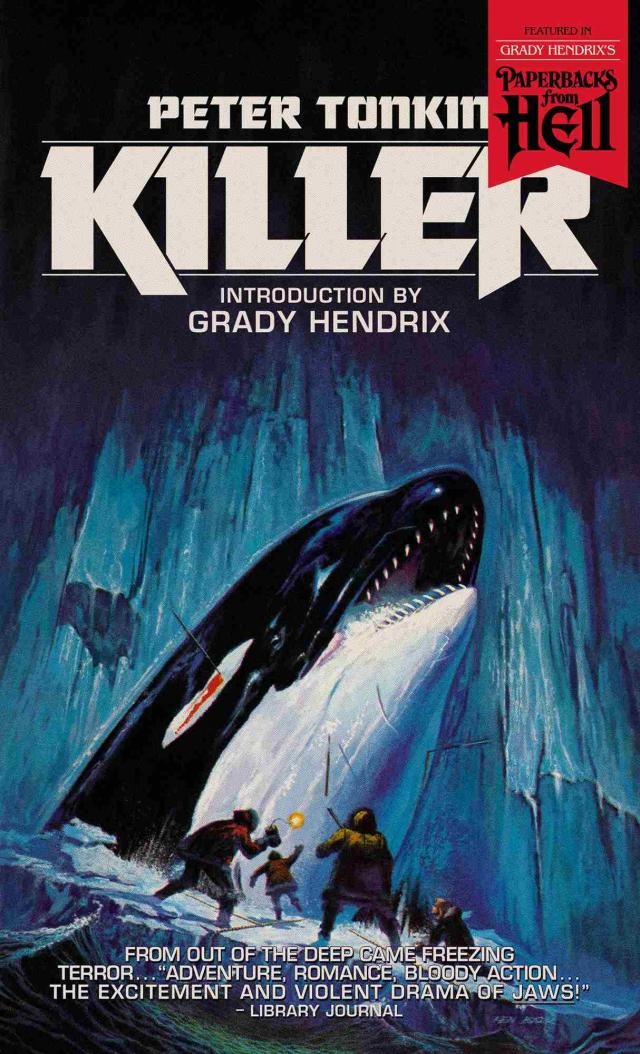
KILLER
Peter Tonkin
with a new introduction by
GRADY HENDRIX
VALANCOURT BOOKS
Killer by Peter Tonkin
First published in Great Britain by Hodder & Stoughton in 1979
First U.S. edition published by Coward, McCann & Geoghegan in 1979
First Valancourt Books edition published 2023
Copyright © 1979 by Peter Tonkin
Introduction copyright © 2023 by Grady Hendrix
“Paperbacks from Hell” logo designed by Timothy O’Donnell. © 2017 Quirk Books. Used under license. All rights reserved.
Cover art © by Ken Barr, reproduced by permission of SQP, Inc.
All rights reserved. In accordance with the U.S. Copyright Act of 1976, the copying, scanning, uploading, and/or electronic sharing of any part of this book without the permission of the publisher constitutes unlawful piracy and theft of the author’s intellectual property. If you would like to use material from the book (other than for review purposes), prior written permission must be obtained by contacting the publisher.
Published by Valancourt Books, Richmond, Virginia
http://www.valancourtbooks.com
Cover painting by Ken Barr
Cover restoration and design by M. S. Corley
INTRODUCTION
As in many of the greatest works of literature, nothing expresses the precariousness of man’s place in the universe more than an assault by 200 fear-maddened, stampeding walruses. Peter Tonkin’s Killer delivers that battle royale, plus arm-eating killer whales, rampaging polar bears, and dynamite-hurling marine biologists in a breathless blast. Killer may be many things, but it is most definitely not screwing around. It’s pulp, but it plays for keeps.
It’s also the only killer whale book on the market, unless you count Orca, Arthur Herzog’s 1977 novelization of Dino De Laurentiis’s motion picture of the same name, starring Richard Harris, Charlotte Rampling, and Bo Derek getting her leg bitten off. This means that Killer stands alone. But it’s not merely its singularity that distinguishes Tonkin’s book. A hurtling, out-of-control man-vs.-nature roller coaster, it starts with a plane crash in chapter one and refuses to ease up on the throttle until the last arm is eaten. Like Jaws, it’s a book that doesn’t have higher aspirations than delivering a rollicking rush of high adventure marine mayhem, but it delivers those goods so efficiently and effectively that it transcends its limitations and becomes pop art.
And it all started with Hubble Bubble the Salmon. When Peter Tonkin was six, his father was stationed at Royal Air Force Base Bruggen in Germany. One day, while heading to the playground, a boy ahead of Tonkin swung the glass-paned door shut too fast and Tonkin put out his hand to stop it from hitting him in the face. His arm went through the glass door, shredding his brachial artery. Then the door swung back in the other direction, shredding his arm again.
“By the time the ambulance arrived,” Tonkin remembers, “my hand had turned completely black and they thought they’d have to take it off. Then they thought they’d have to take my whole arm off.”
Tonkin was in the hospital for six panic-stricken weeks. Terrified his son would lose his arm, his father visited every day when he got off duty and sat by Tonkin’s bed, making up soothing stories about Hubble Bubble the Salmon. These stories served as an island of calm during a horrible ordeal. Tonkin’s arm was saved through some cutting-edge surgery that rerouted his arm’s blood flow (to this day he has no pulse in his right wrist), and the hospital stay, and his father’s stories about Hubble Bubble, sparked a life-long love affair with both storytelling and the sea.
Despite being an officer in the Royal Air Force, Tonkin’s father was an avid fisherman and sailor, as was his father, and Tonkin grew up on RAF bases all over the world, fishing and sailing whenever he could. His school years consisted of deep reading, rowing, and a love for amateur drama, and when he graduated he became a teacher in Peckham, even though he’d already written a novel in longhand. It told the tale of a young boy going off to a boarding school for wizards. His friends, however, thought the idea was daft – a boy wizard at a wizardy boarding school? Who would read such a thing? So Tonkin never submitted it to anyone.
Even as he kept teaching, however, he also kept writing after work and in the evenings. Next up: The Action. Inspired by John LeCarré, it told the tale of a ship slithering with spies from the CIA, the KGB, and MI6, all jockeying over custody of a defector from the Chinese secret service. Tonkin thought the structure was a little weak, but he liked the scenes on board the ship and in a lifeboat, and although it went unpublished, this manuscript landed him an agent.
When Peter Benchley’s Jaws came out, Tonkin inhaled it. “It still raises the hair on the back of my head,” he says. When Spielberg’s movie was released a year later, he and a friend went, and it raised the hair on the rest of his body. On the way out of the theater his friend asked if he could do better.
“Not better,” Tonkin said. “But I can do bigger.”
Tonkin’s math was simple: the great white shark in Jaws is 25 feet long, but killer whales are 40 feet long. They’re also highly intelligent, can communicate with each other, and work in pods to hunt their prey. The Natural History Museum let Tonkin climb inside one of their killer whale skulls to count its teeth. His father, a crash inspector for the RAF, helped make sure the opening plane crash met the bar for realism.
“I love research,” Tonkin says. “It’s a weakness in a writer. I spend far more time finding stuff out than getting stuff down.”
For a year, he came home from a full day’s teaching and banged out a first draft on an old manual typewriter (“I’ve never done a lot of drafts,” he says). If he had to write a scene he was worried about he’d write it longhand and type it up later, a terrific way of editing, he felt, because he’d just skip unnecessary sentences. “Sheer laziness is a very useful tool.”
His agent sold Killer to Hodder & Stoughton, who were very happy with its performance, and then his agent sold it in America, and made a paperback sale to Signet. It did well, and Tonkin would eventually use that Killer cash to buy a flat, as well as trade in his manual typewriter for a word processor that he never actually used. Now, with one hit book under his belt, Tonkin got to work on book number two. Which is where things went off the rails.
Catastrophe One was based on “catastrophe theory,” the study of small mathematical shifts that can lead to dramatic changes, such as landslides. Tonkin set his novel on a space station orbiting Earth that was armed with nuclear warheads and manned by a single astronaut. The book would revolve around attempts by Ground Control to get the astronaut to return command of the space station back to them. Tonkin had the plot, he had the characters, and he had the station designed in his head. He labored over a plot outline for months, but the book wouldn’t come together. Finally, after a year of hard slogging, he abandoned the manuscript.
“I knew giving up on it was a stupid thing to do,” he says. “But it is what it is.”
After Catastrophe One, Tonkin tried a vampire novel called The Journal of Edwin Underhill. He still had his British Museum readers’ card from working on his Master’s thesis in Shakespearean literature and he had a love for horror, and so he began a novel about a man who believes he’s going insane but is actually turning into a vampire. Stretching across centuries and clocking in at around 250,000 words, his editors insisted he edit it down to a slight 75,000 and they released it as The Dead. It came out just as the popularity of Anne Rice’s vampires peaked, and in the shadow of Lestat and Co., it withered.
Tonkin’s post-Killer life wasn’t all misery and bad luck. He met his future wife, got married, and the couple moved into the flat he’d bought with his Killer windfall. And, after The Dead, he spent about eighteen months assuming a new position at one of the Haberdasher Schools, taking on the English Department and organizing poetry competitions and dramatics, and even a school opera, with his students.
After he’d settled into this routine, Tonkin got back to writing. Some American expats hired him to come up with a plot outline for a novel about a mission to rescue American POWs still trapped in Vietnam, but nothing ever came of it. In fact, nothing caught fire until around 1983 when he heard about the Salem, a supertanker carrying 200,000 tons of crude oil that disappeared off the charts, secretly sold its oil to South Africa in violation of an international embargo, then got scuttled by the crew to cover up their crime. It resulted in a massive trial, and Tonkin started doing interviews, and then more research, and then he began to write. The book became The Coffin Ship (1990), and returning to the sea reinvigorated him – it spawned a series of 30 books in his Richard Mariner series, all of them seafaring thrillers. Today, he’s even turned his love of Elizabethan England into a series of detective novels about a sword master solving crimes in the 16th century.
So why are we returning to his first book, Killer, released all the way back in 1979? Well, as Tonkin himself says of its longevity, “It’s the gift that keeps on giving.” With its relentlessly murderous black-and-white mammal murdering a crew of marine biologists one by one, Killer is 100% horror, but it’s also an action novel and those aren’t easy to do. After all, hundreds of men’s adventure thrillers come out every year, clicking mechanically through their clockwork plots, sometimes selling a grand idea (What if an AI went mad?) or an exotic setting (It’s Die Hard on a crashing plane!) They get printed once, readers e njoy them, turn the final page, then promptly never think about them again. So why has Killer survived?
Character is key. As Tonkin says about what made Killer sail where The Action failed, “I’d been reading Alastair MacLean and I knew it’s actually the characters you’ve got to work on. The situation doesn’t function as effectively as it should if you don’t have people involved that you care about.”
Easy to say, difficult to execute. A book clocking in at Killer’s relatively lean 250 pages doesn’t have the time to deliver everyone’s backstory, to describe the color of everyone’s eyes, to move several characters through meaningful growth and change. You have to speak in a shorthand with a book like this, and Tonkin speaks it well. He bases his characters on resonant types (Colin, for instance, is based on Charlton Heston, large and forceful) and once he’s seeing them in his head he’s conveying them through his fingertips.
After fuel-efficient characters, you need a ticking clock, something inexorably tightening the screws, something that keeps the characters on their toes. Tonkin supplies several: the ever-shrinking ice floe, people’s slowly accumulating injuries, the creeping, strength-sapping cold, all of it slowly lowering the probability of survival with every turn of the page. Ticking clocks are valuable because they force more and more extreme decisions to be made by our characters.
Conventional wisdom says a story is only as good as its bad guy, and with the unnamed killer whale we have a great bad guy. Not only because he’s enormous, and hungry, has a rockin’ scar on his face, and hates arms – he’s a great bad guy because he doesn’t think he’s a bad guy. The book opens with the whale believing he’s doing something good, and when it earns him bullets instead of praise, he flees for the open sea, scared, hurt, and vulnerable. His murderous rage comes from a misunderstanding, not a conscious act of evil, making him totally menacing but completely understandable.
Well-sketched characters forced to make choices by a ticking clock, beset by a bad guy with sympathetic motives who’s murdering them one by one – sure it’s a formula, but executing a formula well is harder than it looks. If it was easy, everyone would do it.
1979 saw several big important books dominate the bestseller list, like Hanta Yo and The Establishment, both grand, sweeping American sagas. It saw Richard Bach plumb the depths of the human soul in There’s No Such Place As Far Away. Even Peter Benchley scored another hit with The Island. But no one much remembers those books today. Instead, we’re celebrating Killer. Maybe because we instinctively crave stories that thrill us with primal human dramas: the tale of the hunt, the saga of sheer survival. Maybe that’s what brought us out of the dark, all those millennia ago, gathering around the fire, waiting to be told another of these tales that thrill us and horrify us in equal measure. It doesn’t matter what year it’s from or whether it’s about a killer whale, a killer shark, a cannibalistic serial killer, or a killer number one fan. We recognize a true storyteller the second we read them, and we put ourselves in their hands, and we keep asking that age-old question: what happens next?
Grady Hendrix
Grady Hendrix is the New York Times-bestselling author of How to Sell a Haunted House, The Final Girl Support Group, The Southern Book Club’s Guide to Slaying Vampires, My Best Friend’s Exorcism, and many more. His history of the horror paperback boom of the ’70s and ’80s, Paperbacks from Hell, won the Stoker Award, and his latest nonfiction book, These Fists Break Bricks, is a heavily illustrated history of the kung fu boom in America during the ’70s and ’80s. You can learn more useless facts about him at www.gradyhendrix.com
For
all the family and friends,
without whom . . .
especially for my parents,
Simon, Michael and Carolyn
Jill, Joy and Richard
and all the staff and girls
of Collingwood school
with thanks.
THE LURE OF THE DOLPHIN, FIRST BROADCAST ON BRITISH T.V. 1975
Showed film of experiments performed by the U.S. Navy concerning the training of dolphins, narwhals and killer-whales in techniques of underwater recovery.
Various authorities on the behaviour and training of these creatures revealed they were also being trained in antipersonnel work, and being taught to kill divers.
DAILY MAIL, NOVEMBER 1977
[Wild dolphins have been] trained by the U.S. Navy to patrol Vietnam’s ports against enemy frogmen despatching them with bayonets strapped to their blunt noses.
DAILY EXPRESS, DECEMBER 1, 1977
Squads of dolphins trained to kill enemy divers with gas guns, have already been used to defend American naval bases.
TESTIMONY TO THE SENATE COMMITTEE ON INTELLIGENCE ACTIVITIES, NOVEMBER, 1977
(i) James Fitzgerald, former Chief of the Office of Dolphin Research, Central Intelligence Agency:
“With their built-in sonar the dolphins detected enemy demolition divers on sabotage missions. They impaled them with hypodermic needles connected to carbon-dioxide cartridges. The frogmen just blew up and exploded.”
(ii) Spokesman for the Office of Naval Research:
“Some sixty North Vietnamese frogmen were nullified by our dolphins.”
(iii) James Mullen, ex-trainer:
“One weakness of the dolphin is its strong love for humans. So when they kill, they are killing for those they have learned to love.”
PRELUDE
Everything in the AIM Facility in Oregon shone with the same deep shine, from the back of the killer whale to the boots of the sentry who checked Admiral Hope’s pass. Commander Harper had returned like a whirlwind from his grilling at the Pentagon, and the scientists and enlisted men had listened, totally bemused, to the endless stream of orders which had come from their usually preoccupied and easy-going CO. He needed more money. And if he was to get it he must impress the Navy. And if he was to impress the Navy then he must first impress Admiral Hope. And Admiral Hope had given fair warning that he wasn’t a man to be easily impressed.
For the first time in two years the sergeant’s bellow had echoed above the regular thump of marching feet over the placid waters of the anchorage. Teams of men had repainted the old hulks down to water-line, had gone through the laboratories disturbing dust and notes with equal ferocity, cleaning computers, shining video equipment. Professors seconded from half a dozen universities began saluting everything that moved. White lines appeared on the ground, stars and stripes in the air – after the flagpole had been repainted. For thirteen days there was bedlam; and on the fourteenth, absolute quiet.
“Well,” said Admiral Hope, as Harper escorted him up the white steps to the main Administration Building, “you run a tight ship, Commander, I’ll say that for you.”
The sentry at the door crashed to attention. The commander’s hand rose fractionally ahead of the admiral’s to return the rigid salute.
The Alternative Intelligences Marine Facility was centred on the bay of the anchorage. The long arms of land almost met a thousand yards out from the mainland, and, as they swept back from the sea, they gained stature until they met in a cliff almost two hundred feet high looking out over the Pacific. The back wall of the main Administration Building extended this cliff by another fifty feet, before sloping into a red roof. On either side of the Administration Building were the laboratories. In front of the Administration Building was the parade ground, with the sleeping quarters, the recreation hall, the Facility’s gymnasium, cinema and shops arranged around it. It was not a big base, but in the mid-morning sunshine it looked functional and impressive.