Ill say she does, p.1
I'll Say She Does, page 1
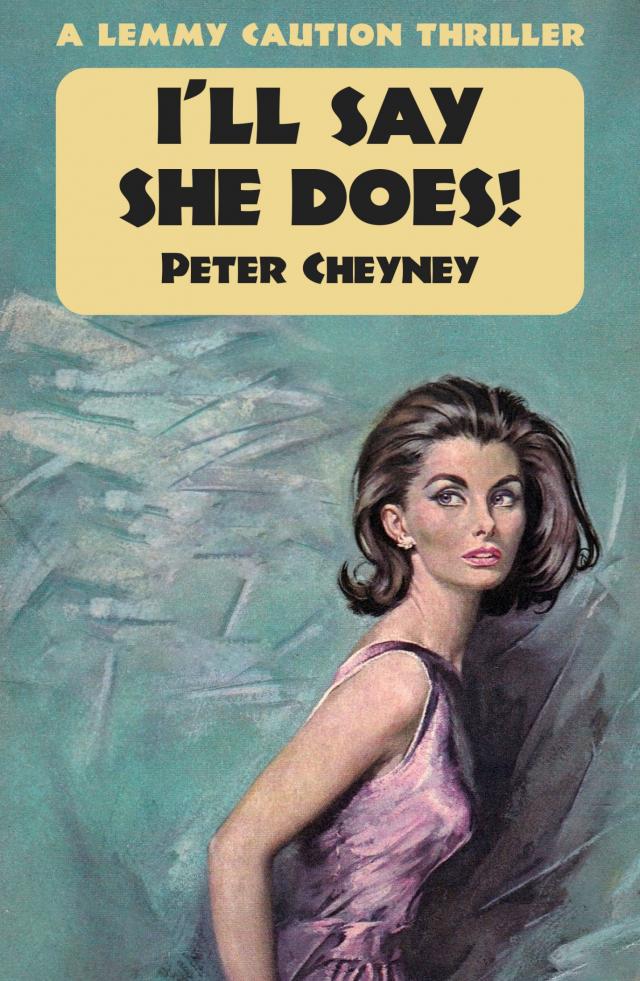


Peter Cheyney
I’ll Say She Does!
I’ll Say She Does! is the result of a promise I made to two brave officers in the Australian Forces. Lieut.-Commander Al Palmer, D.S.C., and Major Brooke Moore. I told them I would do a Lemmy Caution novel especially for them and prisoners of war. This is it.
In his tenth and final adventure, set just after the end of the Second World War, Lemmy Caution is in Paris investigating the theft of secret State Department documents. In the opinion of his chief, however, Lemmy has fallen down on the assignment given to him – to trail two suspected enemy agents, one a Frenchwoman and one an American – and he is ordered to bring them in.
The trail leads from Paris to England, and a thrilling conclusion in the Surrey countryside.
I’ll Say She Does! was originally published in 1946.
‘Peter Cheyney is the Damon Runyon of crime’ The Times
Contents
Cover
Title Page/About the Book
Contents
Chapter One
Chapter Two
Chapter Three
Chapter Four
Chapter Five
Chapter Six
Chapter Seven
Chapter Eight
About the Author
Titles by Peter Cheyney
Copyright
AUTHOR’S NOTE
The time has come when I must say a few words about Mr. Lemuel H. Caution and this book.
I’ll Say She Does is the result of a promise I made to two brave officers in the Australian Forces. Lieut.-Commander Al Palmer, D.S.C., and Major Brooke Moore. I told them I would do a Lemmy Caution novel especially for them and prisoners of war. This is it.
In 1944 my wife was one of the St. John Welfare Officers who went to Sweden to repatriate British Prisoners of War on the Drottningholm—called by the Repatriates the “Trotting Home.” On the voyage home it was discovered that she was Mrs. Peter Cheyney and Palmer and Brooke asked her to bring back to me a letter, written by them on behalf of the people on board. Many of these men had been in prison camps for years.
I have always been rather pleased with inventing Lemmy Caution who has, during the last ten years, found his way into a large slice of the world and acquired a popularity with many people; but I can say without undue sentimentality that the proudest moment in my life as a writer was when I read this letter.
They said that during their years of captivity the Caution books had brought them entertainment and laughter—at times and under circumstances when laughter was not particularly easy. They told me stories of Lemmy Caution in the Stalags—one, of the padre who, walking about the camp with his nose in a large book of Devotions, was discovered, eventually, to have Dames Don’t Care inside the covers.
The letter ended “. . . and thanks for what you’ve done for us.”
Afterwards, when I met Skipper and Brookie and we had the historic “four-fingers” together, I heard the rest of it and said that, as soon as possible, I would do a Lemmy Caution book for all Prisoners of War and especially the Drottningholm people in whom I had a particular personal interest.
Brookie is back in Australia but this book will find him there. I don’t know where one-armed Skipper is at the moment but he’ll get it sometime.
I am very proud of being thanked by prisoners of war for what I have “done for them.” May I, on behalf of Lemmy Caution and all his readers, thank them for what they have done—and suffered—for us.
Chapter One
AND HOW!
Life can be goddam wonderful. And how! It can be so beautiful that every time somethin’ swell happens you don’t believe it. Some guys call this cynicism an’ other bozos describe it as wishful thinkin’ like the guy who made himself up like Santa Claus so’s he could put a ladder in some babe’s stockin’ at Christmas.
Me—I am feelin’ so depressed that I would cut my throat, only then I would not have anythin’ to worry about—except my throat. An’ the reason for all this depression which is now settlin’ over this piece of Paris in the month of March 1945 can be summed up in one word . . . dames! Even if I was Aladdin an’ rubbed the lamp like hell, I reckon the genii would not produce anythin’ I wanted unless I handed in the coupons first.
So now you know.
The guy who called this alleyway the Place des Roses has got a sense of humour, because believe it or not it smells plenty. It looks as if everybody round this place had been throwing away everything they didn’t want an’ leavin’ it there. Or maybe it’s because the Germans ain’t been outa Paris for very long. I wouldn’t know.
Me—I am feelin’ a little high because the guy who told me that Dubonnet mixed with rye was a good drink certainly knew his vegetables. But my head is not so good an’ I am also mixed up a little bit about the babe I had dinner with. I reckon I am gonna call this babe V. 2 because she is so goddam unexpected.
The place is dark, but at the end I can see a crack of light comin’ outa the first floor window. I reckon this is the house all right. Fours told me in the old days when the Gestapo boys was runnin’ the job around here that he an’ the English Secret Service guys usta meet up there. So the place has sorta got atmosphere if you get me. An’ if you don’t what do I care?
When I get to this dump I see an iron bell-pull hangin’ down one side of the door. I give it a jerk an’ stand there waitin’, a cigarette hangin’ outa the corner of my mouth, wonderin’ about that dame—the one I had dinner with. Maybe I’ve told you guys before that three-quarters of the trouble in life is through dames an’ the other quarter is just financial an’ don’t matter. Anythin’ that don’t happen through a dame you can stick in your eye. It wouldn’t worry anybody.
A minute or two goes by an’ the door opens. There is a little light in the hallway, an’ standin’ lookin’ at me is a tall thin bronzed guy. He has got a humorous sorta face an’ nice grey eyes. I like this boyo.
He says: “Would you be Lemmy Caution?”
I say: “Yeah, that’s what my mother said.”
“I’m Jimmy Cleeve,” he says. “I’m a private dick from New York. Maybe they told you about me?”
I say: “Yeah, I heard about you. How’ya, Jimmy?”
He says: “Not so bad. I find life in Paris these days after the German occupation a little bit enervatin’. I don’t know whether it’s the liquor or the babies. As I don’t go for dames in a big way it must be the liquor. Come on up.”
I go into the hallway. In front of me is a windin’ flight of stairs an’ on the right of the hallway is a door lookin’ inta a side room. Everything about this place is goddam dusty except the brass door handle on the inside door. I follow on up the stairs after Cleeve. Halfway up he says to me over his shoulder:
“There’s a pal of yours here. He’s lookin’ forward to seein’ you.”
I say: “Yeah? Who is that?”
He says: “A boyo named Dombie. I reckon he’s worked with you before.”
I say: “Yeah, I like him. He’s a nice fella. He talks too much, that’s all. An’ he’s got a leery eye for dames. But he’s a nice guy. Has anybody got anythin’ to eat up there?”
He opens the door at the top of the stairs. He says: “Yeah. Dombie’s got a bottle.”
We go in.
The room is not bad. There are a coupla chairs an’ a truckle bed, an’ at one end is something that looks as if it used to be a bar sometime. There is a bottle that looks like whisky called Veritable Cognac written on the label, which makes me a bit suspicious, a few glasses an’ some water.
I say: “Hello, Dombie. How’s it goin’? I ain’t seen you for two years. You remember that job we did in London?”
He says: “Yeah—I remember, you dirty so-an’-so, you hooked a lovely dame off me. How could I forget?”
I say: “Listen, I never hooked a dame off anybody. She gave up of her own free will—that one. But I can understand you bein’ annoyed about it.”
He says: “Feller, I should worry about dames. The trouble is keepin’ away from ’em. I got something; every dame in Paris sorta knows it. At least that’s the idea I get.”
I say: “You got somethin’! Say, Jimmy, do you hear that one? Listen to this big lug. He’s got something. He’s got allure.”
Cleeve says: “Yeah—that an’ a gumboil!”
Dombie says: “O.K. O.K. You guys are just gettin’ jealous. Jimmy here, is needled to me because of the baby I got. You wait till you see her. She’s terrific. She goes for me like hell. She even thinks I’m good.”
I say: “Yeah. She must be marvellous.”
“Sure she’s marvellous,” says Dombie. “I tell you that baby’s intellectual. She’s got a sixth sense.”
I say: “You’re tellin’ me. She’s gotta have because she ain’t got the other five if she’s stuck on you.”
Cleeve says: “Wait a minute, you two. Ain’t there a little business goin’ around here?”
I say: “Yeah? What’s the business?” I have got a good idea why the hell this guy Cleeve, who as I have told you is a nice lookin’ guy, an’ a good private dick, is kickin’ around with the “G” office in Paris. It looks like something’s broke.
Dombie takes a swig at the bottle; then he corks it, throws it across to me, an’ a glass after it. I give myself a shot.
Dombie says: “Listen, Lemmy, you’re a guy who has gotta reputation for keepin’ his nose clean, but it looks as if you’re in bad with the big boy.”
I say: “No? Don’t tell me you’re gonna spo il my night’s sleep. What have I done now?”
Dombie goes on: “I reckon it’s a matter of janes again. That last job you did—there was a sorta leakage or something. Somebody wised up the boss that you were gettin’ around a bit with a hot dame—Marceline—you know, the one they knocked off. He’s got the idea in his head that maybe you shot your mouth a little bit.”
I say: “Well, he’s a goddam liar. I can get around with any dame without shootin’ my mouth.”
Dombie says: “Yeah. Well, I hope you’re gonna persuade him about that, because he’s got an idea that somebody did a little talkin’ outa turn an’ that somebody was you.”
I say: “You don’t say?” I give myself another drink.
The guy Cleeve says: “Take is easy, Lemmy. Look, I’m just sorta musclin’ in on this business, see? But I’ve been dragged over here from New York because the chief reckoned I knew something. So he took me away from the agency an’ got me over here. He asked me plenty an’ I had to tell him what I knew.”
I say: “That’s all right by me, but I’d like to know who gave him the big idea that I’d been shooting my mouth to a dame.”
Dombie shrugs his shoulders. Nobody says anythin’ for a minute; then Cleeve says: “But I can tell you that one. She did. The Marceline baby told him that.”
I don’t say anythin’, but it’s like I’ve been kicked in the face by a mule. I say: “Listen, do you mean that?”
He says: “Yeah, Lemmy. I mean it all right. It don’t rate a lot because when they pulled her in for questioning they reckon she’s liable to say anythin’ that she thinks is gonna help her. Maybe she thought if she stuck a medal like that on you she’d make it easier for herself.” He yawns. “I reckon this Marceline had one helluva imagination,” he says, “but the thing is to get the chief to think that. There is also another thing. You remember that guy who was working with you on that?”
I say: “You mean the guy Ribban—a Federal guy—the man from Connecticut. Well, he is a good guy an’ he knows all about it.”
Cleeve says: “That’s what I thought. I thought you might like to have a talk to him before you saw the chief. I sorta fixed it.”
I say: “I think that is pretty swell of you, Jimmy. When do I see the big boy?”
Dombie comes up for air. He says: “I reckon he wants to see you around ten o’clock to-night. He’s burned up about this thing, Lemmy, because there’s some more strings on it. You know there’s a lot of stuff getting round. He says there are leakages everywhere—Paris, London, and everywhere else. Goddam it, they even say that somebody gave the Arnhem show away; that the Jerries knew when the British paratroops were gonna drop an’ where.”
I say: “Yeah! Maybe the chief thinks I told ’em that too.”
“Aw shucks!” says Dombie, “with your record. Take it easy, Lemmy. I reckon he thinks you did a little too much talkin’ to this dame. Well, why not? You thought she was on the up and up. How the hell were you to know she was workin’ for the other side?”
I say: “That makes no difference so far as I’m concerned. I never talk to blondes anyway.”
Dombie says: “I wish I could say the same thing. I don’t talk to ’em about anythin’ serious, but what I do talk to ’em about seems to get me inta plenty trouble.”
I take another swig outa the bottle. I say to Cleeve: “O.K. So I see the boss at ten. Maybe it’s a good idea if I have a talk with Ribban first. You said you fixed something up?”
He says: “Yeah. There’s a little dump he goes to—a little bar place just off the Place Pigalle—Leon’s place. He said he’d be around there at nine o’clock. It’s a quarter short of that now. Maybe you just got time to get around there an’ have one with him an’ hear what he’s gotta say before you see the old man.”
I say: “O.K. I’ll get movin’. Well, I’ll be seein’ you.”
Dombie says: “Yeah. Soon I hope, Lemmy.”
Cleeve says: “I’ll be seein’ you to-night, Lemmy. I think the old boy has got something on the ice for us.”
I get up an’ go down the stairs and out into the Place des Roses. I start walkin’ towards the Place Pigalle.
I think: What the hell!
I stall around for a bit. An’ why not? Me . . . I am not in any great hurry to contact up with this Ribban guy an’ I am certainly not dyin’ on my feet to get around to this interview with the big boy. I reckon that little meetin’ is goin’ to be so goddam interestin’ when it comes off that you’d be surprised. So the longer I stall seein’ Ribban the longer I stall the showdown. Anyhow, Ribban has gotta wait till I show up.
I walk around lookin’ at the sights and comparin’ Paris in this year of grace—or disgrace—whichever way you like to play it—with Paris in 1926 an’ Paris in 1939. I was there on cases both years an’ it was “good goin’” then. Maybe I liked it better in 1939.
I get around to thinkin’ about this babe Marceline. A clever babe that one. A little cute jane who knows how to mix the poison good an’ plenty. I would give a coupla months’ pay to know what that cutey told the chief about me an’ just how much of it was straight stuff. Maybe I did do a spot of talkin’ when I oughta have kept my trap shut. But whether what I said meant a goddam or not is somethin’ I do not wish to talk about right at this moment. No, sir. . . .
You gotta realise that it is not all roseleaves an’ bourbon working for the “G” service with the Army in Paris. I’m tellin’ you. In the good old days in New York when I was a top guy in the Federal Bureau an’ in line for bein’ made a Field Agent, things was pretty good. Maybe I didn’t know when I was well off. Now when a bunch of us mugs is workin’ with the Army Intelligence an’ Secret Services over here, everybody is rushin’ around in circles, playin’ it off the cuff an’ gettin’ so goddam busy that they’re fairly trippin’ over each other.
But I wish to heck I knew just how much that babe Marceline had shot her mouth. . . .
My old mother who was great for knowin’ about dames—an’ why not she was one herself—usta tell me that nobody was gonna get anywhere in the “G” business if he was playin’ around with frails all the time. Well, maybe she was right an’ maybe she wasn’t but right now I’m wonderin’ if I didn’t maybe overreach myself a bit over this Marceline. It looks like the kid was cuter than I thought.
Down the end of the little street I am passin’ I can see a light. I go down there. It is a dump called Wilkie’s. It is one of them places. A bar, some dames, an’ a certain amount of bottles stuck around the place. The liquor is so goddam expensive that it takes a guy about four million francs to get a bit high, an’ if you drink the cheap stuff you sorta pause when you put the glass down an’ wonder if you are merely gettin’ a kick or whether you have been hit in the navel with one of Mister Hitler’s V 2’s.
I lean up against the bar an’ make a sign to Wilkie that I need brandy—an’ outa the right bottle too. I drink two slugs, a chaser an’ then take a look around the bar. I take a look an’ I realise that the guy who wrote that number My Heart Stood Still musta been thinkin’ of yours very sincerely Mr. Lemuel H. Caution—Special Agent of the Federal Bureau of Investigation now attached General Headquarters Intelligence an’ Secret Service U.S. Army, Paris, an’ if there is anythin’ to come back on the empty bottles we shall be pleased to hear from you.
The reason for this shock to my system is that sittin’ at the end of the bar an’ lookin’ just as if she had jumped out of a fashion plate book is my old friend Juanella Rillwater, who is the wife of a guy called Larvey Rillwater who rates as bein’ about the best safe-blower in the United States, an’ who has been chased all his life by every type of copper that there is in the world, most of whom have just been wastin’ their time because there are no flies on Mr. Rillwater. Except once when there were plenty.
Right now I’m tellin’ you guys that the sight of this babe takes my breath away for two reasons. The first one bein’ the way she looks an’ the second one bein’ somethin’ that I will wise you up to in a coupla minutes.
She is a sweet parcel is Juanella. On the tall side with curves just where they oughta be, an’ everythin’ pointin’ in the right direction. She has got auburn hair that looks as if it had just been done by the world’s champion hair fixer an’ green eyes. Her figure is what they would call willowy—if anybody ever taught ’em the word—an’ she has plenty of that stuff that is worth more than pearls an’ platinum to an ambitious dame—the stuff called allure. When they was issuin’ out sex appeal I reckon Juanella took a shoppin’ bag, winked an’ drew double.