

Realms of wizardry, p.1
Realms of Wizardry, page 1


11-09-2023
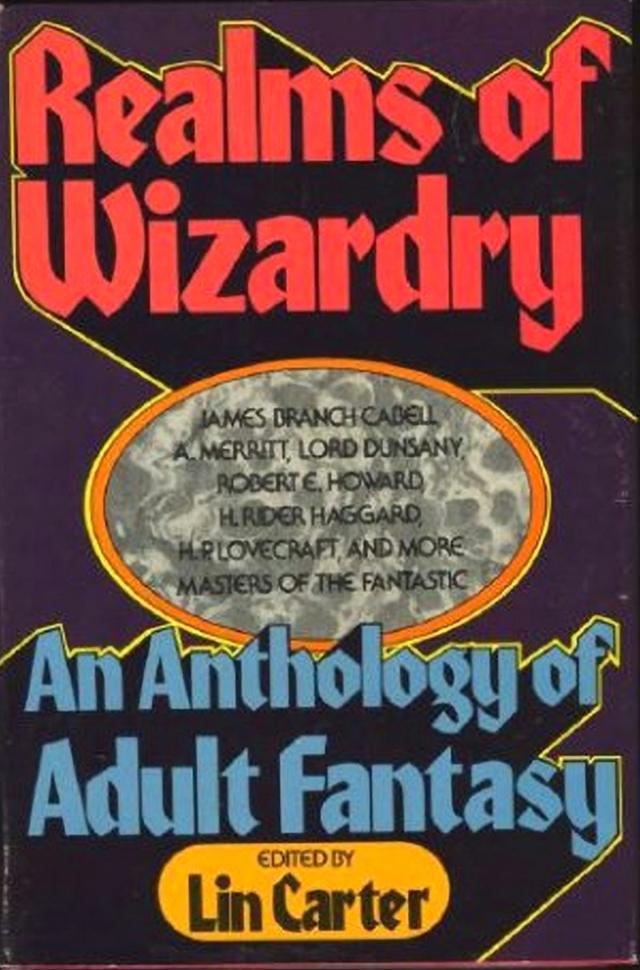
Here is the eagerly awaited companion volume to Lin Carter’s previous anthology of adult fantasy, Kingdoms of Sorcery.
Some of the sixteen stories are well-known, vintage pieces; some are rarities that have not been reprinted in any form since their original publication, but which nevertheless stand as stunning examples of the genre.
Among the writers included are Lord Dunsany, perhaps the most influential single writer in the history of modern fantasy, who harked back to the roots of old romances for his stories; Richard Garnett and James Branch Cabell, who thrilled readers with their satirical fantasies; H. Rider Haggard, who introduced the fantasies of “lost race” romance; Robert E. Howard who combined the adventure story with fantasy to produce heroic swashbuckling at its best; and Michael Moorcock, the dean of British fantasy writers, who continues to probe new realms of the fantastic.
Each story is introduced with the wonderful ruminations of Lin Carter and biographical sketches of each author. Included too is an extensive bibliography of further readings to lead readers yet deeper into…the realms of wizardry.
Realms of Wizardry
OTHER BOOKS BY LIN CARTER
AS THE GREEN STAR RISES
AT THE EDGE OF THE WORLD (Editor)
THE BARBARIAN OF WORLD’S END
BEYOND THE FIELDS WE KNOW (Editor)
BEYOND THE GATES OF DREAM
BLACK LEGION OF CALLISTO
THE BLACK STAR
BY THE LIGHT OF THE GREEN STAR
CONAN(with Robert E. Howard and L. Sprague de Camp)
CONAN OF CIMMERIA(with Robert E. Howard and L. Sprague de Camp)
CONAN OF THE ISLES (with L. Sprague de Camp)
CONAN THE BUCCANEER (with L. Sprague de Camp)
CONAN THE WANDERER (with Robert E. Howard and L. Sprague de Camp)
DESTINATION SATURN(with David Grinnell)
DISCOVERIES IN FANTASY (Editor)
THE DOOM THAT CAME TO SARNATH (Editor)
DRAGONS, ELVES, AND HEROES (Editor)
THE DREAM-QUEST OF UNKNOWN KADATH (Editor)
DREAMS FROM R’LYEH
THE ENCHANTRESS OF WORLD’S END
EVENOR (Editor)
FLAME OF IRIDAR
FLASHING SWORDS! #1 (Editor)
FLASHING SWORDS! #2 (Editor)
FLASHING SWORDS! #3 (Editor)
FLASHING SWORDS! #4 (Editor)
GALLEON OF DREAMS
THE GIANT OF WORLD’S END
GOLDEN CITIES, FAR (Editor)
GREAT SHORT NOVELS OF ADULT FANTASY #1 (Editor)
GREAT SHORT NOVELS OF ADULT FANTSY #2 (Editor)
HYPERBOREA (Editor)
IMAGINARY WORLDS
IN THE GREEN STAR’S GLOW
INVISIBLE DEATH
JANDAR OF CALLISTO
JUNGLE MAID OF CALLISTO
KINGDOMS OF SORCERY (Editor)
KING KULL (with Robert E. Howard)
LANKAR OF CALLISTO
A LETTER TO JUDITH
LOST WORLD OF TIME
LOVECRAFT: A Look Behind “The Cthulhu Mythos”
MAD EMPRESS OF CALLISTO
THE MAGIC OF ATLANTIS (Editor)
THE MAN WHO LOVED MARS
THE MAN WITHOUT A PLANET
MIND WIZARDS OF CALLISTO
THE NEMESIS OF EVIL
NEW WORLDS FOR OLD (Editor)
OUTWORLDER
OVER THE HILLS AND FAR AWAY (Editor)
POSEIDONIS (Editor)
THE PURLOINED PLANET
THE QUEST OF KADJI
REALMS OF WIZARDRY (Editor)
ROYAL ARMIES OF THE HYBORIAN AGE (with Scott Bizar)
SANDALWOOD AND JADE
SKY PIRATES OF CALLISTO
THE SPAWN OF CTHULHU (Editor)
THE STAR MAGICIANS
STAR ROGUE
THE STONE FROM MNAR
THIEF OF THOTH
THONGOR AND THE WIZARD OF LEMURIA
THONGOR AND THE DRAGON CITY
THONGOR AGAINST THE GODS
THONGOR IN THE CITY OF MAGICIANS
THONGOR AT THE END OF TIME
THONGOR FIGHTS THE PIRATES OF TARAKUS
TIME WAR
TOLKIEN: A Look Behind “The Lord of the Rings”
TOWER AT THE EDGE OF TIME
TOWER OF THE MEDUSA
UNDER THE GREEN STAR
THE VALLEY WHERE TIME STOOD STILL
THE VOLCANO OGRE
THE WARRIOR OF WORLD’S END
WHEN THE GREEN STAR CALLS
XICCARPH (Editor)
THE YEAR’S BEST FANTASY STORIES: 1 (Editor)
THE year’s BEST FANTASY STORIES: 2 (Editor)
THE YOUNG MAGICIANS (Editor)
ZOTHIQUE (Editor)
Realms of
Wizardry
Edited by
LIN CARTER
DOUBLEDAY & COMPANY, INC.
GARDEN CITY, NEW YORK
1976
All of the characters in the book are fictitious, and any resemblance to actual persons, living or dead, is purely coincidental.
ISBN: 0-385-11393-5
Library of Congress Catalog Card Number 76-2671
Copyright © 1976 by Lin Carter
All Rights Reserved
Printed in the United States of America
First Edition
ACKNOWLEDGMENTS
“The Hoard of the Gibbelins” by Lord Dunsany first appeared in The Book of Wonder (London: Heinemann, 1912). It appears here by arrangement with the Estate of Lord Dunsany.
“The Doom that Came to Sarnath” by H. P. Lovecraft first appeared in Marvel Tales, the issue for March/April, 1935; a revised version was printed in Weird Tales, the issue dated June, 1938; copyright 1938 by Popular Fiction Publishing Company. It appears here by permission of Arkham House.
“Black Lotus” by Robert Bloch first appeared in Unusual Stories, Vol. I, No. 2, 1935. It appears here by arrangement with Robert Bloch.
“The Gods of Earth” by Gary Myers first appeared in Nameless Places (Sauk City: Arkham House, 1975); copyright (c) 1975 by April R. Derleth & Walden W. Derleth. By arrangement with Arkham House.
“Some Ladies and Jurgen” by James Branch Cabell first appeared in The Smart Set, the issue dated July, 1918; copyright 1918 by The Smart Set, Inc. Appears here by arrangement with Margaret Freeman Cabell.
“The Book of Lullûme” by Donald Corley (orig. “Figs”) first appeared in The House of Lost Identity (New York: McBride, 1927); copyright 1927 by Robert M. McBride & Company.
“The Whelming of Cherkis” by A. Merritt is an excerpt from The Metal Monster, the version which appeared in 1946 from Avon Books in their Murder Mystery Monthly series, No. 41, Copyright 1941 by the Frank A. Munsey Company.
“How Orcher Broke the Koph” by Hannes Bok is an excerpt from Sorcerer’s Ship, which first appeared in Unknown Worlds, the issue dated December, 1942; copyright 1942 by Street & Smith Publications, Inc.
“Swords of the Purple Kingdom” by Robert E. Howard first appeared in King Kull (New York: Lancer Books, 1967); copyright (c) 1967 by Lancer Books. It appears here by permission of Glenn Lord, agent for the Estate of Robert E. Howard.
“The Goddess Awakes” by Clifford Ball first appeared in Weird Tales, the issue dated February, 1938; copyright 1938 by Popular Fiction Publishing Company.
“Quest of the Starstone” by C. L. Moore and Henry Kuttner first appeared in Weird Tales, the issue dated November, 1937; copyright 1937 by Popular Fiction Publishing Company. It appears here by arrangement with the Harold Matson Company, Inc.
“Liane the Wayfarer” by Jack Vance is a chapter from The Dying Earth (New York: Hillman Periodicals, 1950); copyright 1950 by Hillman Periodicals, Inc. It appears here by permission of the Scott Meredith Literary Agency, Inc.
“Master of Chaos” by Michael Moorcock first appeared in Fantastic; copyright (c) 1964 by Ziff-Davis Publishing Company. It appears here by arrangement with Wallace, Aitken, & Scheil, Inc.
“Thelinde’s Song” by Roger Zelazny first appeared in Fantastic, the issue dated June, 1965; copyright (c) 1965 by Ziff-Davis Publishing Company. It appears here by permission of Henry Morrison, Inc.
For Jack Vance, whose own “realms of wizardry”
I have visited with great pleasure for many years
Contents:-
ACKNOWLEDGMENTS
INTRODUCTION - THE HORNS OF ELFLAND
EDITOR’S NOTE
I Fantasy as Legend LORD DUNSANY - THE HOARD OF THE GIBBELINS
H. P. LOVECRAFT - THE DOOM THAT CAME TO SARNATH
ROBERT BLOCH - BLACK LOTUS
GARY MYERS - THE GODS OF EARTH
II Fantasy as Satire RICHARD GARNETT - THE CITY OF PHILOSOPHERS
I
II
III
JAMES BRANCH CABELL - SOME LADIES AND JURGEN
I
II
III
IV
V
DONALD CORLEY - THE BOOK OF LULLÛME
III Fantasy as Romance H. RIDER HAGGARD - THE DESCENT BENEATH KOR
A. MERRITT - THE WHELMING OF CHERKIS
HANNES BOK - HOW ORCHER BROKE THE KOPH
I
II
III
IV
V
IV Fantasy as Adventure Story ROBERT E. HOWARD - SWORDS OF THE PURPLE KINGDOM
1. “VALUSIA PLOTS BEHIND CLOSED DOORS”
2. MYSTERY
3. THE SIGN OF THE SEAL
4. “HERE I STAND AT BAY!”
5. THE BATTLE OF THE STAIR
CLIFFORD BALL - THE GODDESS AWAKES
C. L. MOORE AND HENRY KUTTNER - QUEST OF THE STARSTONE
V New Directions in Fantasy JACK VANCE - LIANE THE WAYFARER
MICHAEL MOORCOCK - MASTER OF CHAOS
ROGER ZELAZNY - THELINDE’S SONG
Other Realms of Wizardry SUGGESTIONS FOR FURTHER READING
Introduction
THE HORNS OF ELFLAND
THROUGH some stories there echoes a wilder, rarer music, as of a dim, far, faint snatch of song blown hither from more distant realms than our geographies record. Such tales are fantasies; this form of fiction goes back to the shadowy, nigh-forgotten dawn of literature—to the myths and epics, the legends and sagas, and such curious works as Amadis of Gaul, Orlando Furioso, and The Faerie Queene.
No one is supposed to write such stories, these days. We are still mired down in the Age of Realism, argue the Professors. A book or tale, to be worthy of reading, must be Socially Relevant, right up to tomorrows headlines, grappling with a problem of the day (busing, say, or water pollution, or, at very least, the survival of the whooping crane).
To read purely for entertainment, for just an echo of the Sirens’ Song, or the faint, wild, heart-stirring music of the Homs of Elfland, is mere juvenile escapism. Or so say the Professors—
But you and I know different. We do, that is, if you are fond of reading fantasy. If so, then take heart, for such wizardry as sings through the old, heroic legends has not quite been silenced yet.
Fantasy began to go out of fashion about two hundred years ago. At this time the foundations of the modern novel were being laid down by Defoe and Richardson and Fielding and their like. The very first of these new fictions, actually, were protests against fantasy, which until then had dominated literature from its beginnings—satires of the fantastic romance, like Rabelais’ Gargantua and Pantagruel or Cervantes’ Don Quixote. Such books quite effectively ridiculed the genre of magical tales into extinction, and soon the mainstream of letters was taken over by the picaresque, replacing the fantastical, and comedies of everyday life (well, more or less), such as Tom Jones or Roderick Random or Moll Flanders, became the rage.
Fantasy became old-fashioned—and it is always deadly to be thought old-fashioned. The world, after all, was being explored and tamed and colonized; Ultima Thule, the Fortunate Isles, the Empire of Prester John, the Country of the Amazons, and all the other old and golden realms of wizardry were relegated to the very edges of the map; even as stories about them were being relegated to the nursery, where such childish things could still give pleasure.
I suppose a little of the child lives on in each of us. Anyway, fantasy could not be suppressed for long; there have always been a few of us who heard, above the rumble of the internal combustion engine and the shrilling of the factory whistles, the Horns of Elfland.
One who did was William Morris, the Victorian artisan and designer. Morris, a wild and woolly Welshman whose ancestry was rooted in the Severn marches, among the ancient Silurian hills, harked back to the gentler, more magical ages, before the Industrial Revolution began to blacken the skies with its soot and smoke and to dull men’s hearts and minds with dreary toil over smoking machines. In 1894 he published a story called The Wood Beyond the World, which was the first great modern fantasy, and the dawn of a new age.
After that book came others even better; and after William Morris came new writers who had also heard those far, sweet horns singing from the twilight realm between this world and those other realms nearby where dragons live, and giants too, where elves and sorcerers yet thrive, and Magic has not ever been dethroned by Technology. Lord Dunsany wrote The Book of Wonder, and E. R. Eddison wrote The Worm Ouroboros, and H. Rider Haggard published She, and Austin Tappan Wright Islandia, and A. Merritt Dwellers in the Mirage, and H. P. Lovecraft The Dream-Quest of Unknown Kadath. And fantasy was reborn—this time to delight the few, not the many; but the delight was real and lasting, and the genre thrived.
Back from the dim edges of the map had come those few and fortunate travelers with the light that shines on far horizons agleam in their eyes, to tell us once more of the realms of wizardry. They had newer tales to tell and histories to record of realms our forefathers never knew, with names like Babbulkund and Zaccarath, Poictesme and Kôr, Yu-Atlanchi and Karain, Zimiamvia, and Kadath in the Cold Waste. Oh, they were wonderful stories!
Here I have made a book of them, to guide in their searchings those who are hungry for the realms of wizardry, the kingdoms of sorcery, and for those who have heard—as I have heard—
.…how thin and clear
And thinner, clearer, farther going,
O sweet and far, from cliff and scar,
The horns of Elfland, faintly blowing.
—LIN CARTER
Hollis, Long Island, New York
EDITOR’S NOTE
Books are seldom created in a vacuum and generally grow into being with the advice, assistance, example, and aid of colleagues. Some of my friends who have helped in one way or another with the making of this book, and to whom I am very grateful, and to whom I wish to express my gratitude in public, are: L. Sprague de Camp, for giving me some information I was lacking about H. P. Lovecraft; Sam Moskowitz, for advice on a suitable selection from A. Merritt; Paul Spencer, who procured for me the text of the Cabell story; and Roger Zelazny, for lending me his own only copy of “Thelinde’s Song” so that it could be included herein. Good fellows, one and all.
—LIN CARTER
Realms of Wizardry
Push off, and sitting well in order smite
The sounding furrows: for my purpose holds
To sail beyond the sunset…
—Lord Tennyson/Ulysses
I Fantasy as Legend
LORD DUNSANY
WHEN William Morris invented modern fantasy in the last decades of the Nineteenth Century, he was trying to write in the style of the old Medieval romances, the Grail quests, the Arthurian prose sagas. The first writer to follow him, however, introduced some innovations. For one thing, he adapted the Morrisian prose epic to short-story form; for another thing, he introduced elements drawn from Oriental fable. And, more importantly, he went directly back to the original roots of the old romances, which were the hero-legends, and drew inspiration from them.
This writer was Lord Dunsany, an Anglo-Irish baron of Norman descent who lived in a Thirteenth Century castle near Dublin; his first book, The Gods of Pegana, was published in 1905 in London, when its author was twenty-seven. Book after book filled with brief, exquisitely-written neolegends followed that first exercise in fantasy: Time and the Gods (1906), The Sword of Welleran (1908), A Dreamer’s Tales (1910), The Book of Wonder (1912), and so on. In all, Dunsany produced eight collections of his short fantasy, and at least three novels, of which The King of Elfland’s Daughter (1924) is probably the best. He went on to write plays, volumes of verse, mysteries, something rather close to science fiction, humorous novels of Irish country life, essays, three volumes of autobiography, and all sorts of other things, about sixty-five books in all. He died in 1957.
We who love fantasy remember Lord Dunsany with affection and respect as probably the finest single fantasy writer who ever lived. He possessed an incredible facility for coining exotic, evocative names (like “Zretazoola, the city of Sombelene the centauress,” and “the witch Ziroonderel”), a remarkable knack for inventing unforgettable titles (like “The Injudicious Prayers of Pombo the Idolater” and “How One Came, As Was Foretold, to the City of Never”), and a splendid gift for sprinkling his stories with crisply memorable, almost epigrammatic, phrases (such as the very first sentence of the story which follows). He was perhaps the most influential single writer in the history of modem fantasy, and today, twenty years after his death, his influence is still alive and working among us.






