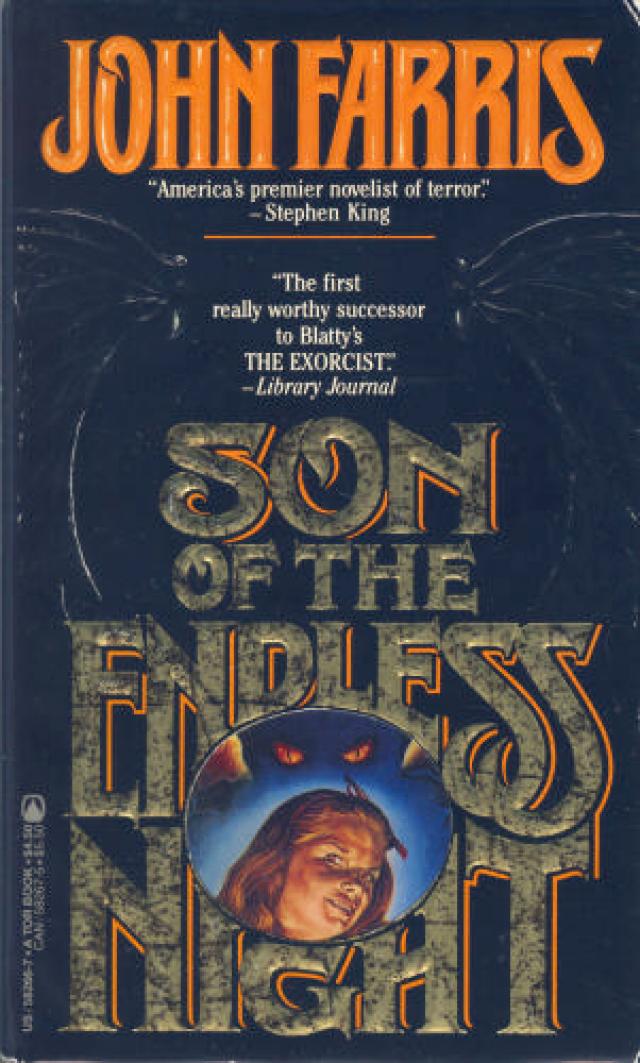
Son of the endless night, p.41
Son of the Endless Night, page 41


"Quite all right," Philip Leighton said unexpectedly, with an eager smile. The two women looked expectantly at him. A small frown creased his forehead. "I must call the gallery before it closes; remind me again after tea, darling."
"Yes, of course I will. I do wish you had eaten more of your lunch."
No response; he had lapsed back into his dignified silence, and Conor felt his own spirits sinking into the pool of oblivion in which Philip Leighton spent most of his days.
Edith chose that moment to say, regretfully, "Now you understand why I cannot consider leaving. But I admit I was intrigued by the dilemma posed by the possession of your brother. If you wouldn't think it unkind of me, I would like to know more. Perhaps we can think of something to do. Oh, this has been dreadful of me! I would like for you to meet Sigrid Torgeson, without whom I assure you I would be quite at a loss these days."
Conor had been sneaking glances at Sigrid at every opportunity. She might not have been the most beautiful woman he'd ever seen, but looking at her made it impossible for him to remember even the face of his own wife. There was simply nothing wrong with Sigrid, not in the cut of her pale hair, the spacing of her lively eyes, the line of her chin, the dimensions of each dimple that glowed with white heat in her tanned cheeks when she smiled. Her body, which was minimally covered— halter top, denim shorts— also revealed no flaws, only abundance at every curve and youthful swell of flesh. Maybe, he thought, knowing he was holding her outstretched hand too long, maybe Sigrid had calluses on the bottoms of her bare feet. She must have calluses there. But when he looked down, foolishly, at those desirable feet he saw that even her dusty toes were straight and well-spread, as if she'd never worn shoes. He was so smitten he couldn't utter a sound.
"I have heard about your brother," Sigrid said. "I know the hell he is suffering, and I pray he will be delivered soon."
Conor said wearily, "I was with him a couple of times when— I just don't think any of us can appreciate what it's like for Rich. I don't even know if my brother still exists."
"Oh, yes. He does. And he's terrified, all the time. I know. I was possessed, when I was sixteen years old. It went on for more than three months. I remember nothing of the exorcism, of course. But I know I nearly lost my life."
"Possessed? By the— "
"Yes. I have photographs. It would serve no purpose to show them to you, except to turn your stomach, and I know you have had enough of that already."
Conor smiled, patronizingly, not half believing her. "You seem to have come through okay."
"Mostly okay," she said. "But with a reminder that none of us are ever as beautiful as we wish to be, or as ugly as we fear we really are."
She turned her back on Conor then. It looked as if she had spent her three months of demonic possession on a bed of nails in a torture chamber. The scars, little shallow nicks from the nape of her neck to the waistband of her shorts, were beyond counting. Her back resembled a piece of pumice. It was the faded heliotrope shade of a blotted birthmark.
Conor found himself holding his breath, suffocating in this tragedy of her marred youth and comeliness. He felt, sickeningly, cheated. He felt lust for her that made his head swim.
Sigrid turned back to him complacently, as if she had anticipated some of his emotions before she recognized them.
"But— why don't you— "
"Do something? Plastic surgery would be a long and painful process. And you see, the scars really don't matter to me in the way you think. They are my scars of war, and I want to remember that the war against Satan is not just a matter for my lifetime, but for all time. I don't ever want to feel that I would rather not be involved."
74
The prisoner was taking good care of his body, spending about forty minutes every other day working out, alone, in the cramped recreational room of the jail, where the leisure-time facilities consisted of one soiled deck of forty-eight playing cards, a black and white TV set on which the picture of the single channel it was capable of receiving appeared in undulating smeary images like a film of oil on the surface of slowly moving water, and coverless back numbers of magazines on the order of Yankee and The Rotarian.
While he exercised he was guarded by two jailers, one of whom carried a short-barreled shotgun, the High-Standard M-10 model, the low-powered shells of which were loaded with flechettes instead of shot. Flechettes were pieces of brass rod that tore flesh to tatters but had little ricocheting capability, which was desirable if it became necessary to fire the shotgun in an area enclosed by concrete walls. The prisoner customarily filled the forty minutes with situps, pushups, and jogging in place. He seldom paused to rest. When he rested he never spoke or acknowledged the presence of his jailers.
But Duke Fridley felt that, one of these days, the prisoner was going to get out of line again. And Duke was ready for him. Duke was the one with the shotgun, and he had about as much use for the prisoner as he did a maggot in a piece of filet mignon. Duke was just aching for him to try something. For his part he had made attempts to antagonize the prisoner, resorting to verbal abuse, only to be ignored. Most days he had to be content just to let the prisoner finish his routines and then herd him back to his cell.
On this particular day, however, Duke was nursing at the teat of a swollen grudge against his ex-wife, who had taken all the child support money he'd been so faithful about paying and blown it all on her boyfriend; there wasn't a dime of it left to get the kids' teeth fixed. At the same time Duke was working on a fantasy of how he would handle it if the prisoner suddenly bolted up from his current set of pushups and tried to take the gun away from him. BA-ROOM! BA-ROOOMMMMM! Two quick shots, he'd be wearing his ears inside out and whistling through his swallow-pipe. Save the county a whole lot of time and money. So come on, you asshole. You piece of dogshit. Let's see you get tricky. Just look at me the wrong way once.
"Time," said the other jailer, whose name was Parker. He looked up from his wristwatch and yawned. The prisoner kept right on pumping away, on his fingertips, as if he hadn't heard Parker. See about that. Duke walked up behind the prisoner and kicked him hard in the tail, sent him sprawling.
"Hey, Duke," Parker said mildly. "What's that about, man?"
"This fucker thinks he can do what he wants, when he wants to do it. That ain't the way it works around here. The man said time, Devon. Means you stop what you're doing, get up right then, and hold out your arms for the straitjacket. Got that?"
The prisoner looked up at Duke. There was no anger in his face that Duke could respond to with another admonishing kick, scarcely any expression at all.
Duke did see, or thought he saw, little reddish points of light the size of chiggers in the prisoner's eyes. Duke felt a wave of heat inside his head that left him so lazy-minded he no longer had control of his own body.
To his surprise control was reestablished for him. He felt himself turned and walked to the farthest wall in the rec room, where he was made to stand as close to attention as he could, with the muzzle of the shotgun in his right hand, which he held by the pistol grip with his finger on the trigger, snugged up into his left armpit.
"Duke, what the hell are you doing?" Parker yelled.
The prisoner, down on one knee, studied Duke keenly, raising a slow hand to his forehead to wipe away the perspiration there.
"I don't know what I'm doing!" Duke squealed. "I mean I can't help myself! Stay away from me, Parker. Don't touch me or the gun— Jesus. It's gonna go off, Parker. Those flechettes'll blow my goddam arm to bits! Help. Help. Oh shit help me man the trigger gonna blow my own arm no noooooo!"
The prisoner lowered his head momentarily, unperturbed by Duke's terror.
The shotgun didn't fire. But the loss of his arm would have been a joy compared to the horror of the visions that swept through Duke's mind for the next few moments.
He saw his world, the few square miles of rural Vermont through which he swaggered, got drunk, chased random tail, and took his children to the movies on Sunday afternoons, as a permanently darkened and forbidding place filled with remnants of humanity who pursued each other through ruins and tore at living flesh to cram into their mouths. Duke's head lolled stuporously; his eyes were glazed. His right arm jerked out and the shotgun was flung from his hand. The prisoner rose up and caught it deftly before it could hit the floor.
Duke fell to his knees, moaning softly. Parker backed away from the prisoner, not daring to reach for his pistol.
The prisoner gestured for him not to move, and Parker obediently froze, except for the false teeth that were clicking in his mouth.
The prisoner walked over to Duke, who shrank back a little in craven anticipation of the postponed bloodbath.
"You dropped this, Duke," the prisoner said, and handed down the shotgun to him.
Duke took it, shaking, knowing more about the prisoner than he had ever wanted to know. He could summon no belligerence, no desire to fall upon the prisoner and pound him senseless with his baton.
Because it was clear to Duke that the prisoner was in control of them, his jailers; not the other way around. He could leave any time he wanted to, and nobody— nothing— could stop him.
But he didn't want to leave. For some reason that Duke only vaguely associated with the vision that had crumbled the delusions which enabled him to keep the shoddy engine of his life in motion, the prisoner was content to remain right where he was. Duke licked his lips and tasted the sour knowledge of what a powerless and mediocre little shit he really was.
As soon as Steve, the head jailer, heard Parker's report, he called Duke into his office.
"Duke, you're through. I don't want you around here anymore."
Duke tried to smirk, but it wasn't much of an effort. He was sinking fast into a morass of hopelessness from which he hadn't the resources to extricate himself. He said truthfully, "I wouldn't come around this goddam jail again in a M-60 tank."
75
Conor talked for a long time in Edith Leighton's home by the sea, until his voice had coarsened to a rasp and the woven shades needed to be lowered all the way against the blinding sun. The veranda contained an aging light the color of whiskey in which their faces were deeply shadowed. She had asked for his permission to tape-record everything. He told them all he knew or suspected of how Rich had become entrapped, then possessed, by Zarach' Bal-Tagh. He spoke of the terrifying manifestations which he had seen for himself. Of the dead or missing witnesses who had seen Rich, or Zarach', kill Karyn Vale, too many other sudden or unexplained deaths to be written off as coincidence. Of Adam Kurland's crucial decision to plead demonic possession, although he was aware of the disastrous effect this decision could have on his career. Of the demonic attacks on Hillary and, possibly, himself. Of his own short life as a priest, the feelings of guilt that persisted years after his renouncing of vows. Of his love for his family, his fears for their safety. Of the more specific fear that despite his best efforts nothing could be done now to save Rich.
"There is only one way to save him," Edith said, "and that is to have a trial. Make no mistake: a trial will be a very dangerous business. For one thing, the enormous publicity generated by the trial might very well cause widespread terror and dread in the majority of human beings who are mentally and emotionally unequipped to deal with the idea, the threat to their souls posed by the Legion. One undesirable effect might be the death of religious belief. Another, a paralysis of will, resulting in one's inability to believe in oneself, in the sanctity of human life, which would leave one quite unable to cope with negative forces. That would be an even greater tragedy. The human will is our most precious resource."
"Maybe— if there was some way to control all the publicity— "
Edith scoffed gently. "My dear, the simplest way to establish the existence of Zarach' in court is to reveal him. Can you imagine what that would be like? You've had some experience with the Son of the Endless Night already. Let me assure you that he is capable of a circus of terror far exceeding what he thus far has demonstrated. But a verdict exonerating your brother may not necessarily save him. Not only must your brother be exonerated, but Zarach' must be banished from this earth as well. There are only two ways Zarach' may lose his hold on Richard. Through death, or through the intervention of a powerful positive force. If Zarach' is to be revealed, then there must exist the means to control him. That's the rub."
"What you're saying is, my brother's life isn't worth the consequences of a trial."
"Have I said that? I have not. I've pointed out that the undertaking is not for amateurs, however well-meaning your Mr. Kurland may be."
"And you can't help."
"All of us at Sundial can form a circle of psychic light around Richard, and pray for his deliverance. This could be of considerable value. As for my own contribution, even if I were able to leave my husband at this time, it has been several years since I was in a courtroom. My skills, I'm afraid, have been blunted through disuse."
Sigrid shook her head disbelievingly, but said nothing. Edith put a hand on Conor's arm.
"Well, I think we've all gone round and round this dilemma long enough for one day. You look exhausted. It's time to eat and then to rest. I have a meeting to attend tonight. Perhaps in the morning after you've had your sleep Sigrid would be willing to show you more of our community."
76
"Martin, you haven't dressed yet."
Louise Vale had discovered, without having to guess, where her husband had disappeared to. Karyn's room. He had lighted a single small crystal lamp and opened the windows that overlooked the sound. A chill April breeze danced the curtains. Through the budding branches of the oak the evening star flashed like a solitaire. He was sitting on the edge of the four-poster bed with the pink puff quilt, looking out. A drink in one hand.
"I don't think I want to go tonight."
"Not go to Bill's birthday party? He's your partner. And this is a very important milestone in his life. He'd never understand if you weren't there."
In a voice thickened by a syrup of grief in the throat Vale said, "Doesn't anyone realize how much I loved her, and wanted life to be good for her?"
"Oh, Martin. Of course. Everyone does." She yearned to sit beside him, but it seemed a violation of the intimacy he was trying, in this room, to reestablish with his dead daughter. "What's wrong, Martin? Is it the trial that has you down like this? The trial won't start for another six weeks. You can't let it obsess you— you'll just destroy yourself."
"Something's going to go wrong. I feel it. Devon will get off. He won't be punished the way he should be."
"It's that demonic possession nonsense that has you upset. Tommie said not to give it a thought. The plea won't be allowed."
"Tommie's a good man. But he's tied in with a rural prosecutor who doesn't have the experience to try a case like this. There are just too many loopholes that boy can slip through, and be free in a year or two."
Vale turned his face slowly toward his wife. Around the eyes, where he'd always been liverish when stress went unbalanced by sufficient sleep and exercise, he was now black as a panda. The tan he had sported in January had faded to yellow in the vertical creases of his face. He hadn't been going to the athletic club; forty laps in the pool, twenty minutes on the Nautilus. His appetite was poor.
He said, "I would give anything— even my life— to see that it doesn't happen."
She spoke sharply, from fear. "You must stop this. We've all been suffering. The law can't be as cruel and indifferent as you think. Listen to Tommie. Now, we're expected for dinner, and I won't make excuses."
An eighteenth-century clock on a French commode whirred and began, delicately, to chime. Time hurried through the neat room like quicksilver bullets, which were stolen by the dark at the windows. Martin Vale held out a hand as if pleading for the clock to stop, to reverse itself. The hand was pierced, invisibly; he held it to his mouth, his eyes spilled over. Silence. Karyn, unblemished, looked down at him from a portrait on the wall, blissfully forbidding. Remember. Remember.
77
The cave into which Sigrid Torgeson and Conor descended was well lighted and some eighty feet high. Unlike caves formed slowly in limestone by the action of subterranean waters, this one had been created in a dramatic fury by a river of lava poured down from the heights of the Montana del Fuego. The jagged basalt walls were shades of gray and red, the stalactites long lances of solidified lava.
"After the eruption," Sigrid explained, "the lava cooled and hardened quickly on the surface, forming a tube through which more lava continued to flow. In places there are tubes on top of tubes, galleries much larger than this one. Not all of the caves have been explored."
"Where are we going?"
"A little way toward the sea, to a favorite spot of mine. The vibrations are particularly right for me by the Lago de Ilusion."
"The what?"
"You'll see. I wouldn't want to spoil it for you. This way."
Today Sigrid was wearing shoes, stout hiking boots. So was he. She cautioned him about where he put his hands. The ledges could be as sharp as razors.
"I don't understand all this about 'vibrations,' " Conor said.
"Is matter solid?"
"Well— not really. All matter is composed of molecules."
"And there is space between each molecule, no?"
"I wasn't much of a whiz at physics."
"The amount of space between molecules determines density. Air, water, flesh, stone, all have a different density decided both by the arrangement of molecules and their speed relative to one another. Nothing is motionless in nature, ever. Frequency of motion equals vibration. Vibration determines what our senses perceive: in other words, the dimension we inhabit now, the third dimension."
"Is there a fourth dimension?"
"Oh, heavens, yes; hundreds of dimensions. But most of them are found well beyond the plane of earth." She had to laugh, but she seemed a trifle apprehensive in the frail light of the cavern. "What a terrible look you have on your face! Have I offended you?"