Fall of hyperion, p.50
Fall of Hyperion, page 50
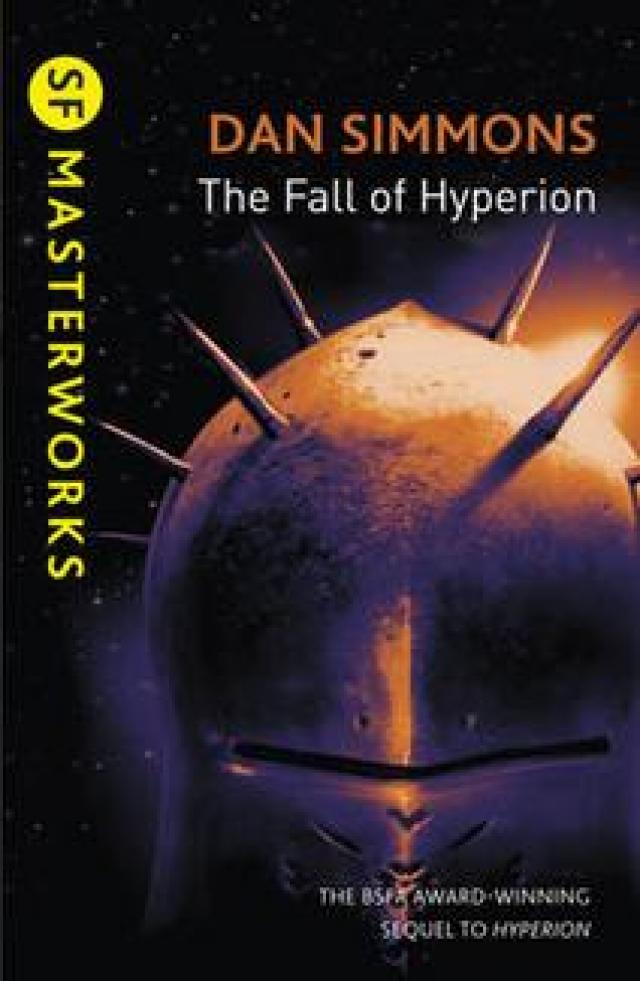


Kassad turned, keeping the rifle and pennant high. The Shrike moved forward half a step, opened its stance, and unfolded fingerblades.
Kassad shouted and attacked. Behind him, Moneta followed, weapon held high. Thousands followed.
Later, in the carnage of the valley, Moneta and a few others of the Chosen Warriors found Kassad’s body still wrapped in a death embrace with the battered Shrike. They removed Kassad with care, carried him to a waiting tent in the valley, washed and tended to his ravaged body, and bore him through the multitudes to the Crystal Monolith.
There the body of Colonel Fedmahn Kassad was laid on a bier of white marble, and weapons were set at his feet. In the valley, a great bonfire filled the air with light. All up and down the valley, men and women moved with torches while other people descended through the lapis lazuli sky, some in flying craft as insubstantial as molded bubbles, others on wings of energy or wrapped in circles of green and gold.
Later, when the stars were in place burning bright and cold above the light-filled valley, Moneta made her farewells and entered the Sphinx. The multitudes sang. In the fields beyond, small rodents poked among fallen pennants and the scattered remnants of carapace and armor, metal blade and melted steel.
Toward midnight, the crowd stopped singing, gasped, and moved back. The Time Tombs glowed. Fierce tides of anti-entropic force drove the crowds farther back—to the entrance of the valley, across the battlefield, back to the city glowing softly in the night.
In the valley, the great Tombs shimmered, faded from gold to bronze, and started their long voyage back.
Brawne Lamia passed the glowing Obelisk and struggled on against a wall of raging wind. Sand lacerated her skin and clawed at her eyes. Static lightning crackled on the cliff tops and added to the eerie glow surrounding the Tombs. Brawne spread her hands over her face and stumbled on, squinting between her fingers to find the trail.
Brawne saw a golden light deeper than the general glow flowing through the shattered panes of the Crystal Monolith and seeping out over the twisting dunes that were covering the valley floor. Someone was inside the Monolith.
Brawne had vowed to go straight to the Shrike Palace, do whatever she could to free Silenus, and then return to Sol, not to be turned aside by diversions. But she had seen the silhouette of a human form inside the tomb. Kassad was still missing. Sol had told her of the Consul’s mission, but perhaps the diplomat had returned while the storm raged. Father Duré was unaccounted for.
Brawne came closer to the glow and paused at the jagged entrance to the Monolith.
The space inside was expansive and impressive, rising almost a hundred meters to a half-sensed skylight roof. The walls, seen from within, were translucent, with what appeared to be sunlight turning them a rich gold and umber. The heavy light fell on the scene at the center of the wide area before her.
Fedmahn Kassad lay on some sort of stone funeral bier. He was clothed in FORCE dress black, and his large, pale hands were crossed on his chest. Weapons, unknown to Brawne except for Kassad’s assault rifle, lay at his feet. The Colonel’s face was gaunt in death, but no more gaunt than it had been in life. His expression was calm. There was no question that he was dead; the silence of death hung about the place like incense.
But it was the other person in the room who had shown the silhouette from afar and who now commanded Brawne’s attention.
A young woman in her mid- to late twenties knelt by the bier. She wore a black jumpsuit, had short hair, fair skin, and large eyes. Brawne remembered the soldier’s story, told during their long trip to the valley, remembered the details of Kassad’s phantom lover.
“Moneta,” whispered Brawne.
The young woman had been on one knee, her right hand extended to touch the stone next to the Colonel’s body. Violet containment fields flickered around the bier, and some other energy—a powerful vibration in the air—refracted light around Moneta as well so that the scene was cast in haze and halo.
The young woman raised her head, peered at Brawne, rose to her feet, and nodded.
Brawne started to step forward, a score of questions already forming in her mind, but the time tides within the tomb were too powerful and drove her back with waves of vertigo and déjà vu.
When Brawne looked up, the bier remained, Kassad lay in state under his forcefield, but Moneta was gone.
Brawne had the urge to run back to the Sphinx, find Sol, tell him everything, and wait there until the storm abated and the morning came. But above the rasp and whine of wind, Brawne thought that she could still hear the screams from the thorn tree, invisible behind its curtain of sand.
Pulling her collar high, Brawne walked back into the storm and turned up the trail toward the Shrike Palace.
The mass of rock floated in space like a cartoon of a mountain, all jagged spires, knife-edge ridges, absurdly vertical faces, narrow ledges, broad rock balconies, and a snow-capped summit wide enough for only one person to stand there—and he or she only if both feet were together.
The river twisted in from space, passed through the multilayered containment field half a klick out from the mountain, crossed a grassy swale on the widest of the rock balconies, and then plunged a hundred meters or more in a slow-motion waterfall to the next terrace, then rebounding in artfully directed rivulets of spray to half a dozen minor streams and waterfalls which found their way down the face of the mountain.
The Tribunal held session on the highest terrace. Seventeen Ousters—six males, six females, and five of indeterminate sex—sat within a stone circle set in the wider circle of rock-walled grass. Both circles held the Consul as their locus.
“You’re aware,” said Freeman Ghenga, the Spokesman of the Eligible Citizens of the Freeman Clan of the Transtaural Swarm, “that we are aware of your betrayal?”
“Yes,” said the Consul. He had worn his finest dark blue bolo suit, maroon cape, and diplomat’s tricorne cap.
“Aware of the fact that you murdered Freeman Andil, Freeman Iliam, Coredwell Betz, and Mizenspesh Torrence.”
“I knew Andil’s name,” said the Consul softly. “I wasn’t introduced to the technicians.”
“But you murdered them?”
“Yes.”
“Without provocation or warning.”
“Yes.”
“Murdered them to take possession of the device which they had delivered to Hyperion. The machine which we told you would collapse the so-called time tides, open the Time Tombs, and release the Shrike from bondage.”
“Yes.” The Consul’s gaze appeared to be focused on something above Freeman Ghenga’s shoulder but far, far away.
“We explained,” said Ghenga, “that this device was to be used after we had successfully driven off the Hegemony ships. When our invasion and occupation was imminent. When the Shrike could be … controlled.”
“Yes.”
“Yet you murdered our people, lied to us about it, and activated the device yourself, years ahead of time.”
“Yes.” Melio Arundez and Theo Lane were standing beside and a step behind the Consul, and their faces were grim.
Freeman Chenga folded her arms. She was a tall woman in the classic Ouster mode—bald, thin, draped in a regal, dark blue flowsuit which seemed to absorb light. Her face was old but almost free of wrinkles. Her eyes were dark.
“Even though this was four of your standard years ago, did you think we would forget?” asked Ghenga.
“No.” The Consul lowered his gaze to meet hers, It appeared as if he almost smiled. “Few cultures forget traitors, Freeman Ghenga.”
“Yet you returned.”
The Consul did not reply. Standing near him, Theo Lane felt a light breeze tug at his own formal tricorne. Theo felt as if he were still dreaming. The ride here had been surreal.
Three Ousters had met them in a long, low gondola, floating easily on the calm waters below the Consul’s ship. With the three Hegemony visitors sitting amidships, the Ouster at the stern had pushed off with a long pole, and the ship had floated back the way it had come, as if the current of the impossible river had reversed itself. Theo had actually closed his eyes as they approached the waterfall where the stream rose perpendicular to the surface of their asteroid, but when he opened his eyes a second later, down was still down, and the river seemed to be flowing along normally enough, even though the grassy sphere of the small world hung to one side like a great, curved wall and stars were visible through the two-meter-thick ribbon of water beneath them.
Then they were through the containment field, out of the atmosphere, and their velocity increased as they followed the twisting ribbon of water. There was a tube of containment sphere around them—logic and the absence of their immediate and dramatic death dictated that there had to be—but it lacked the usual shimmer and optic texture that was so reassuring on Templar treeships or the occasional tourist habitat open to space. Here there were only the river, the boat, the people, and the immensity of space.
“They can’t possibly use this as their form of transportation between Swarm units,” Dr. Melio Arundez had said in a shaky voice. Theo had noted that Arundez also was gripping the gunwales with white fingers. Neither the Ouster in the stern nor the two seated in the bow had communicated with anything more than a nod of confirmation when the Consul had asked if this then was their promised transportation.
“They’re showing off with the river,” the Consul had said softly. “It’s used when the Swarm is at rest, but for ceremonial purposes. Deploying it while the Swarm is moving is for effect.”
“To impress us with their superior technology?” asked Theo, sotto voce.
The Consul nodded.
The river had wound and twisted through space, sometimes almost doubling back on itself in huge, illogical loops, sometimes wrapping itself in tight spirals like a fiberplastic cord, always gleaming in sunlight from Hyperion’s star and receding to infinity ahead of them. At times the river occluded the sun, and the colors then were magnificent; Theo gasped as he looked at the river loop a hundred meters above them and saw fish silhouetted against the solar disk.
But always the bottom of the boat was down, and they hurtled along at what must have been near cislunar transfer speeds on a river unbroken by rocks or rapids. It was, as Arundez noted some minutes into their voyage, like driving one’s canoe over the edge of an immense waterfall and trying to enjoy the ride on the way down.
The river passed some of the elements of the Swarm, which filled the sky like false stars: massive comet farms, their dusty surfaces broken by the geometries of hard vacuum crops; zero-g globe cities, great irregular spheres of transparent membrane looking like improbable amoebae filled with busy flora and fauna; ten-klick-long thrust clusters, accreted over centuries, their innermost modules and lifecans and ‘cologies looking like something stolen from O’Neill’s Boondoggle and the dawn of the space age; wandering forests covering hundreds of kilometers like immense, floating kelp beds, connected to their thrust clusters and command nodes by containment fields and tangled skeins of roots and runners—the spherical tree-forms weaving to gravity breezes and burning bright green and deep orange and the hundred shades of Old Earth autumn when ignited by direct sunlight; hollowed-out asteroids long-since abandoned by their residents, now given over to automated manufacturing and heavy-metal reprocessing, every centimeter of surface rock covered by prerusted structures, chimneys, and skeletal cooling towers, the glow of their internal fusion fires making each cinderish world look like Vulcan’s forge; immense spherical docking globes, given scale only by the torchship- and cruiser-size warcraft flitting around their surfaces like spermatazoa attacking an egg; and, most indelible, organisms which the river came near or which flew near the river … organisms which might have been manufactured or born but probably were both, great butterfly shapes, opening wings of energy to the sun, insects which were spacecraft or vice versa, their antennae turning toward the river and gondola and its passengers as they passed, multi-faceted eyes gleaming in starlight, smaller winged shapes—humans—entering and exiting an opening in a belly the size of a FORCE attack carrier’s dropship bay.
And finally had come the mountain—an entire range of mountains, actually: some blistered with a hundred environment bubbles, some open to space but still heavily populated, some connected to others by suspension bridges thirty klicks long or tributary rivers, others regal in their solitude, many as empty and formal as a Zen garden. Then the final mountain, rising higher than Mons Olympus or Asquith’s Mount Hillary, and the river’s penultimate plunge toward its summit, Theo and the Consul and Arundez, pale and silent, gripping the thwarts with quiet intensity as they plunged the final few kilometers with a suddenly perceptible and terrifying velocity. Finally, in the impossible last hundred meters as the river shed energy without deceleration, wider atmosphere surrounded them once again, and the boat floated to a halt in a grassy meadow where the Ouster Clan Tribunal stood waiting, and stones rose in their circle of Stonehenge silence.
“If they did this to impress me,” Theo had whispered as the boat bumped the grassy shore, “they succeeded.”
“Why did you return to the Swarm?” asked Freeman Ghenga. The woman paced, moving in the minuscule gravity with the grace common only to those born in space.
“CEO Gladstone asked me to,” said the Consul.
“And you came knowing that your own life would be forfeit?”
The Consul was too much the gentleman and diplomat to shrug, but his expression conveyed the same sentiment.
“What does Gladstone want?” asked another Ouster, the man who had been introduced by Ghenga as Spokesman of the Eligible Citizens Coredwell Minmun.
The Consul repeated the CEO’s five points.
Spokesman Minmun folded his arms and looked at Freeman Ghenga.
“I will answer now,” said Ghenga. She looked at Arundez and Theo. “You two will listen carefully in the event that the man who brought these questions does not return to your ship with you.”
“Just a minute,” said Theo, stepping forward to face the taller Ouster, “before passing judgment here, you have to take into account the fact that—”
“Silence,” commanded Spokesman Freeman Ghenga, but Theo had already been silenced by the Consul’s hand on his shoulder.
“I will answer these questions now,” repeated Ghenga. Far above her, a score of the small warships which FORCE had called lancers flashed silently past, darting like a school of fish in three-hundred-g zigs and zags.
“Firstly,” said Ghenga, “Gladstone asks why we are attacking the Web.” She paused, looked at the other sixteen Ousters assembled there, and continued. “We are not. Except for this Swarm, attempting to occupy Hyperion before the Time Tombs opened, there are no Swarms attacking the Web. ”
All three of the Hegemony men had stepped forward. Even the Consul had lost his veneer of bemused calm and was all but stuttering in excitement.
“But that’s not true! We saw the … ”
“I saw the fatlined images from the … ”
“Heaven’s Gate is destroyed! God’s Grove burned!”
“Silence,” commanded Freeman Ghenga. Into that silence she said, “Only this Swarm is doing battle with the Hegemony. Our Sister Swarms are where the long-range Web detectors had first placed them … moving away from the Web, fleeing from further provocations such as Bressia’s attacks.”
The Consul rubbed his face like a man awakening. “But then who … ?”
“Precisely,” said Freeman Ghenga. “Who would have the ability to carry out such a charade? And the motive to slaughter humans by the billion?”
“The Core?” breathed the Consul.
The mountain was slowly rotating, and at this moment they turned into night. A convection breeze moved across the mountain terrace, rustling the Ousters’ robes and the Consul’s cape. Overhead, the stars seemed to explode into brilliance. The great rocks of the Stonehenge circle seemed to glow from some internal warmth.
Theo Lane stood next to the Consul, fearing that the man might collapse. “We have only your word on this,” Theo said to the Ouster spokesman. “It makes no sense.”
Ghenga did not blink. “We will show you proof. Void-Which-Binds transmission locators. Real-time starfield images from our sister Swarms.”
“Void Which Binds?” said Arundez. His usually calm voice showed agitation.
“What you call the fatline.” Spokesman Freeman Ghenga paced to the nearest stone and ran her hand across its rough surface as if taking warmth from the heat within. Starfields pirouetted above.
“To answer Gladstone’s second question,” she said, “we do not know where the Core resides. We have fled it and fought it and sought it and feared it for centuries, but we have not found it. You must tell us the answer to that question! We have declared war on this parasite entity you call the TechnoCore.”
The Consul seemed to sag. “We have no idea. Authorities in the Web have sought the Core since before the Hegira, but it is as elusive as El Dorado. We’ve found no hidden worlds, no massive asteroids crammed with hardware, and no hint of it on Web worlds.” He gestured tiredly with his left hand. “For all we know, you are hiding the Core in one of your Swarms.”
“We are not,” said Spokesman Coredwell Minmun.
The Consul did shrug at last. “The Hegira bypassed thousands of worlds in the Grand Survey. Anything that didn’t score at least nine point seven on their ten-point terrabase scale was ignored. The Core could be anywhere along those early lines of flight and exploration. We’ll never find it … and if we do, it will be years after the Web is destroyed. You were our last hope for locating it.”
Ghenga shook her head. Far above them, the summit caught the light of sunrise while the terminator moved down the icefields toward them with almost alarming rapidity. “Thirdly, Gladstone asked for our demands for a cease-fire. Except for this Swarm, in this system, we are not the ones attacking. We will accept a cease-fire as soon as Hyperion is under our control … which should be momentarily. We have just been informed that our expeditionary forces now have control of the capital and its spaceport.”