

The russian lode, p.1
The Russian Lode, page 1
part #9 of Gunslinger Series


The Home of Great
Western Fiction
John Ryker was just about the most lethal one-man slaughter-force in the violent West.
An ace gunsmith and professional bounty hunter, no-one knew more about death than Ryker.
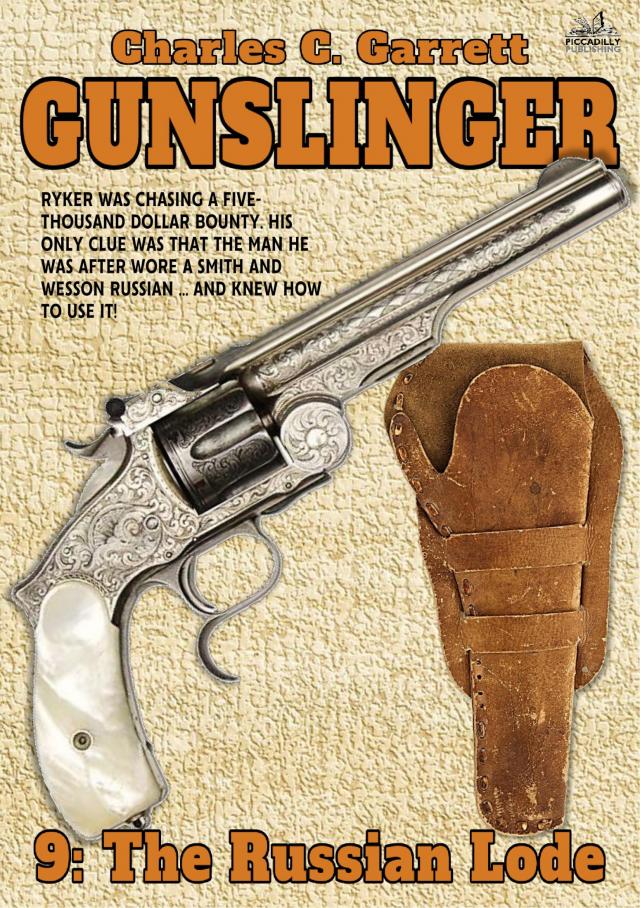
So when Matthew Tennant was gunned down by a stranger sporting a Smith & Wesson Russian, Ryker soon found himself out on the trail in search of Tennant’s killer. Tennant’s widow had offered $5,000 if Ryker could find the right man, and it was a surefire certainty that when Ryker found him a lot of lead was going to let fly…
CHARLES C. GARRETT
GUNSLINGER 9:
THE RUSSIAN LODE
GUNSLINGER 9: THE RUSSIAN LODE
© Charles C. Garrett 1980
This electronic edition published August 2024
Names, characters and incidents in this book are fictional, and any resemblance to actual events, locales, organizations, or persons living or dead is purely coincidental.
You may not copy, store, distribute, transmit, reproduce or otherwise make available this publication (or any part of it) in any form, or by means (electronic, digital, optical, photocopying, recording or otherwise), without the prior written permission of the publisher. Any person who does any unauthorized act in relation to this publication may be liable to criminal prosecution and civil claims for damages.
This is a Piccadilly Publishing Book / Text © Piccadilly Publishing
Series editor: Mike Stotter
Visit www.piccadillypublishing.org to read more about our books
Slingers of words and guns – but mostly of enthusiasm -
for which we all thank them:
Dave Whitehead and Mike Stotter.
With friendship.
Chapter One
TUCSON WAS QUIET. On a Wednesday it mostly was: especially at the middle of the month. Especially during the Spring round-up time.
It was too early – or too late – for the hands to come in off the surrounding ranches like they did when the Winter lay-off gave them time to spare, or the lush Summer grass held the cows close to the good pastures. They didn’t get paid until the end of the month; and what little they had to spend in the Spring got blown at the end of the week, when hoarded money or argued advances could buy whiskey and women on a blurred weekend that left the few lucky enough to enjoy the fleshpots of the town riding back with red-rimmed eyes and liquor-blown memories of the pleasures of a town.
The stage still came through twice a week. Once on the long swing west through Arizona to California. Then again on the dog-leg back to the East, cutting through to New Mexico before dividing the passengers heading for Texas from those going on to Kansas or Missouri or Illinois.
And every once in a while the stage dropped people off in Tucson. People who were drummers, or saloon girls, or just travelers.
The man who climbed down from the drop-step with the noonday sun shining light off the sweat beading his face was a traveler. Beard stubble held the beads of moisture close against his angular jaw. He looked hot – sweaty – but the first thing he did when he stepped into the dust of Main Street was to hike his black coat back clear of the gun holstered on his right hip and check the slide of pistol against leather.
Then he looked up and down the street, hiding his movement under the pretense of wiping a bandanna across his face. And moved automatically into the shade of the porch, where the overhanging verandah of Dolly Harman’s What Cheer saloon could hide him from the bright, burning glare of the sun.
The guard on the Concord tossed a small valise down, and the man caught it with the deft movement of long practice, cradling it under his left arm as he watched the coach roll away down the street. Then he pushed in through the batwings and went up to the bar. He ducked his head as he went through the doorway.
‘Beer.’ His voice was soft, the last syllable rolling into a slur. ‘Then whiskey.’
He downed a mug of beer in one long swallow. Called for a second as he sipped the harder liquor. Then took his time over the next, eyes scanning the long room that made up the central part of the What Cheer.
In the afternoon, in the middle of the week, in Spring, there weren’t too many people there. Down the end of the room a few townsfolk were taking their midday meal. Store-owners, mostly, or ranchers come in to discuss business with the new banker who had taken over when Goldburgh got killed.1
The sole difference from any other of the many townships the man had seen was the group of card players over against the far wall. There were four of them. Each one had a glass in front, the whiskey forming dark rings on the baize topping. There was a bottle at the center, alongside the pile of chips.
But no one was playing the game.
Instead, they were listening to the dark-haired man seated against the wall. His voice was a low murmur that didn’t carry further than his immediate circle of companions. He held his cards folded close against his chest. The others were letting theirs show as they gaped at the speaker.
From where the tall man in the black suit lounged casually against the bar the cards were in clear view, spread out in surprise and greed. One player held a matched set of pairs; another carried a useless mixture of random cards; the last held a flush that folded slowly on to the table as the dark-haired man went on parlaying his spiel.
The man at the bar emptied his beer mug and then tipped down the whiskey. He turned to the barkeep. ‘I want a room.’
Ben Turner nodded and said, ‘Two dollar room, or a four dollar special?’
‘At the front. Bath, too.’
‘Got one looks right over the entrance. For a dollar extra, I’ll fix the bath to be brought up.’ Turner grinned: ‘Five more can fix a real good scrubbing. Dolly got a Chinese girl in a while ago. Knows all the secrets of the Orient. Things you ain’t never experienced.’
‘Forget it.’ The tall man shook his head. ‘Just hike the bath up there. That and a bottle of good whiskey.’ There was something in his voice that stopped Ben from pushing the wares of the What Cheer any further. Instead, he fumbled under the bar for the key and passed it over to the big man.
‘Number seven,’ he said. ‘Take the door on yore left an’ head along the corridor.’
‘Thanks.’ The man took the key and lifted his valise in his left hand. ‘Get that bath ready.’
‘Yessir! Right away.’
Somehow Ben didn’t feel like arguing.
The room was small and hot. There was a narrow bed banged up against the window to the left side of the saloon’s door. A washstand with a jug of dirty water, flies floating on the surface, beside the bed. A few hooks on the facing wall, and a porcelain bowl under the bed. The porcelain was cracked and the pot gave off a sour odor.
The man stripped down to his undershirt, hanging his vest and pants on the hooks. Wearing only a sweat-stained set of long johns, he began opening up his valise.
It contained a second gun and an oil-skin pouch of tools and cleaning equipment, along with a spare shirt and extra underwear. The gun kit took up most of the room in the small bag.
Spreading a cloth square on the bed he began to check over his two pistols, stripping them down to the component parts before oiling them very carefully and reassembling the delicate mechanisms. After that he checked each cartridge, sliding six into the pistol he holstered on his belt, and five into the spare pistol kept in his valise.
A tapping at the door announced the arrival of his tub, and he swung the thin partition inwards. Holding the frame with his left hand, he stepped back so that the door partly shielded him. The loaded revolver was in his right hand, muzzle at hip height. The young Mexican carrying the zinc tub glanced warily at the black mouth of the gun and set the bath down in a hurry. Behind him an elderly Chinaman turned pale eyes on the gunman and whistled softly between his teeth. He ignored the implied danger with the stoicism of the Orient as he tipped a bucket of steaming water into the receptacle and folded a towel neatly on the bed.
The man waited until the Mexican and the Chinese returned with more water and two pails of cold, still standing just inside the small room with the pistol angled into the corridor.
When the bath was full, steam curling in lazy clouds through the warm air, he locked the door. Then he opened the window and thrust his head out, scanning the sidewalk. The street was empty save for a few old men playing moon around an upturned barrel, and a grizzled gray dog that was gnawing on a bone under the far porch. The man left the window open, but drew the grubby curtains. Then he cocked the revolver and set it on the floor beside the tub. Stripped out of his long johns. And climbed into the water.
He was a big man. Too big for the tub, so that he was forced to bend his knees and assume a crouched position that left his belly and torso clear of the water. His skin was pale, the puckered redness of scar tissue showing where bullets had pierced his right shoulder, left arm, and left hip. Down the right side of his face, running from the graying hair of his temple to the corner of his wide mouth, there was a fine, white scar. A knife wound. He rubbed it absently as he luxuriated in the cleansing warmth, then picked up the soap and began to scrub his muscular body.
It had been a long time since the last bath, and the cooling water assumed a gray color, the surface collecting a scum of whitish froth.
When he was finished he stood up, dousing himself in the cold water, then climbed out and began to towel dry.
He dug clean underwear and a fresh shirt from his valise. The underwear was bright red; the shirt white. He pulled on black pants; black boots; buttoned his black vest over his flat stomach. Then he buckled the gunbelt tight around his waist. Tied the holster down on his right leg and dropped the pistol inside. The holster and belt were shiny, oiled leather: better tended than his clothes. He shrugged into his coat and settled a flat-crowned black stetson on his head.
Then he pushed the valise under the bed and left the room.
Ben Turner looked up from the newspaper he was reading as the man approached. Something about his manner prompted Ben to slide both hands under the bar where they touched the comforting shape of the sawn-off Remington shotgun kept there.
‘You forgot my whiskey.’ gray eyes bored, unblinking, into Ben’s. ‘I don’t like people who forget things.’
‘Jesus!’ Ben’s forefinger curled nervously around the trigger of the scattergun. ‘I’m sorry, mister. You want it now?’
The man shook his head. ‘No. Just remember that when I ask for something I expect to get it. I don’t expect to ask twice.’
‘Nosir!’ Ben nodded, wondering what a hardcase like this was doing in Tucson on a quiet Wednesday. Til not forget again.’
‘Don’t,’ grunted the man.
And walked out into the afternoon heat.
He paced down the sidewalk, steps surprisingly light for so big a man. So light they made hardly any sound on the sun-weathered boards. His head remained forwards, tilted slightly so that the black stetson shaded most of his face. But his eyes drifted constantly from left to right, and back again. Checking. Watching.
And his right hand stayed close to the butt of the pistol.
He located the barber shop and found an empty chair. Draping his coat over the back, he settled down and called for a shave. As the cloth settled about him, he eased his revolver from the holster and rested the gun between his knees.
One hour later he emerged with a fresh-shaved face and a haircut. His boots were polished to a shine that danced the sun’s light back at the sky. And he smelled faintly of lavender water.
He went into the Rickarts’ eatery, calling for steak and hash greens. Anne Rickarts opened her mouth to tell him that they were closed until evening, then changed her mind and asked her husband to serve him. Dave Rickarts looked out through the kitchen hatch and began to cook. He didn’t serve the food himself, leaving that duty to the wandering lawyer they had taken on as waiter after he turned up beaten black by some itinerant owlhooter.
The man ate his food at a measured pace, chewing each mouthful as carefully as if it was his last. He drank four cups of coffee, and settled his bill with high-shining coins of the latest vintage.
It was around five when he left. The sun was still heating Tucson, though now it was spreading dark shadows along the streets, cut off from the alleyways flanking the main drag so that they were plunged into a dim half-light where dust danced in the air and lazy dogs sought comfort from the heat.
The man turned down one such alley, following the signs that pointed to Gus Traver’s stable.
He went in through the man-sized door cut alongside the main opening. And began checking over the horses before Gus woke up from his customary nap.
By the time the stablehand was fully awake, his unexpected customer had a tall bay stallion out in the central aisle and was checking over the animal’s points. He turned as Gus emerged from his tiny office, right hand dropping to the butt of his pistol.
‘He ain’t fer sale.’ Gus walked forwards, scrubbing at his eyes and wiping the rheum down his shirtfront. ‘Belongs to Mort Gannon. An’ Mort reckons him the finest horse in Arizona.’
‘He could be right,’ said the man, slurring the t into a soft sound. ‘I want him.’
‘I told you he ain’t fer sale,’ grumbled Gus. ‘You want a horse, I got some good stock out back. Mustangs, Quarter Horses, even a Morgan. Give over a good price, too.’
The man shook his head: ‘I want this one.’
‘Christ Jesus!’ Gus dug a finger into his left ear. Examined the findings, and flicked them away. ‘That one ain’t fer sale! How many times you need telling?’
‘Just once,’ said the man. ‘I remember things. The same way I expect folks to remember what I say. I want this horse.’
‘You can’t have him.’ Gus kicked straw from the stable’s floor. ‘That pony’s worth around one hundred dollars. I can sell you a mount fer twenty. No more’n fifty if you fancy the Morgan.’
‘I’ll take this one.’
The tall man reached over to drape the bridle around the post. Then he slung a saddle over the bay and hiked a knee hard against the stallion’s belly so that the animal sucked in its breath and let him fasten the girth straps tight over the ribs.
Gus picked up a pitchfork and stumbled forwards:
‘You ain’t nothin’ but a goddam horse thief! You back off now!’
The tall man in the black outfit laughed.
Drew his gun.
And shot Gus Traver through the belly.
The old man staggered back, feet dancing under the impact of the bullet. The pitchfork flew loose from his hands, curling through the dim air to imbed ten feet behind him. The tines set up a dull thrumming.
The man walked forwards and shot Gus in the face. The slug ruptured the nose, shattering the fragile bones so that they exploded inwards, collapsing the eye sockets and the upper lip into a single, massive hole that had once been a face.
The straw covering the stable’s floor got sticky with blood. Gus Traver voided his last connection with life and lay still amongst the mess of his own body.
The gunman climbed up on the bay stallion and walked the big horse up to the stable doors. He dismounted just long enough to open the doors and take the horse through. Then he tossed two lanterns down the aisle. Waiting until the kerosene was spreading over the straw.
And fired twice.
Each bullet ignited the fuel, spreading flames along the length of the stable. The central space burst into fire that crept up over the stalls in little, flickering tongues of darting flame. Yellow became red. Blue mixed in as manure heated and took flame. And the fire climbed over dry wood and stored grass.
Horses screamed, kicking against the stalls. Manes and tails began to burn as sparks fell down from the loft and a raw wall of fire ran down through the stable.
The gunman rode down the alley and dismounted outside the What Cheer.
The crackle of the flames was already pulling people out on to the street: impromptu fire fighters were pumping water and hauling buckets towards the burning stable. The saloon was mostly empty.
Except for the card players.
The same quartet was still bunched around the table. Still listening to the dark-haired man. The only differences were the empty whiskey bottle and the forgotten cards. No one held anything now – except glasses – and they were ignored as the dark-haired man went on talking.
The tall man in the black suit went up to the bar and reached over for the bottle Ben Turner had left when he ran out to help fight the fire. He poured a measure into a clean glass and drank it as he studied the paper he tugged from his inside pocket.
The sheet was worn where it had been folded, the creases blanched out into tear-lines so that the thing was punctuated with ragged holes. He stared at it, not really needing to study the words again, but enjoying the feeling of anticipation now that his quarry was so near.
Neat writing covered the sheet where it was not broken by the folds. There was no name at the top, nor any signature at the bottom. Only the carefully-scribed hand that had penned the message:
Matthew Tennant is around thirty years old. He has dark hair and dark eyes.
Clean shaved. Women say he is handsome. He talks a lot and favors dark clothing. He carries a pocket pistol in his vest, but he is not a gunman.
He travels with his wife, who is a pretty woman of about twenty-five years’ age. She has auburn hair and eyes the color of chestnuts. Do not harm her!
Kill Tennant, and I will pay you the $3000 promised.
You know where to come.






