

The outsiders, p.1
The Outsiders, page 1


THE
OUTSIDERS
There's always a backwater area—the sticks—a place that isn't a frontier because it isn't on the way to anywhere, and isn't anything itself. And always some people who live there. In the galaxy — it was The Rim. It wasn't anywhere, and there wasn't any place to go....
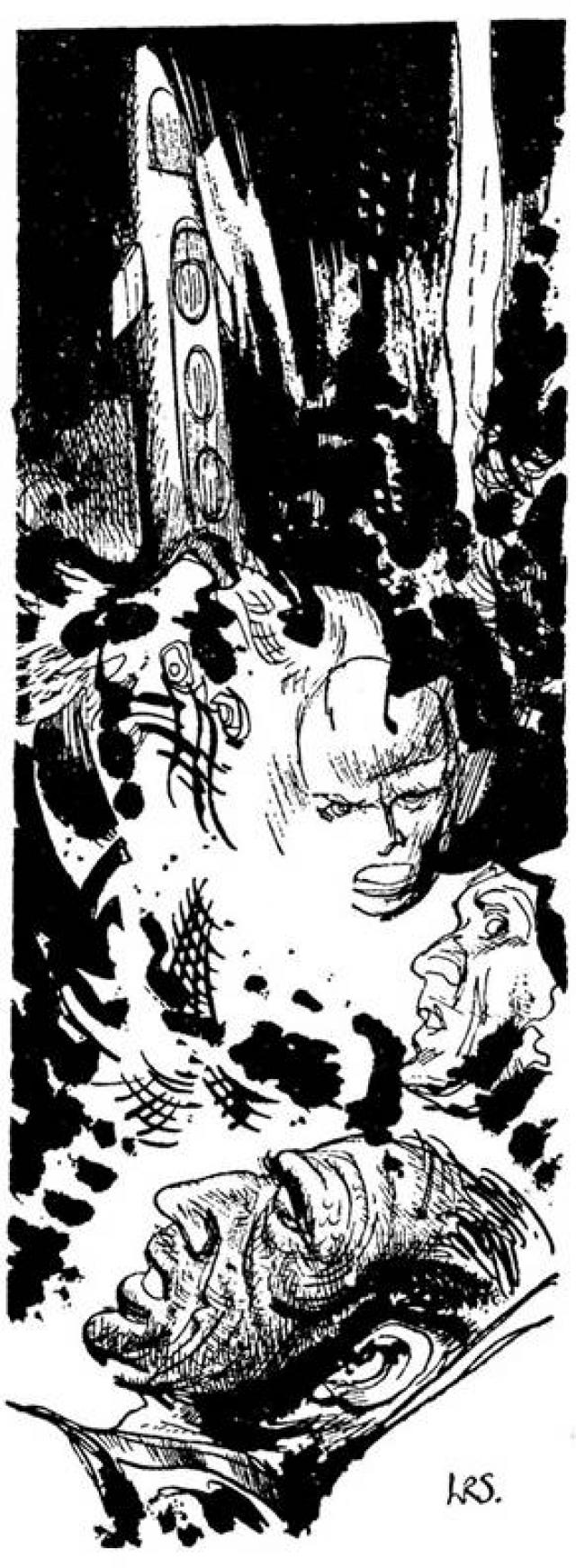
Illustrated by Summers
BY A. BERTRAM CHANDLER
WAS on Stree that star tramp Rimfire, received the news. He was in his day cabin at Calver, master of the the time and he and Jane Calver, who was both his wife and his catering officer, were trying to entertain the large, not unhandsome saurian who acted as Rim Runners' local agent. It had been heavy going; the lizard people of Stree are avid for new knowledge and delight in long winded philosophical discussions. Both Calver and Jane tried hard not to show their relief when there was a sharp rapping at the cabin door.
"Excuse me, Treeth," said Calver.
"Most certainly, captain," replied the agent. "Doubtless one of your officers has news of great import."
"I doubt it," said Jane Calver. "It'll be merely some minor problem of stowage."
"Come in!" called Calver.
The lizard, who had been sitting on the deck, rose gracefully to his feet, his long tail skimming the afternoon tea crockery on the low coffee table with a scant millimeter of clearance. Jane, when the expected crash failed to eventuate, gave an audible sigh of relief. Treeth looked at Calver and grinned, showing all his needle teeth. Calver wished that a childish sense of humor did not, as it too often does, go hand in hand with super intelligence.
Levine, the little Psionic Radio Officer, came into the cabin. He was obviously excited.
"Captain," he said, "I've picked up a message. An important one. Really important. Donaldson, the P.R.O. at Port Faraway, must have hooked up every telepath and every dog's brain on the whole planet to punch it through at this range!"
"And what is the news?" asked Calver.
"The Thermopylae salvage case. It's been settled at last."
"So Rim Runners get their new ship," said Calver.
"To hell with Rim Runners," replied Levine. "We get our whack—all of us who were in the poor old Lorn Lady at the time."
Treeth sat down again. He did not repeat the infantile joke with his tail and the tea things, which was unlike him. He said, in the well modulated voice that had only the suggestion of a croak, "I trust you will forgive my curiosity, captain. But we, as you know, were entirely ignorant of commercial matters until your Commodore Grimes made his landing on our world. What is salvage?"
"Putting it briefly," said Calver, "it's this. If you come across another ship in distress, you do your best to save life and property. The life-saving part is taken for granted. It's when property—the other vessel, or her cargo—is saved that the legal complications creep in. When you save property, the Courts decide what payment you shall receive for so doing. And a spaceship is a very expensive hunk of property."
"And the Thermopylae?" asked Treeth. "We heard something about it from Captain Vickery of the Sundowner. It happened shortly after the last time that you were here in Lorn Lady, didn't it? I shall be obliged if you will tell me all about it."
"All right," said Calver. "Thermopylae was—and, as far as I know, still is—one of the Trans-Galactic Clippers, a large passenger liner. She was making a cruising voyage out along the Rim. She got into trouble off Eblis—"
"A most unpleasant world," said Treeth. "I have seen pictures of it."
"As you say, a most unpleasant world. Anyhow, Thermopylae was putting herself into orbit around Eblis when she blew her tube linings, as a result of which she was doomed to make a series of grazing ellipses until such time as she crashed to the surface. We came along in Lorn Lady and tried to tow her into a stable orbit. We succeeded—but wrecked Lorn Lady in the process. Then Thermopylae used our tube linings to make temporary repairs. As you can see, it was the sort of case that brings joy to the hearts of the lawyers and money into their pockets—in addition to the straightforward salvage there was the sacrifice of one ship to save the other."
"And you have been rewarded by the owners of Thermopylae?" asked Treeth.
"So it would appear," agreed Calver.
"And how!" cried Levine, who had been waiting with ever increasing impatience. "Three-quarters of a million to Lorn Lady's crew! I haven't got the individual figures yet, but—"
"This," said Jane, "calls for a celebration. Luckily we're well stocked with liquor."
The agent got to his feet again.
"Now I must leave," he said. "For me, a stranger, to be present at your celebration would not be meet. But there is one thing about you beings that always mystifies me, the need that you feel to deaden the exhilaration that comes with good news by the ingestion of alcohol . . .
"Good afternoon to you, captain and captain's lady, and to you, Mr. Levine. I am familiar enough with your vessel to find my own way ashore.
"Good afternoon—and my sincere congratulations."
There was Calver, and there was Jane Calver who, as Jane Arlen, had been catering officer of Lorn Lady. Calver sat at the head of the table in Rimfire's saloon and Jane, tall and slim and with the silver streak in her glossy dark hair gleaming like a coronet, sat at his right. Very much the captain and the captain's lady they had been when the other officers had been there, the officers who had not served in the Lorn Lady. But now the others were gone to their cabins, and the party was one for Lorn Lady's people only.
There was the gangling Bendix, with the few strands of black hair brushed carefully over his shining scalp, who had been Interstellar Drive Engineer in the T. G. Clippers before coming out to the Rim for reasons known only to himself. There was Renault, the Rocket King, swarthy, always in need of depilation, Reaction Drive Engineer; he, like Jane and Calver, was out of the Interstellar Transport Commission's ships. There was little Brentano, in charge of Radio Communications, highly competent and capable of standing a watch in the control room or either of the two engine rooms should the need arise. There was Levine, another small man but competent—extremely so—only in his own field. There was old Doc Malone, looking like a monk who had, somehow, put on a uniform in mistake for his habit.
The decanter passed round the table.
"A toast," said Bendix harshly. "A toast. We want to drink to you, Calver. It was you who made this good fortune come our way."
"No," demurred Calver. "We'll drink to us. To all of us. We were all in it together." He raised his glass. "To us," he said quietly.
"And to hell with the Rim!" almost shouted Brentano. "To hell with Lorn and Faraway, Ultimo and Thule and the whole Eastern Circuit!"
"And are you going home?" asked Doc Malone. "And are you going home, Brentano? To the warm Cluster Worlds, to the swarming stars and planets? Won't you feel confined, shut in? Won't you miss that empty sky, the call of it, the mystery of it? Won't you miss this freemasonry of ours?"
"What about you, Doc?" asked Brentano. "Aren't you going home?"
The old man was silent for what could only have been seconds, but seemed longer. He said, at last, very softly, ". . . And home there's no returning—"
"I'm afraid he's right," muttered Bendix.
"He is right," said Renault.
Calver remembered how he and Jane had stood in the captain's cabin aboard Thermopylae, and how her hand had found his, and how he had said, "We belong on the Rim." He said it again.
"So we belong on the Rim," said Jane practically. "We seem to be in agreement on that point, with the exception of Brentano—"
"Why make an exception of me?" asked the radio officer plaintively. "I'm as much a Rim Runner as any of you."
"But you said—"
"What I say isn't always what I think, or feel." His face clouded. "Old Doc put it in a nutshell. And home there's no returning. All the same, there must be more in life than running the Eastern Circuit."
"What if we ran it for ourselves?" asked Calver.
"You mean—?" queried Renault.
"What I said. With what we've got we can buy an obsolete Epsilon Class tramp and have enough left over for the refit. We know the trade, and there's quite a deal of goodwill on the Eastern Circuit planets that's ours rather than the company's—"
"The Sundown Line didn't last long," said Levine.
"Perhaps not," said Bendix, "but they didn't lose any money when Rim Runners bought them out."
"I never thought," said old Doc Malone, "that I should finish my days as a shipowner."
"You aren't one yet," remarked Brentano.
"Perhaps not. But the idea has its charm. Now, just supposing we do buy this ship, what do we call ourselves?"
"The Outsiders," said Calver.
Calver was rather relieved that it was not necessary to make the voyage all the way to Terra to pick up the ship. The return to his home planet would have brought back too many memories—for Jane as well as for himself. When he had come out to the Rim he had said good-by to Earth, and he liked his good-byes to be permanent.
It was Levine who, spending his watches gossiping with his opposite numbers in all the ships within telepathic range, learned that Epsilon Aurigae had been delivered to Nova Caledon for sale to a small local company, and that the sale had broken down. It was Levine who succeeded in getting in touch with the P.R.O. of Port Caledon and persuading him to pass word to the commission's local agent that buyers would shortly be on the way.
The stickiest part of the whole business, of course, was the mass resignation of all of Rimf ire's senior officers when she set down at Port Faraway. Commodore Grimes—back in harness as Astronautical Superintendent after his exploratory jaunts —stormed and blustered, threatened to sue Calver and the others for breach of contract. Then, when he saw it was hopeless, he softened.
"You're all good men," he said. "Yes—and one good woman. I don't like to see you go. But, with all that money coming to you, you'd be fools to stay on the Rim."
"But we are staying on the Rim, sir," said Calver.
"What? If you intend to live on the interest of your salvage money, captain, there are far better places to do it."
"Commodore," said Calver, "you're an astronaut, not a businessman. I'm talking to you now as one spaceman to another, and I'd like you to respect the confidence. We—the officers who were in Lorn Lady at the time of the salvage—are going to set up as shipowners. You've often said yourself that there's a grave shortage of tonnage on the Eastern Circuit."
Grimes laughed. "I think that if I were in your shoes, Calver, I'd be doing the same myself. But I'll warn you—there won't always be the scarcity of ships, of Rim Runner ships, out here."
"But there is now," said Calver.
"There is now. We may be willing to charter you. But when there's no longer a shortage—"
"You'll run us out of Space," finished Calver.
"We will. Meanwhile, captain, the best of luck. Let me know when you're back on the Rim and I'll see what I can do for you—as long as it doesn't conflict with Rim Runners' interests, of course."
"Thank you, sir," said Calver, shaking hands.
So they booked passage for Nova Caledon, all of them, making the lengthy, roundabout voyage that was inevitable in this poorly served sector of the galaxy. At last Delta Sagittarius, in which vessel they had made the last leg of the journey, dropped down through the inevitable misty drizzle to Port Caledon. Calver, as a shipmaster, could have had the freedom of Delia Archer's control room, but he preferred to stay in the observation lounge with his own officers and, of course, with Jane.
There was only one other ship in port—obviously an Epsilon Class vessel.
"Ours," Jane murmured.
"Ours," repeated Bendix.
"She looks a mess," said Brentano.
"No more a mess than the poor old Lorn Lady was," declared Bendix.
"She's a ship," said Calver. "She'll do."
Customs formalities dragged, and then there was the problem of the disposal of their not inconsiderable baggage. The master of Delta Sagittarius was helpful, and put them in touch with the deputy port captain, who arranged temporary storage at the spaceport and also put through a call to the Commission's agent.
When the agent arrived they were already aboard the ship, were already checking the condition of her instruments and machinery. She was a good ship, decided Calver. She was overage and obsolescent, but the Commission looks after its ships well. He, like the others, however, was disappointed to find that it would be impossible to sleep aboard her that night. There was so much to be done before she would be habitable, even though there was little doubt as to her spaceworthiness.
Later, he stood with Jane and the agent in the control room.
"You're getting a good ship here, captain," said the agent.
"I know," said Calver.
"There's one thing I don't like about her," said Jane.
"And what's that, Mrs. Calver?"
"Her name. As you know, most ships have fancy names and their crews are able to twist them around into something affectionate and amusing. But Epsilon Aurigae . . ."
"Don't listen to her," said Calver. "In any case, we're changing the name."
"Of course," said the agent. "And what are you calling her?"
"The Outsider," said Jane.
"And how in the galaxy can you twist that into anything affectionate or amusing?" asked the puzzled agent.
So The Outsider she was.
When the shining, new golden letters of her new name had been welded to the sharp prow Jane went up in the cage to the top of the scaffolding and, with all the others watching from below, smashed a bottle of what had been sold to them as genuine champagne over the gleaming characters. With the symbolic action performed, The Outsider was ready for Space. She was fueled and provisioned. Hydroponic tanks and tissue culture vats were functioning perfectly. She had, even, already begun to pay for herself, her cargo compartments being full of casks of whisky and bales of tweed for Faraway.
Manning had been the biggest problem. There is no shortage of spacemen at the Center—neither, oddly enough, is there at the Rim. It is on halfway worlds such as Nova. Caledon that it is hard to find qualified officers. In the end, however, Calver found a chief officer of sorts, a drunken derelict who had missed his ship on Nova Caledon. He found a second officer—he was a Nova Caledonian who, tired of Space, had come ashore to raise sheep and now, tired of sheep, was willing to make the voyage out to the Rim provided that repatriation was guaranteed. Then there were two professors—one of physics and the other of mathematics—from the University of Nova Caledon who wanted to see something of the galaxy and who were willing to sign on as junior engineers. There were no pursers available—but Jane and the two communications officers would be able to cope quite easily.
After the brief remaining ceremony the scaffolding was wheeled away and The Outsider's crew marched up the ramp to the air lock, Calver leading, and, once inside the ship, dispersed to their stations. Spaceport Control gave the final clearance, the conventional good wishes. Renault's rockets sighed gently, and then gave tongue to the familiar screaming roar. The Outsider lifted, slowly at first, delicately balanced a-top the lengthening column of her incandescent exhaust. Faster and faster she climbed through the misty skies of Nova Caledon until the pearly overcast was beneath her and ahead of her was the black of Space.
Once she was well clear of the atmosphere Calver put her through her paces. She was a good ship, and responded sweetly to her controls. The ship was good and, with one exception, the crew was good. The two scientists made up in intelligence and enthusiasm for what they lacked in practical engineering experience. The ex-cattleman demonstrated that he had forgotten very little about ships in his years ashore. Of the capabilities of the old crew of Lorn Lady there was, of course, no doubt. The mate was the weak link in the chain; his reactions were painfully slow and he seemed to have no interest whatsoever in his duties. Calver decided to have Brentano fix up duplicate, telltale instruments in his own cabin at the first opportunity. There is little risk of mishap to a well found, well organized ship in Deep Space—but on the rare occasions that mishaps do occur they are liable to be disastrous unless the officer of the watch is alert. Calver also made up his mind to tell Jane to keep Maudsley's liquor ration to the bare minimum and to impress upon old Doc Malone not to give the mate any of his home-made Irish whisky. Furthermore, he would have to read the Riot Act to the mate as soon as possible.
The first thing to be done, however, was to set course for the Rim. Rockets silent, The Outsider turned around her humming gyroscopes to the correct heading, checked and steadied. For the last time the rockets flared and she pushed off into the black infinity, the pale-gleaming ball that was Nova Caledon dwindling astern of her. There was free fall again as the Reaction Drive was cut, there was the familiar, yet never familiar, gut-wrenching twist, the uncanny feeling of deja vu as the Mannschen Drive built up its temporal precession fields.
And then, outside the control room ports, the hard, brilliant stars flickered and faded, were replaced by the hypnotically coiling whorls of luminosity, the shifting colors, known only to those who have made the Long Drop, who have ridden to the stars on a crazy contraption of precessing gyroscopes through the warped fabric of Space and Time.
Time—subjective time—passed. Time passed fast and pleasantly for most of The Outsider's people. There was so much to do, so many little things that were not quite right, that could be—and were—tinkered with until they were brought to the stage of perfection that gladdens the heart of an efficient Officer who is also an Owner. Cappell, the second mate, and Lloyd and Ritter, the two junior engineers, had no shares in the ship but were infected by the general enthusiasm. Maudsley was the odd man out, the malcontent. He kept his watch, and that was all. He refused to mix with the others, bolting his meals in silence and then retiring immediately to his cabin.






