

Beatrice the sixteenth, p.2
Beatrice the Sixteenth, page 2
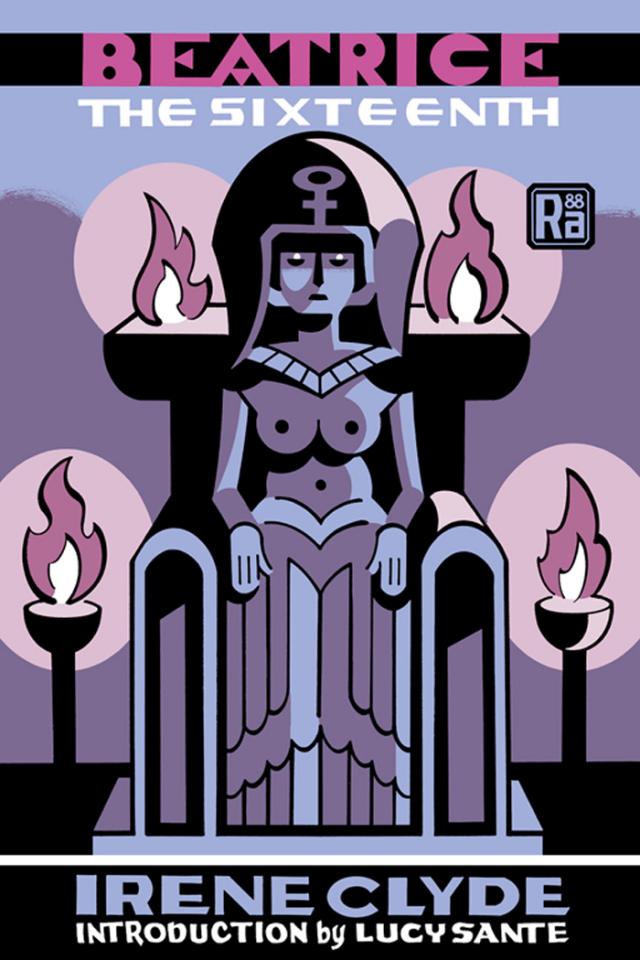


“Where should we get our children from?” Ilex asks rhetorically. It’s around this point in the book that you begin to notice that all the characters are what we would call female. Earlier a fair number of masculine pronouns had been observed going by, but they had been diminishing steadily. At least one character, the eminent doctor Athroës, begins as a he but reappears as a she. By midway, the only significant character to still bear the epithet “he” is the villainous steward Galêsa, who is soon dispatched. Since the babies are imported without distinction, does that mean that they evolve toward femininity, or else fail to? This is not explained. But the characteristics of masculinity do thrive among the inhabitants of truculent neighboring states, such as Uras, with which Armeria is constantly on the edge of war. “In point of physical development, there was no doubt that the town folk here were possessed of bigger frames, stronger muscles, stouter limbs, louder voices, than my shapely friends of Armeria.” Interestingly, Clyde barely stresses the hostility between the countries as a war between genders. You gather that she would rather masculinity be considered as little as possible, that it remain out there, in partes infidelibus, and stick to its function of breeding girls.
Like many time-travel narratives, Beatrice the Sixteenth is a wish-fulfillment fantasy—it isn’t quite a time-travel narrative, although it might as well be. The court Astrologer explains everything halfway through: “The shock to the brain has sent you clean out of one plane of existence . . . and set you down in another.” Which settles the matter. It seems she has been outfitted with a new body for the journey—presumably along with the English tailoring she is described as wearing before adopting Grecian gowns. And the only way to communicate with her home plane involves punting something across the Western Sea, which sounds unappealing to our heroine, who before long has decided to stay in Armeria anyway. That is as science-fictional as the novel gets. Apart, that is, from the pleasures of constructing a new society. Clyde describes her paradise, its clean, open, underfurnished rooms piled with rugs populated by lissome female couples who lie around like odalisques when they are not transacting urgent business. There is a plotline of sorts. The state is beset, and its queen is embattled. The queen is the most distinct character besides the protagonist. (Ilex is so wise, agreeable, and loving she is undisguisedly a projection.) “I never saw anyone whose face seemed such a transparent index of her mind.” Beatrice is much concerned with Uras, which is trying to lay claim to her kingdom based on the fact that it supplied Armeria with a monarch 800 years before. “Oh, I know they think us an effete community!” says the queen, “Their blatant chivalry will ride over our levies like a horse in a flower field.” Armeria is outnumbered and outmatched by the swaggering carelessness of Uras. As if that weren’t enough, there are traitors in her midst, who are conspiring with diplomats from Uras.
All of these conflicts have come to a head by the end of the book, albeit in curiously muted fashion. The war, when it comes, does so at even further remove. Our heroine winds up in a fortified enclosure miles away from the brunt of the fighting, although surrounded by a hostile crowd that “thronged round the fort in masses on every side, and indulged in provocative language to their hearts’ content” in place of sticks and stones. Clyde was seemingly incapable of depicting action. That is not an uncommon handicap among authors of utopian fiction, who often, like Clyde, have only the one novel to their name. Their interest in creative literature is generally limited to its evangelical potential, and they regard the rest of the package as little more than unnecessary if expected curlicues. Clyde clearly did not look upon literature with contempt, but she doesn’t really seem to have understood it, either. She was not a bad writer—I have quoted her often here, because she is often able to sum up a situation economically—but she was not a bad writer for an author of texts on international law. She had little notion of how to pace her work, how to not tax the reader, how to break her inflexibly even tempo for a spot of dynamism. The book feels much longer than its page count.
I hope that someday somebody will produce a scholarly edition that includes a character index like the one the Pléiade supplies for Balzac’s Human Comedy. This thin novel is tenanted by an overabundance of characters, of greater and lesser significance, outfitted with cod-Greek names that all blend together—Opanthë, Iôtris, Appthis, Lyphra—who may go away and reappear thirty pages later, by which point we’ve completely forgotten them, let alone their back story, so that much time is spent paging back and forth trying to detect a name subtly different from all the others flashing by (tablet users will have an advantage here). Naming privileges is another perquisite of the utopian novelist, who is able to project sentiment as it were poetically. Clyde’s names are redolent of the Songs of Bilitis, of Sappho and her Decadent devotees, very much in the wheelhouse of an Edwardian proto-transwoman.
The novel begins as a tale of foreign adventure in the style of the nineteenth-century chroniclers of colonialism, as extended by novelists like H. Rider Haggard and W. H. Hudson. Clyde may well have been conversant with Charles M. Doughty’s Travels in Arabia Deserta (1888), a classic of the British travel genre, famed for its cadences apparently based on the rhythms of spoken Arabic:
I admired the noble proportions of this clay hall, as before of the huge Kasr; the lofty walls, painted in device with ochre and jiss, and the rank of tall pillars, which in the midst upheld the simple flat roof, of ethel timbers and palm-stalk mat-work, goodly stained and varnished with the smoke of the daily hospitality.
It is not very far from that to:
As they greeted us with the polished salutation, which I did my best to imitate . . . servants in short kirtles began to move towards us from the sides of the room, where, in pillared recesses, were tables covered with the materials of our morning meal.
A good deal of the novel consists of descriptions of interiors, of upholstery and carpeting, of exquisite woodwork and stonework and metalwork, of carved screens and fluted pillars. (The decor seems divided between Classicist and Orientalist.) The descriptions are technical, as if written for a guidebook, rather than sensuous. The protagonist has the Edwardian positivist’s classificatory mind, and she might be compiling a guidebook of her own, so determined is she to note all the variants of architectural style and interior display.
The rest of the novel consists of chitchat. For her incapacity as a depicter of action Clyde compensates with dialogue, in spades. It isn’t Socratic dialogue, nor does it involve more than one or two soliloquies. It is simple, load-bearing conversation relayed in five- to ten-word clusters, and when it is not conveying information it is flattering, or thanking, or apologizing—women’s talk, in other words. The texture of Beatrice the Sixteenth thus alternates between ethnographic adventure novel; Guide Bleu–style inventory of the material culture of an unknown society; and fluttering Victorian comedy of manners, such as those published in Godey’s Lady’s Book and the like, often turning on arcane points of ritual and etiquette and frequently featuring all-women casts. It represents the segmented facets of a complicated mind, at once liberated and reactionary.
Being the Personal Narrative of Mary Hatherley, M.B.,
Explorer and Geographer
1
The Desert
Desert so far as the eye could reach. Only, on the skyline, a tuft which might be a clump of palms. Overhead, the sun industriously burning up everything visible.
I raised myself on my elbow and looked round. Then I remembered what had happened. The blow from the camel’s hoof had stretched me senseless. Of course I remembered. But where was my Arab escort of the morning? And who were these unknown figures standing round me?
My first thought was for my revolver. But it had disappeared. Nor was it possible to think of flight from the surrounding assemblage.
So I spoke to them in Arabic. Who were they? Where was my escort? How far was it to Wady Keirân? Were they friends? None of them answered, and they talked among themselves in a tongue which was certainly not Arabic, nor Turkish, nor Persian. Who were they, these clean-shaved, fair, smiling people—all in kilted brown robes with a broad yellow stripe across the front? It was useless to speculate. The nearest to me proceeded to make signs in the burlesque manner of those who are not accustomed to it, and it was clear enough that the party wished me to proceed with them. There was, indeed, nothing else for it. I joined the caravan, only too thankful to be in no worse company. A smile is a sign of good intentions all the world over.
Most were walking, of the twelve or fifteen who made up the party. A few pairs of mules supported full baskets between them, and some of these had riders. Science asserted her sway, and I endeavoured to find out something about the language spoken by my companions. Addressing myself to a tall, striking-looking personage, with a profile like an old cameo of Odysseus which once hung near my fireplace in a Surrey house—far away now—I began to acquire a few nouns and verbs. But my education had not proceeded far when night overtook us, and the caravan prepared to bivouac.
I know no more of what happened that evening, for sleep came suddenly and irresistibly, and I sank into the folds of a rough, soft rug, as a child nestles into its pillows.
By early morning we were moving. But the palm-like tuft on the horizon grew no nearer after three hours of steady walking. We halted for a meal of flat cakes and excessively sweet wine, and proceeded on our way, a seat being found for me in one of the mule-baskets, for my head still ached violently. Gradually I fell into an uneasy doze, with that accompanying sensation of uncertainty and danger which is so disquieting when one sleeps on a journey. I could have felt certain once or twice, in a dreamy way, that something had passed my lips. But I wakened fresh and alert towards evening, when I found no preparations for resting, but the whole company steadily pressing on. There must have been a halt during the day to enable them to walk as they did. For myself, I lay down in my capacious basket, wrapped my rug more closely round me, and watched the moving figures in the bright moonlight, until a deep, restful sleep came upon me, which lasted until morning.
And then I saw the explanation of the palm-like tuft against the sky. There towered before us a magnificent obelisk, the very base of which was the size of a palace. Perfectly simple, its entire plainness had a unique and lonely grandeur. Its solemn finger, as we neared it, pierced more and more into the blue. It was the discovery of an eighth wonder of the world. But how had it remained so long for unsuspected in solitary majesty? As I thought of the generations of Arabs who must have so well guarded the secret, of the many explorers who must have passed within an ace of finding it out, I could not repress a smile. The impulse was infectious. The kindly faces of my conductors beamed with pleasure, and the very mules seemed to start with fresh energy.
I soon saw why. Seven or eight miles away, so far as I could judge, appeared the serrated edge of a low range of hills, towards which we were evidently directing our course, to everybody’s high satisfaction. An hour’s further journey, and the stony desert melted into fresh green pasture. Feathery-topped, graceful trees appeared; the scorching heat itself gave place to a pleasant coolness; one caught sight of figures moving behind the foliage, and paddling light craft past the rushes. Finally, we stopped at two huts, for no reason that appeared. Here there came out to us the most surprising ostlers that, of many strange beings, it had been my lot to meet. Tall, lithe, brown, with a swinging step and a free carriage—so far they were commendable, but not uncommon. The singular thing to me then was their extreme beauty, and the fact that everyone of them was clothed in ivory silk, of a perfectly Grecian fashion.
These remarkable personages performed our mules’ toilet, watered and fed them, and offered us various kinds of fruits and honey, which most of my companions were nothing loath to accept. Still, when all was disposed of, and even conversation flagged, we waited on. It occurred to me that some of the white-garbed people might know a little Arabic, and as I was increasingly uneasy as to my whereabouts, I selected a particularly intelligent looking subject to inquire of. But my inquiries were met with a bland stare of regret, and a minute later with a response delivered with a stately kind of diffidence, as though the speaker thought it right to answer, but hardly expected to be understood. Nor did I understand for a while, but some familiar chord in my memory was set working. Bits of old school day learning came back to mind, and as the strange people chatted with each other, I knew that their speech was a near relative of Latin, with a strong infusion of an element more resembling Greek. The blood rushed to my head—I could understand them; I could speak to them!
Only the first and third declensions and conjugations were used. The words were not spoken according to any modern system, though very nearly as in the Italian method. And to those broad vowels for classical speech I was well accustomed from days long past, when I had pored over Cicero and Horace, with some big Scottish cousins in a Dumfriesshire garden. When shall I ever forget those old Dumfriesshire mornings? The low, incessant undulations of the mossy, bent-covered earth; the damp pools; the distant mountains; the silver Solway, shining far away like the glint of its own salmon! And inside the red-brown walls of the garden, a tangled maze of larkspur and snapdragon and marigolds, and a dozen more flowers whose names we did not know, nor cared to; for we three were in the Senate watching Cataline, or listening with Plato to the last words of Socrates.
“Ulinde venitis?” The words forced themselves to my lips, and no sooner were they spoken than there ensued a most laughable scene of confusion, everybody joining immediately in animated colloquy, difficult from its rapidity to understand—the more so as my first friends did not speak the Italo-Greek dialect among themselves, but a language entirely different and totally unintelligible. And, besides, the traveller I addressed, after a sharp turn with an emphatic nod to a neighbouring muleteer, began to reply to my questions. The pronunciation was not quite easy to follow, but in a few minutes I had made out that my acquaintances were merchants, bringing country produce to town across the desert, and escorting travellers, who had business or other engagements in the city. Of these there were five or six among their number.
The city, they said, was large and populous, though its extent seemed to me exaggerated; still, I knew the wide area an Eastern city will cover. The people were engaged in trade and in manufactures, so far as I could gather; they were acquainted with the arts, and were hospitable to strangers. But when I inquired their relations to the Turkish authorities and to the desert tribes, the most impenetrable density met every question. “Arabes,” “Syria,” “Alexandria,” “Parthii,” and “Nilus”—a shake of the head met every reference to these, and the eyebrows would rise inquiringly and innocently, without a quiver.
“It is all very well,” I thought to myself; “our excellent friends have reasons, doubtless for keeping their own counsel as to their knowledge of the world and the best thing I can see at present is to humour them.”
Accordingly, I waived the delicate subject, as I inferred it to be, and proceeded to inquire, what was my next point of concern, how they had come across me. But I did not succeed in obtaining the least clue to my position. They had stumbled on me lying absolutely alone, and had not been much surprised, as travellers were frequently found to be overcome by heat or weariness, and for this reason generally availed themselves of the merchants’ escort, and travelled in their company.
“And were you not struck by my odd appearance? Had you ever seen a European before?” I asked.
No; they were well aware that foreign nations had each their own customs. Very likely their own seemed absurd to strangers. I glanced at the ivory silks, and then at my own tailor-made garments, and I hardly felt the comparison justified their surmise.
I changed the subject. What was the name of the great obelisk we had passed? Was it on a bird, then, they said, that I had ventured to cross the Stony Desert, without knowing the use of the Index Maxima? If my guides had abandoned me without explaining its use, nothing could be bad enough for them. Words failed to express the hopelessness of the position in which they must have left me.
“But I was not intending to come here; I was going to Wady Keirân,” I explained; whereat, the polite stare of incomprehension again and an awkward silence. I would have inquired the name of the city, and how far we were distant, when two horsemen came briskly up, and were at once surrounded by the travellers. These five new arrivals were well armed, but, so far as I could see, not with rifles. They were certainly nothing like Bedouins; for one thing, although they rode easily and well, they had not the air of being constantly in the saddle. Their long dark cloaks covered their dress, but the metal helmets which they wore had so classical an appearance that I half expected to see them arrayed in corset and lorica, like a Roman eques. Their real attire, however, turned out to be a much simpler dress; and the idea faded which for a moment had possessed me—that these people were the relics, preserved like flies in amber, of some Romano-Syriac civilisation. Still, I was no nearer as to what they were.
The new-comers scrutinised carefully all the members of the caravan, and continually referred to parchment rolls which they carried with them. They talked for some time to the principal spokesman, with an air of friendly authority. Suddenly the young looking of the two dismounted, and came swiftly, but quietly and naturally, to where I was standing.
“Let us sit down and talk whilst matters are being arranged.” My arm was taken, a pair of eyes looked into mine, and I found myself resting on the spicy herbs with a hospitable figure beside me.






