

Patchwork dolls, p.1
Patchwork Dolls, page 1


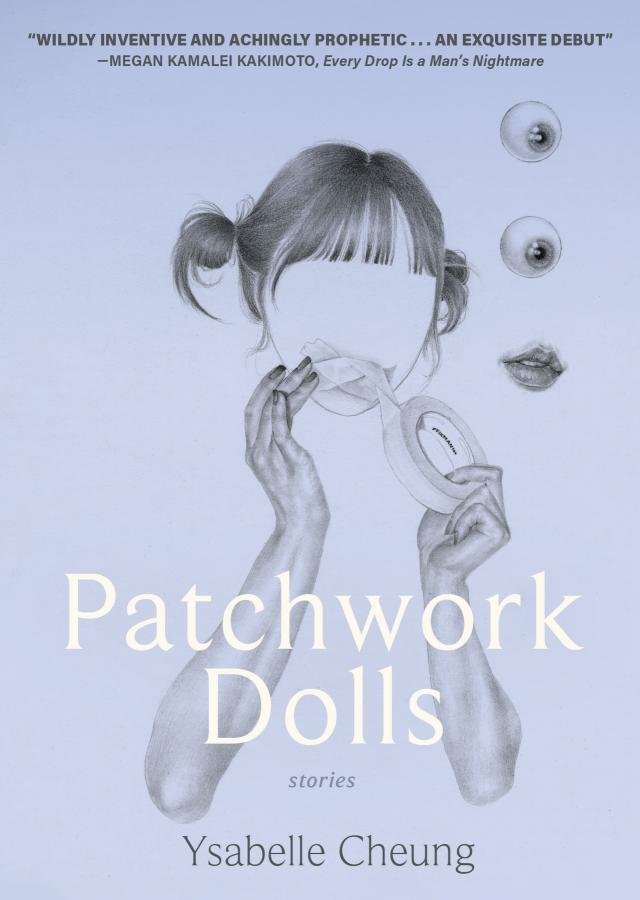
PATCHWORK
DOLLS
stories
YSABELLE CHEUNG
— BLAIR —
Copyright © 2026 by Ysabelle Cheung
All rights reserved
Printed in the United States of America
Cover design by Laura Williams
Interior design by April Leidig
Blair is an imprint of Carolina Wren Press.
The mission of Blair/Carolina Wren Press is to seek out, nurture,
and promote literary work by new and underrepresented writers.
We gratefully acknowledge the ongoing support of general operations by the Durham Arts Council’s United Arts Fund and the North Carolina Arts Council.
All rights reserved. No part of this publication may be reproduced, stored in a retrieval system, or transmitted in any form or by any means, electronic, mechanical, photocopying, recording, or otherwise without the prior permission of the copyright owner.
The stories in this collection are works of fiction. As in all fiction, the literary perceptions and insights are based on experience; however, all names, characters, places, and incidents are either products of the author’s imagination or are used fictitiously. No reference to any real person is intended or should be inferred.
Library of Congress Cataloging-in-Publication Data
Names: Cheung, Ysabelle, 1989 – author
Title: Patchwork dolls / Ysabelle Cheung.
Other titles: Patchwork dolls (Compilation)
Description: Durham : Blair, 2026.
Identifiers: LCCN 2025025306 (print) | LCCN 2025025307 (ebook) | ISBN 9781958888643 paperback | ISBN 9781958888711 ebook
Subjects: LCGFT: Fiction | Short stories
Classification: LCC PR9450.9.C54 P38 2026 (print) | LCC PR9450.9.C54 (ebook)
LC record available at https://lccn.loc.gov/2025025306
LC ebook record available at https://lccn.loc.gov/2025025307
Contents
Mycomorphosis
Please, Get Out and Dance
To My Great-Granddaughter, Who Will Find This Letter When I Am Dead
The Reader
Find Your Spirit
Patchwork Dolls
Galatea
Herbs
The In-Between
Not in This Neighborhood
Acknowledgments
Mycomorphosis
The morning of the fall, Noel was followed by a filmy, vegetal smell—dreams that she was being buried in cold soil. Then her phone grunted angrily. Two messages from her mother, three missed calls from her employer. She was late.
In a fluorescent-tinted coffee shop, her employer, a China studies professor, sternly told her that she was late on various assignments. When he gestured, she tried not to flinch but instead sucked in more air, coffee-bitter and moist.
On the subway ride back to her apartment, she noticed the train cars were slick with dirt; she saw it on everybody’s skin, that same burnished layer of fermenting heat and oil. A man muttered to himself in the corner seat as she edged her way inside. You, you, you, the man said. You, I’m going to get you. Oh, I’m going to get you. Yes, I’m going to get you.
An MTA worker announced overhead that they would be stuck in the tunnel until further notice. She tried not to touch anything and silently pushed down an incoming panic attack.
Back at the apartment, she drew a bath to calm her nerves. It had been humid all day, so wet that the towels slid to the floor. Outside, a truck was backing up, and a new store had installed speakers that hosed the streets with noise. Car alarms screamed. Her upstairs neighbors bickered over their small child. She felt like a sieve through which these sounds entered and left, leaving specks of anxious pollutants each time. Washing herself, she listed all the things she had to do. Ask her landlord to fix the gas. Request an extension on rent. Index her employer’s paper. Pay monthly federal student loans. Message her mother back. Toss leftover food in the fridge. File taxes. Review insurance claim forms again.
She looked at herself in the mirror near the bathtub, the heated silvers of water knives on her skin. From ear to nose she tracked the scar that lay across her face, like a shriveled wad of paper mapping her cheek. In the subway, it had itched, sweaty in the closed tunnel, and it took all her strength not to touch it. She remembered how in the hospital they had removed all the mirrors. Six weeks later, seeing her face again for the first time, she had not been able to reconcile with this new topography. She had recurrent nightmares about it leeching off her flesh, her skin. But recently, these dreams had slunk into other shapes; they were silkier, led by a single image or feeling— a handful of moss, white roots in water, a sheet of sunlight— before vanishing.
From the bathtub she saw her phone jittering on the floor. Mother calling. She had already read the messages from that morning and ignored them. Do you know what today is? It’s one year since the attack, so you should come home. Why do you wait? What are you waiting for?
Faint with exhaustion, Noel lay back in the bathtub. She felt a migraine coming on and closed her eyes. She wondered how it would feel to sink; to dissolve into the water, to yield.
Her skin pimpled when the bath turned cold. She stood to get out, and in the mirror she thought she saw herself fuzz, as if covered in a thin lichen. Then she was falling; the floor moved up abruptly to meet her head. A rumbling in her ears began to round out like a pebble rolling farther and farther away until she could hear nothing, her head filling with cotton.
Hours later, she woke up well rested, coiled on the towels like translucent pink fungus sprouting from the muted floors of spring.
* * *
IT HAD BEEN DAYS since the fall, and her migraines were getting worse. Noel’s doctor referred her to a neurologist whose clinic was in a Chinatown building with a sticky corridor. Down the hallway were other white doors—for an acupuncturist, a Chinese herbalist, a dermatologist—around which groups of people clustered. One by one the doors opened.
Her X-ray was iron black. “Everything looks good,” the neurologist said. The hairs on his head, she couldn’t help noticing, resembled plump white bean sprouts—they stood from his scalp as if fat with water. His fingers too. “The only thing is that you have extra fungus in your head.”
“I’m sorry?”
“Extra. Fungus.” The neurologist planted the X-ray up on the light box. The sheet throbbed. “You see? Here? These very black dots? Just fungi. On average, a woman may develop two or three spores in a lifetime. You seem to have at least seven. Practically harmless. In about a decade or so, we might see some growth, which may affect the ear canal, and then we can consider surgical removal. But most choose not to go down that route. You can simply trim them with stainless steel scissors once they grow out of your ears.”
Noel stared at the X-ray, the dots. She nodded mutely as the doctor wrote down a prescription for Valium, to help with the migraines.
At the front desk, she tried not to linger on the numbers on her bill. She noticed the young man taking her payment had a slip of white, like enoki, dangling from his left earlobe.
“I like your earring,” she said. “Did you make that?”
“Oh—thanks.” He smiled. The printer spat out her receipt, warm and dry. “No, I wish! I bought it somewhere in Europe.” He looked at her, then dropped his gaze, handing her the piece of paper. Noel knew it was the scar, and she did not blame him for it. She was used to the nonstares by now.
As she was leaving the clinic, she noticed that the herbalist’s office had still not opened. The men and women lined up outside were passing around a bag of pumpkin seeds. “My eczema … my eczema …” one of the women murmured.
“Neoi, if only you had listened to me the first time around,” said the other woman, presumably the mother, before breaking into a stream of Cantonese.
Noel walked slower, trying to catch remnants of the language, phrases she had not heard since she was young. Her own mother had once said that she needed to teach her at least a hundred lessons a day to prepare her for life. Neoi, don’t ever go to sleep with your hair wet. Neoi Neoi, when you marry, make sure that the man loves you more; don’t settle for less. Neoi, your eyes look too small when you wear eyeliner like that. Neoi, when I die, promise me you’ll have a daughter so you can teach her these things. Be a good girl, now, neoi, don’t disappoint me.
* * *
WHEN SHE RETURNED HOME, Noel researched head fungus. She had heard of it before, knew that it was common in humid, hotter places like Malaysia, Singapore, Hong Kong. She vaguely remembered the fleshy growths of an older woman in her mother’s apartment building at home. The woman, she was told by her mother, went mad after her philandering husband died. Day after day she sat in the lobby wearing the same lavender pajamas, using a small handheld electric fan to soothe her neck and ears. The other residents actively shunned her, and whenever they walked past, her mother would talk loudly to others as if to smother the woman with the sound of avoidance. Once though, when Noel was alone, she had looked at the woman directly. The woman stared back, curious and serene in her pastel-toned long shirt and pants, her ears steaming in the heat.
On the internet, Noel read that scientists didn’t exactly know when or how brain fungi grew—its origins and causes had not yet been “concretely identified,” according to Wikipedia. There were a few sentences about the lack of research and funding and multiple possible origins for the condition. A few external links took her to websites with Chinese and Japanese characters. Images multiplied on her scr een: brain scans of fungal matter; women with flesh-colored fungi funneling out of their ears, woody and scalloped like lingzhi or braided with ridges like morels. There was a stock photo of a businesswoman with a bar of the straightest teeth she had seen, and in her ear—yes, there they were—lustrous caps of velvety-nude fungi, curled up on the ledge of her pinna. Another: a girl lying in a field, hair dark and parted to reveal milky gills fanning from her head. She found recipes in Thai script and hangul, which she ran through a translation system, loosely figuring that if you trimmed the shriveled edges of your fungi, you could brew the discards into a potent herbal tea with antioxidant properties. There were also murmurs of a special hallucinogenic drug with the correct extractions, professional glassware. Intrigued, she read a few long-form articles surrounding a ring of harvesters in the 1990s who plucked fungi from the ears of drugged women in Tokyo nightclubs, root and cap, and left them bleeding in bathrooms. The high, one of the convicted harvesters described later to a journalist from prison, was unlike any other. “Imagine tripping off of someone else’s brain,” they said. “We’ve been doing drugs wrong this whole time.”
Noel looked again at her X-ray. The seven spores collected around the left side of her brain. She brushed her fingers against the area; it was still sore, tender. A soft plummy bruise was forming. She thought she felt the tissue of a growth pulsing there, close to the scars that crept over her skull.
* * *
SHE HAD NEVER NOTICED it before, but now she saw brain fungus everywhere. On the street, she found herself fixing her gaze on the ears of strangers as they passed, occasionally catching the bright shadow of an obtrusion. In Columbus Park, she wended through the elderly men and women squashed around the stone tables, red-faced and roaring at a turn of Go; the grandmas too had mushrooms in their ears, stuffed with a wispy floss of hair. It looked like the dragon’s beard candy she used to have back home.
Once, on the subway, she saw a red-haired girl nonchalantly pinching and pulling at something on her skull. Occasionally, she plucked a hair out, letting it fall to the ground. After a while, she noticed Noel staring and flicked her eyes up and down quickly.
They exited the next stop together, but the redhead went first, racing up the steps. She was on her phone, whispering, but not so quietly.
“Hey, I’m coming … yeah. Dude, I think I saw that Asian girl that Hannah used to live with, yeah, the one who, you know, who had her face …”
It was bright on the streets. Light poured off the surfaces of cars like butter. She saw her face in the reflections, dozens of herself vanishing and resurfacing in the mirrored windows of the moving vehicles. She recalled wanting to die last year upon returning from the hospital after the attack.
Now, she wanted something different. Please, please, make this easier, she asked as her face conjured itself again and again in the reflections. Show me how to live.
* * *
THE ATTACK HAD HAPPENED last spring, and by the time the leaves fell to the ground her face had hardened into rivulets. That winter, she found it hard to sleep, so she would go downstairs to the dive bar on the corner to watch the late-night news and coat her stomach in thick, prickly liquor. One night there was a report on an incident down by Canal Street. A woman with meringue-whipped hair introduced the segment: “Anti-Asian hate crimes increased by nearly 150 percent in the last year …”
The men at the bar on their bolted-in stools had watched with slack, glazed eyes as the news footage clicked through images of streets, subway stations, the faces of those like her, composing a narrative of targeted assaults. Her scarless, smooth face was in there too, a tiny photograph like a square on a bingo card. She waited for one of the men at the bar to mutter something about how awful it all was, to shake his head, but none of the spectators moved, their eyes blinking slowly as the news changed over to sports highlights. She left soon after that.
* * *
THE FUNGI IN HER head were growing. Two weeks after she hit her head, she looked in the mirror and was shocked to see the fold of a new ear: a pale peach tip. She touched it. It felt like cloud ear fungus, rubbery, silky.
From her cabinet she removed a bamboo ear pick purchased on her last trip home. She kept it wrapped in its original padded cotton case, only sometimes opening it to admire the pristine craftmanship, buttery lines of organic wood that led to a feathery puff, like a tail. So different to the ear pick her mother had used on her: a surgical gray-and-white electronic tool with a flashlight that boiled with heat, scraping blood and crumbling wax as she screeched in pain. Neoi ah, hold still, her mother would snap, her fingers pulling at her ear. You’re moving too much. Stop struggling! Don’t you know how difficult you’re making all of this?
She tapped the pick against the visible tip of the fungus; it did not wobble as she expected but remained firm, stubborn. Pushing the stick around the growth, she began to feel into her ear canal. When she poked the fungus, a strange disconnect occurred, similar to when she stroked an arm or foot that had gone numb. She pushed further. A loud rustling occurred. She felt something tip out.
On the floor was a small, neatly severed fungus, shaped like a small abalone. She picked it up and prodded it in the palm of her hand, admiring its color—it was lustrous and light, pink like her closed lids under the three o’clock sun.
It trembled, as if to show it had been alive, then became lifeless and still.
* * *
NOEL BEGAN TO OBSESS over these mushrooms, the mysterious neighbors in her own ear. She felt as if time was wilting, oozing. During nights when she couldn’t sleep, she would turn her attention away from her bills, her work, the pain on her face, and toward the petrified mushroom that had fallen out of her ear. Using a small flashlight, she studied each crevice and cavity, the walls of the fungus magnifying and merging with the walls of her apartment. She wondered why it belonged to her, what it meant. She spent hours trawling the internet, posting questions on forums. Are there rarer forms of fungi? Are there any connections between brain fungus and productivity? What about longevity?
Her employer emailed, threatening that she would not be credited in his next book. She read the message twice, three times, her anxiety trying to mark a space in her body to hide and fester. But now something else was growing: something stickier and rebellious. Fine, she thought, if you won’t credit me, I won’t do the work.
She felt the same small resistance when her landlord sent an eviction warning. “Your tenant contract states that the landlord of this building has control over basic amenities and can turn them off at their discretion. Pay up immediately,” stated the letter that was slid under her door, “or we will evict you by the end of this week.”
She pushed the letter away onto her kitchen counter, the words already fading in her mind. On her phone was a Reddit thread. She had asked a question a few hours earlier, at 3 a.m.: Does the presence of head fungus indicate long life?
There were fourteen answers already. The first was at least four paragraphs long and primarily statistical. “It’s difficult to say; the demographic most likely to develop head fungus is the Asian female, and the life expectancy of, say, a Japanese woman is already 87, compared to that of the male, which is 81 years old,” it began. There were other answers that were more philosophical, ruminating on the merits of longevity. “Long life, maybe,” one user stated. “But is that really what we want? Health seems more important to me.”
Another: “My grandma lived till she was 101. She had the most enormous and smelly brain fungus. When she died, my dad donated them to a hospital for research, and the doctors said it was the best specimen they had ever come across.”
While reading the text, she searched in her cabinet for a bag of dried shiitake she had bought on her last trip home. Each had deep white fissures across the cap. She placed ten in water, soaking them for a few hours, then ate them toaster-grilled with fat, glistening rocks of salt, scanning the internet page for clues to her own future.






